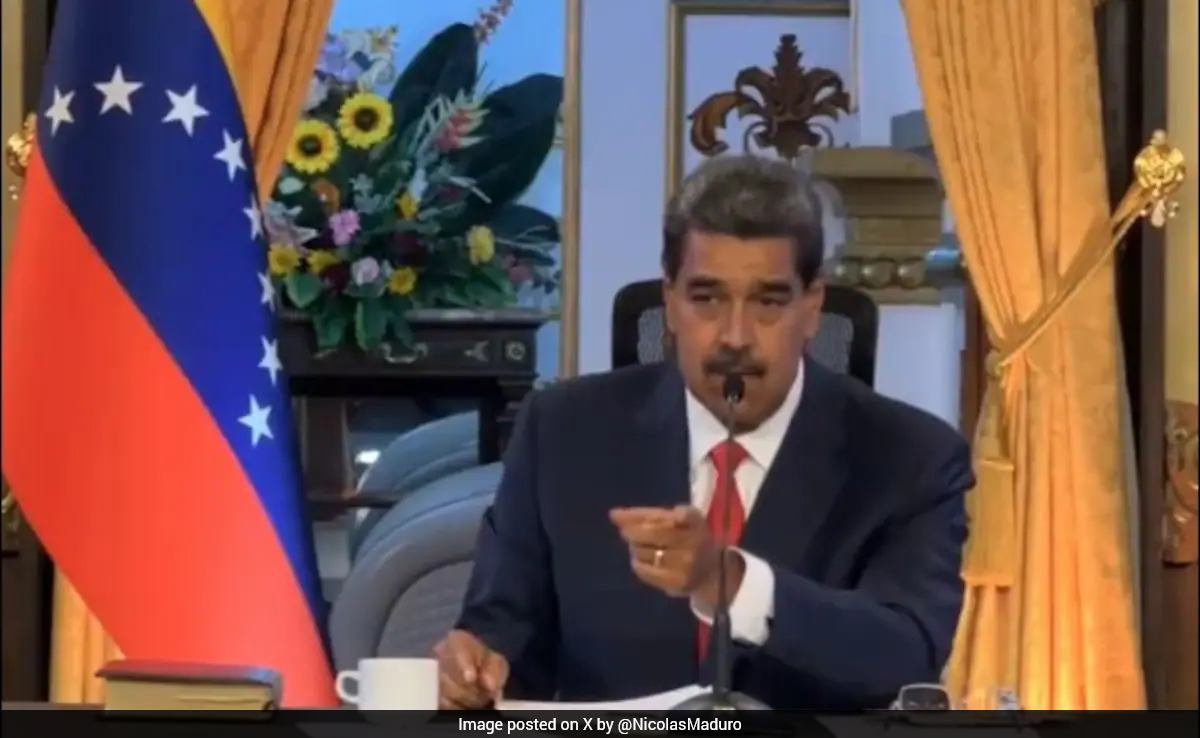
The United States hit Venezuela with a "large-scale strike" early Saturday and said President Nicolas Maduro had been captured and flown out of the country after months of stepped-up pressure by Washington - an extraordinary nighttime operation announced by President Donald Trump on social media hours after the attack.
Trump said that Maduro "has been, along with his wife, captured and flown out of the Country. This operation was done in conjunction with U.S. Law Enforcement. Details to follow."
Secretary of State Marco Rubio retweeted Trump's announcement without comment, but his deputy, Christopher Landau, posted Trump's statement, adding that it marked "a new dawn for Venezuela!" "The tyrant is gone. He will now-finally-face justice for his crimes," Landau said.
Maduro's government immediately accused the US of attacking civilian and military installations. The Venezuelan government called it an "imperialist attack" and urged citizens to take to the streets.
"Venezuela rejects, repudiates, and denounces before the international community the extremely serious military aggression perpetrated by the current government of the United States of America against Venezuelan territory and people," the government said.
Venezuela's Vice President Delcy Rodriguez said, "We do not know the whereabouts of President Nicolas Maduro and First Lady Cilia Flores." He added: "We demand proof of life."
The Trump administration has accused Maduro of heading a drug cartel, but the Venezuelan leader denied any involvement in the narcotics trade, saying Washington was seeking to overthrow him because Venezuela has the largest known reserves of oil on Earth.
In an apparent bid to force him out, Washington informally closed Venezuela's airspace in recent weeks, imposed more sanctions and ordered the seizure of tankers loaded with Venezuelan oil.
US forces have also carried out numerous strikes on boats in both the Caribbean Sea and eastern Pacific Ocean since September, targeting what Washington says are drug smugglers.
Here's how the countries reacted to Maduro's capture by the US:
China
Condemning the attack, China said "such hegemonic acts of US seriously violate international law and Venezuela's sovereignty". China is deeply shocked by and strongly condemns the U.S.'s blatant use of force against a sovereign state and action against its president. Such hegemonic acts of the U.S. seriously violate international law and Venezuela's sovereignty, and threaten peace and security in Latin America and the Caribbean region. China firmly opposes it. We call on the U.S. to abide by international law and the purposes and principles of the UN Charter, and stop violating other countries' sovereignty and security," China's Ministry of Foreign Affairs posted on X.
France
France condemned the American operation that resulted in the capture of Venezuelan President Nicolas Maduro, saying it undermined international law while no solution to the country's crisis can be imposed from the outside. Maduro "gravely violated" the rights of Venezuelans, but the military operation that led to him being grabbed "contravenes the principle of non-use of force, which underpins international law", Foreign Minister Jean-Noel Barrot wrote on X. "No lasting political solution can be imposed from the outside", he said, warning that "the increasing violations" of this principle by permanent UN Security Council members "will have serious consequences for global security, sparing no one".
Germany
Germany's foreign ministry told news agency AFP that "we are monitoring the situation in Venezuela very closely and following the latest reports with great concern. The foreign ministry is in close contact with the embassy in Caracas." Berlin added that the government's crisis team was in session and "we are coordinating closely with our partners."
Russia
Russia condemned the US military action in Venezuela, saying there was no tenable justification for the attack and that "ideological hostility" had prevailed over diplomacy. "This morning, the United States committed an act of armed aggression against Venezuela. This is deeply concerning and condemnable," the Russian Foreign Ministry said in a statement. "Ideological hostility has triumphed over businesslike pragmatism," it added.
Colombia
The leftist president of neighbouring Colombia, Gustavo Petro, called on X for an emergency meeting of the United Nations and said he was deploying troops to the Venezuela border.
Spain
Spain offered to mediate in the crisis between the United States and Venezuela after US attacks on Caracas and the capture of President Nicolas Maduro. "Spain calls for de-escalation and restraint," the foreign ministry said in a statement, adding that "in this regard ... it is prepared to offer its good offices to achieve a peaceful, negotiated solution to the current crisis".
Iran
The Iranian foreign ministry in a statement said it "strongly condemns the American military attack on Venezuela and the flagrant violation of the national sovereignty and territorial integrity of the country".
Cuba
Cuba, a supporter of the Maduro government and a longtime adversary of the United States, called for the international community to respond to what president Miguel Diaz-Canel Bermudez called "the criminal attack." "Our zone of peace is being brutally assaulted," he said on X.
Argentina
President Javier Milei of Argentina praised the claim by his close ally, Trump, that Maduro had been captured with a political slogan he often deploys to celebrate right-wing advances: "Long live freedom, dammit!"
Bolivia
Former Bolivian president Evo Morales, a close Caracas ally, said on X he "forcefully rejected" the US "bombardment."
Italy
The office of Italy's Prime Minister, Giorgia Meloni, said she was "closely monitoring the situation in Venezuela, remaining in constant contact with the Minister of Foreign Affairs and International Cooperation, Antonio Tajani, also in order to gather information about our fellow citizens."
Chile
Chilean President Gabriel Boric gave a call for peaceful resolution and condemned the military action in Venezuela, adding that the crisis must be resolved through dialogue and multilateralism. In a post on X he said, "As the Government of Chile, we express our concern and condemnation of the military actions by the United States taking place in Venezuela, and we call for seeking a peaceful solution to the serious crisis affecting the country. Chile reaffirms its commitment to basic principles of International Law, such as the prohibition of the use of force, non-intervention, the peaceful settlement of international disputes, and the territorial integrity of States. The Venezuelan crisis must be resolved through dialogue and the support of multilateralism, and not through violence or foreign interference."
Mexico
Mexico's left-wing government condemned the US strikes in Venezuela, saying any form of military action "seriously jeopardizes regional stability." Mexico "strongly condemns and rejects the military actions carried out unilaterally in recent hours by the armed forces of the United States of America against targets on the territory of the Bolivarian Republic of Venezuela," the foreign ministry said in a statement.
Track Latest News Live on NDTV.com and get news updates from India and around the world


