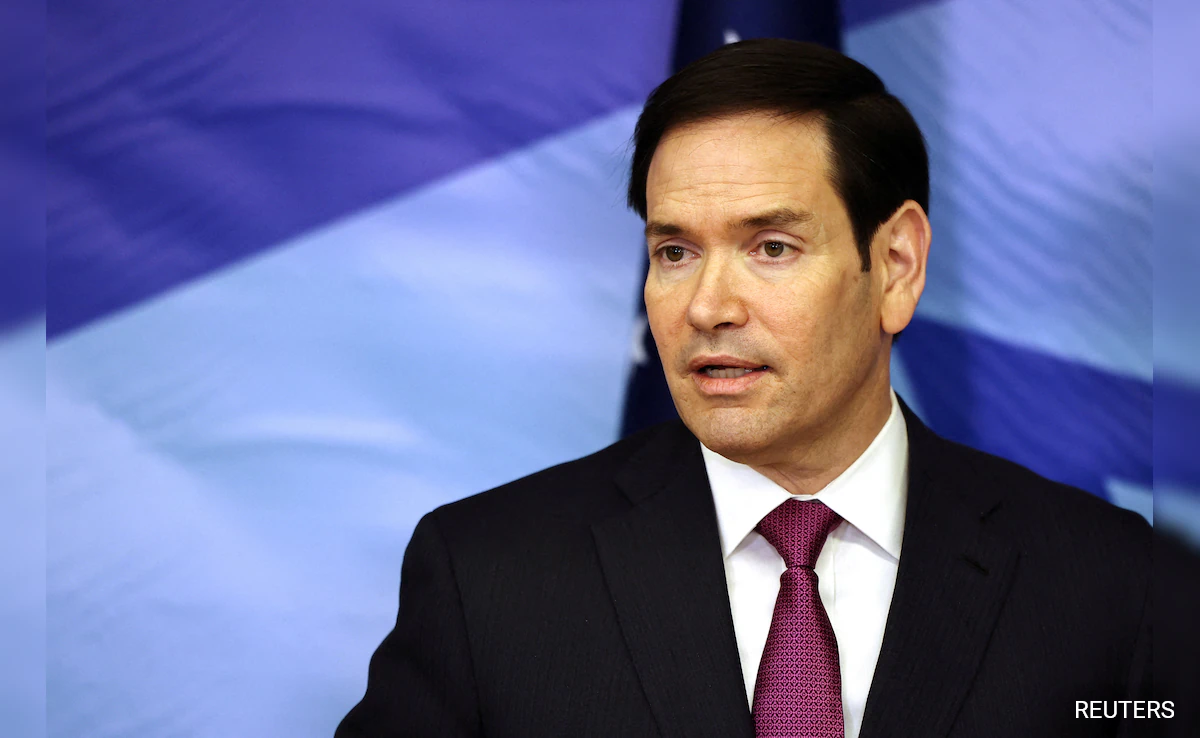
US Secretary of State Marco Rubio said Sunday that Washington is "not disputing" a report by five European countries that imprisoned Russian opposition leader Alexei Navalny was fatally poisoned with a rare frog "toxin".
Rubio said the report released on Saturday by Britain, France, Germany, the Netherlands and Sweden was "very troubling". Britain, which has outright blamed Russia for Navalny's death, said it was considering new sanctions on Moscow as a result.
Navalny, a staunch critic of President Vladimir Putin, died in a Siberian prison on February 16, 2024, while serving a 19-year sentence. While Russia has never explained the circumstances, it has said Navalny died suddenly and the foreign ministry in Moscow has dismissed the European report.
Rubio, on a brief visit to Slovakia, said Navalny's death was "very serious" and the US decision not to join the report "doesn't mean we disagree with the outcome".
The report said Navalny was poisoned with a "rare toxin", epibatidine, from an Ecuadoran dart frog. The Europeans also said that Russia was the prime suspect.
The United States has held contacts with Russian officials on improving ties, but Rubio said the US administration did not join the statement because it was a European-led initiative.
"Sometimes countries go out and do their thing based on the intelligence they have gathered. We obviously were aware of the report. It's a troubling report," he added.
"Certainly we don't have any reason to question it or we're not disputing or getting into a fight with these countries over it."
The five European countries said that epibatidine was found on laboratory analyses of samples from his body.
Experts have said the toxin can also be produced synthetically, instead of extracting it directly from the Ecuadoran amphibian.
"Russia claimed that Navalny died of natural causes. But given the toxicity of epibatidine and reported symptoms, poisoning was highly likely the cause of his death," the European countries said in their joint statement.
Britain's foreign office said separately that "only the Russian state had the means, motive and opportunity to deploy this lethal toxin". It added: "We hold it (Russia) responsible for his death."
Britain will consider "increasing sanctions" against Russia following the report, Foreign Secretary Yvette Cooper said Sunday.
"We continue to look at coordinated action, including increasing sanctions on the Russian regime," Cooper told the BBC from the Munich Security Conference.
"We do know that the Russian regime has had possession of this particular chemical," the minister said.
Navalny's widow, Yulia Navalny, said on Saturday it was now "science proven" that the Kremlin opponent had been murdered. She had previously said in September that laboratory analysis of smuggled biological samples found that her husband was poisoned.
French Foreign Minister Jean-Noel Barrot paid "tribute" to Navalny after the findings.
"We now know that Vladimir Putin is prepared to use biological weapons against his own people to remain in power," Barrot said in a post on X.
(Except for the headline, this story has not been edited by NDTV staff and is published from a syndicated feed.)
Track Latest News Live on NDTV.com and get news updates from India and around the world


