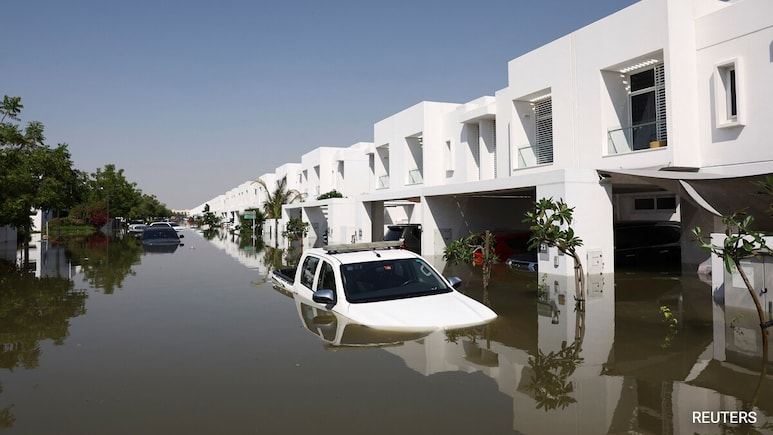
As the Middle East grapples with weeks of war-driven devastation, another crisis is now looming large over the region. A powerful and potentially dangerous weather system is set to hit the region starting Wednesday, threatening widespread disruption across the United Arab Emirates (UAE) southern Iran, eastern Iraq and other neighbouring countries.
Not A Normal Phenomenon For Region
Middle East region is typically defined by arid conditions for most of the year. But meteorologists are warning of unusually intense rainfall in the next few days. Projections by some models are suggesting totals that could far exceed annual averages. The system is so large that some areas could see between 100 mm and 500 mm of precipitation in the next three days, raising serious concerns about catastrophic flash flooding.
The storm is expected to peak on Thursday and Friday. It is being driven by a deep trough anchored over Egypt and Saudi Arabia, merging with a cut-off low moving in from the eastern Mediterranean toward Jordan and Iraq. Adding to its intensity, a potent shortwave trough from Italy is set to amplify the system, tilting it negatively over Saudi Arabia and pulling in moisture from the Red Sea via a strengthening jet stream.
This combination is likely to trigger severe thunderstorms across Qatar, Bahrain, the UAE and southwest Iran. A surface low over Iraq could further prolong the system, bringing heavy snowfall to higher elevations.
Likely Devastation For Urban Centers
Dubai currently sits at the center of concern. The city typically receives around 100 mm of rainfall annually, but European weather models are projecting between 76 mm and 152 mm or more within just 24 to 48 hours. Similar risks loom over Abu Dhabi, Sharjah and key ports near the Strait of Hormuz, which are already under strain due to ongoing conflict.
Beyond heavy rain, the system could also unleash rare desert tornadoes, hailstorms and gale-force winds across the UAE, northern Oman, Bahrain and Qatar.
Region Witnessed Extreme Conditions In 2024
Echoes of past disasters are hard to ignore. In April 2024, the UAE recorded its heaviest rainfall in 75 years, with Al Ain receiving 254.8 mm. Dubai Airport alone saw 142 mm, nearly one-and-a-half years' worth of rain in just hours. This led to airport shutdowns, massive traffic disruptions and at least four deaths. Across the region, 46 people died in weather-related incidents, with Oman alone reporting 20 fatalities as floods swept through roads and homes.
Similar extreme events have struck before. In March 2019, record rains across Iran, Iraq and Syria killed dozens and caused billions in damage. Jeddah in Saudi Arabia saw catastrophic flooding in 2022 after receiving 179 mm of rain in just six hours.
Storm systems in 2020 impacted nine countries from Egypt to Iran, while Iran's 2024 Persian Gulf floods killed 18 people.
Increasingly, such "once-in-a-century" events are becoming more frequent, driven by rising temperatures and rapid urbanisation that worsens run-off in desert landscapes.
Natural Disaster Amid War Concerns
The geopolitical backdrop adds another layer of risk. Ongoing conflict and tensions around the Strait of Hormuz have already disrupted tanker movement, leaving millions of barrels stranded and pushing up global oil prices. Any flooding in this critical chokepoint, through which nearly 20 per cent of the world's oil flows could further disrupt supplies from Iraq, the UAE and Kuwait.
Authorities across the Gulf are closely monitoring the situation. With emergency services on alert, advisories are expected as the storm approaches, amid fears of flash floods, transport disruptions, and broader economic fallout.
Track Latest News Live on NDTV.com and get news updates from India and around the world


