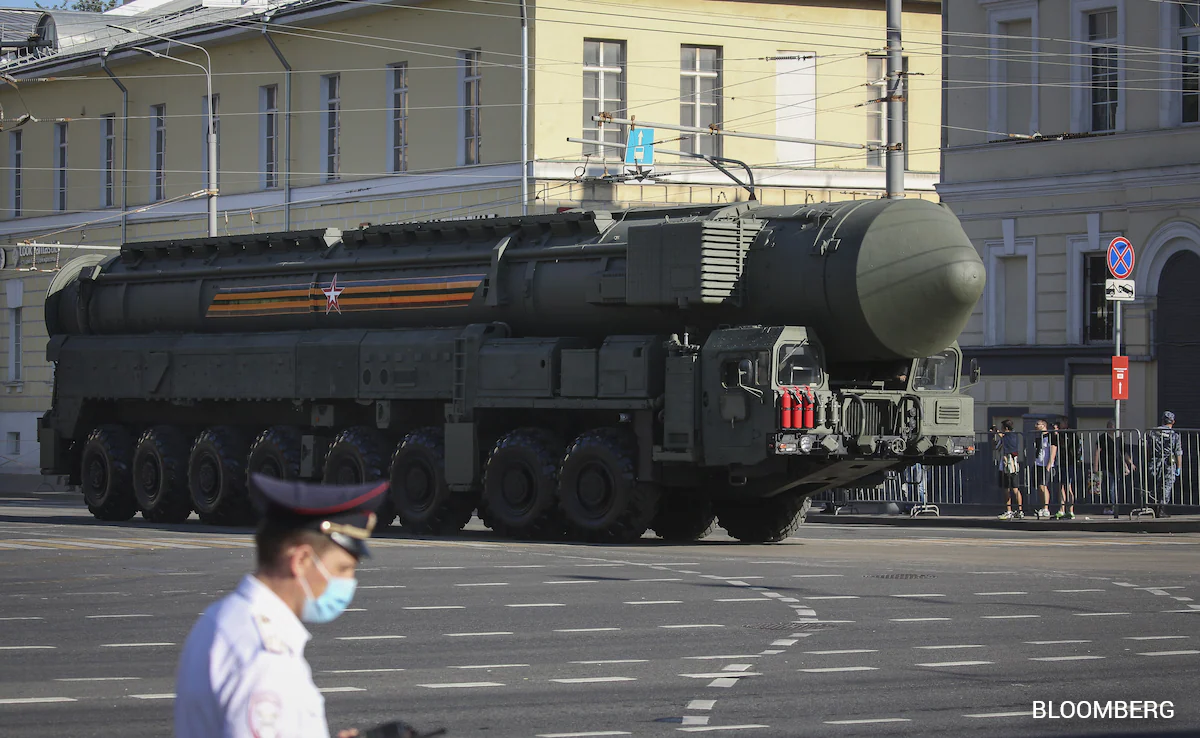
The last major arms control agreement between the US and Russia expired Thursday, increasing the risk of a new arms race between the world's two largest nuclear powers amid growing global instability.
The 2011 Strategic Arms Reduction Treaty, or New START, limited the size of the Russian and US nuclear arsenals and allowed for inspections and exchanges of information. Its demise leaves Moscow and Washington without a framework to regulate their strategic stockpiles for the first time since the depths of the Cold War in the 1980s.
The end of the accord "definitely doesn't make the world safer," said Pavel Podvig, a senior researcher at the United Nations Institute for Disarmament Research in Geneva. "The real loss will be a loss of transparency, and it will increase political risks."
START is expiring as relations between Russia and Europe have spiraled to their worst in decades over the war in Ukraine and with uncertainty among US allies about its long-term commitment to the NATO military alliance. China is bolstering its strategic forces, and other nations are eyeing the need for nuclear weapons to safeguard themselves as major powers increasingly jostle for dominance in their regions.
The treaty had been due to expire in 2021 before the two sides agreed to a five-year extension, though Russian President Vladimir Putin suspended formal participation in 2023, halting inspections and information exchanges as confrontation with the US surged over his full-scale invasion of Ukraine. Still, he pledged to uphold the pact, which restricts each side to 1,550 deployed strategic warheads.
Bloomberg
"The immediate danger is that, in the absence of legal constraints and verification measures, both countries will revert to worst-case planning and begin uploading hundreds more warheads to their deployed forces out of fear that the other is doing so," said Mackenzie Knight-Boyle, a senior research associate for the Nuclear Information Project at the Federation of American Scientists. "The United States and Russia have significant upload capacity that would allow them to drastically increase their numbers of deployed nuclear warheads in a short amount of time."
In September, Putin said he'd be ready to adhere to the terms of the treaty for another year after it expired if the US did the same. US President Donald Trump didn't formally respond to that idea.
Trump will decide the path forward on nuclear arms control and will clarify it in his own timeline, a White House official said. The president has spoken repeatedly of addressing the threat from nuclear weapons and indicated that he wants to involve China in arms control talks, the official added.
"China's nuclear strength is by no means at the same level with that of the US," Lin Jian, a Chinese Foreign Ministry spokesperson, told reporters at a Feb. 3 briefing. "It is neither fair nor reasonable to ask China to join the nuclear disarmament negotiations at this stage."
China hopes the US will respond to Russia's "constructive" proposal for extending START's terms and "truly uphold global strategic stability," the spokesman added.
Russia now assumes the two sides "are no longer bound by any obligations or symmetrical declarations within the context of the treaty" and are "free to choose their next steps," the Foreign Ministry in Moscow said in a statement late Wednesday. Still, Moscow "remains open to the search for political and diplomatic ways to comprehensively stabilise the strategic situation," it said.
Some Republican lawmakers privately urged Trump not to entertain Putin's proposal, according to a person familiar with the matter, in light of the risk it would end up constraining the US's ability to manoeuvre without doing much to limit Moscow's actions.
In particular, the treaty only regulated strategic weapons and didn't place limits on tactical nuclear weapons for either side. Former CIA Director Bill Burns has said there was a genuine risk of Russia resorting to those shorter-range and lower-yield weapons in Ukraine in the fall of 2022.
At a Senate hearing on Tuesday, retired Admiral Charles A. Richard, a former commander of United States Strategic Command, told lawmakers that "simply extending the New Start Treaty for one year does not constrain Russia to the same way that it constrains us," and that doing so would prevent the US from meeting the challenge posed by China's own rapid buildup.
Rose Gottemoeller, a former undersecretary of State for arms control in the Obama administration who was the chief US negotiator of the New START treaty, advocated for an extension, saying it would be better to "keep them limited at least for another year while we continue to plan and prepare for the Chinese threat."
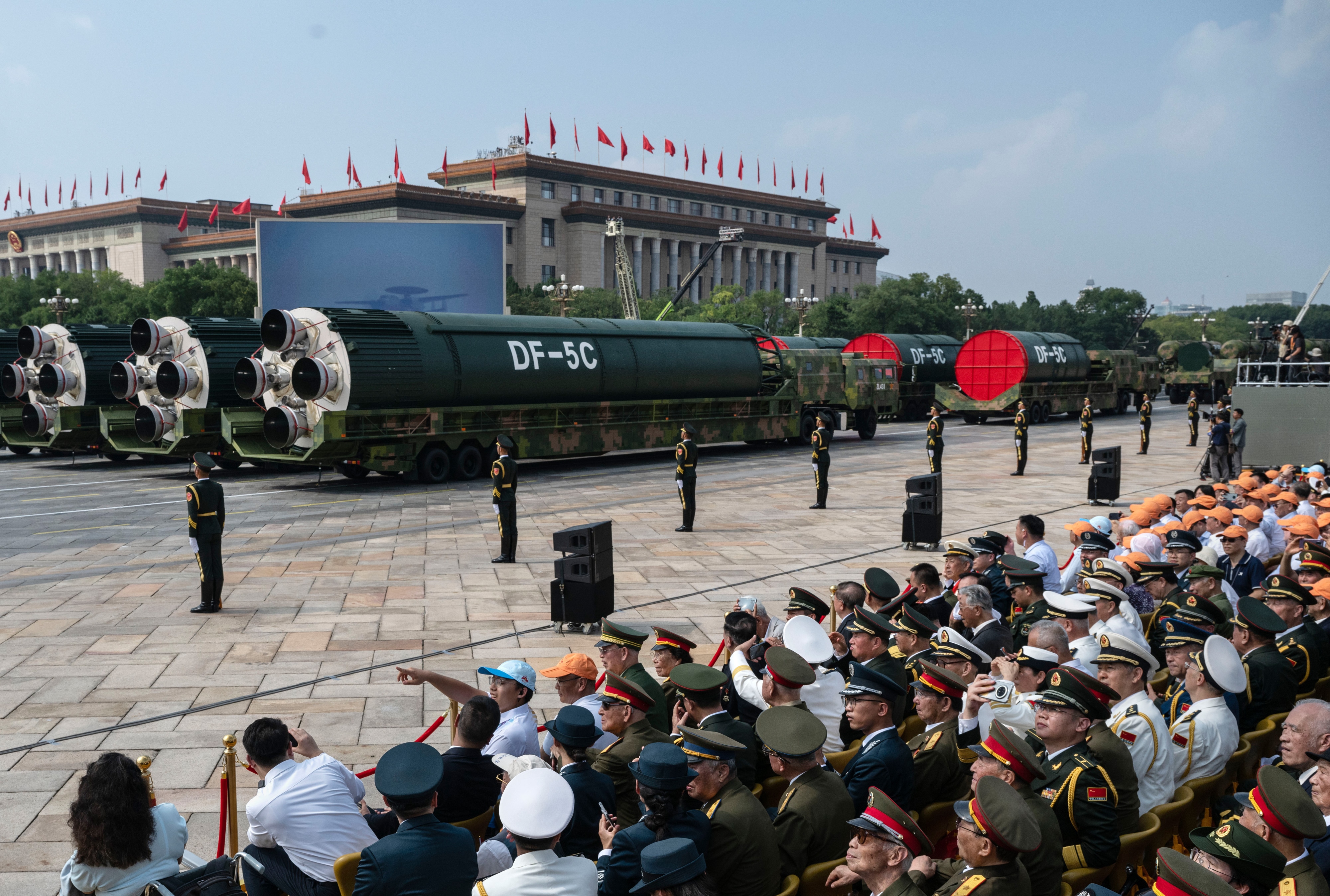
China has been growing its nuclear forces to catch up with Russia and the US. In its 2025 annual report to Congress on military developments in China, the Pentagon said Beijing had "continued its massive nuclear expansion" as part of its goal of achieving "strategic counterbalance" against the US by 2027.
The People's Liberation Army is on track to have more than 1,000 warheads by 2030 from a stockpile in the low 200s at the start of this decade, according to the Pentagon report. While Beijing adheres to a no-first-use policy on nuclear weapons, China "has not demonstrated a willingness to advance discussions on nuclear risk reduction measures, bilaterally or multilaterally," it said.
Russia may indicate "a willingness to refrain from buildups until the United States increases its strategic arsenal," said Dmitry Stefanovich, a research fellow at the Center for International Security at the Institute of World Economy and International Relations in Moscow. Still, the absence of binding agreements between the nuclear powers creates "the foundation for an increase in strategic offensive weapons in the medium term," he said.
An unconstrained nuclear era that led to increases in Russian and US weapons would likely prompt other states from the UK and France to North Korea and Pakistan, to seek to increase their strategic arsenals, according to Knight-Boyle of the Federation of American Scientists.
Putin boasts that Russia has developed a new range of strategic weapons in recent years that are capable of evading existing defences. They include the nuclear-powered Burevestnik cruise missile and Poseidon torpedo drone, as well as the Kinzhal hypersonic ballistic missile that's claimed to be capable of travelling at up to 10 times the speed of sound.
Russia has also used the Oreshnik intermediate-range ballistic missile in strikes on Ukraine, a weapon that's capable of carrying atomic warheads and has a range of 5,000 kilometers (3,100 miles), putting most of Europe and the US West Coast in striking distance.
After Moscow conducted trials of the nuclear-capable Poseidon and Burevestnik, Trump threatened to resume atomic tests "on an equal basis" to other powers. That prompted Putin to order his officials to seek more information about Washington's intentions and to set out proposals for "the possible commencement of work on nuclear weapons testing".
The US's last nuclear explosive test was in 1992, though it continues to test delivery systems. Russia's last known nuclear detonation was in 1990, while China's was in 1996.
Russian officials say negotiations on a potential new agreement would also have to cover the issues of North Atlantic Treaty Organization expansion, the US global missile defence system and medium- and short-range missile deployments.
A deal to settle the war in Ukraine "could open up a broader dialogue with the Russians on strategic stability," said Ankit Panda, Stanton Senior Fellow in the Nuclear Policy Program at the Carnegie Endowment for International Peace.
"The Russians will be interested in engaging on arms control."
Track Latest News Live on NDTV.com and get news updates from India and around the world


