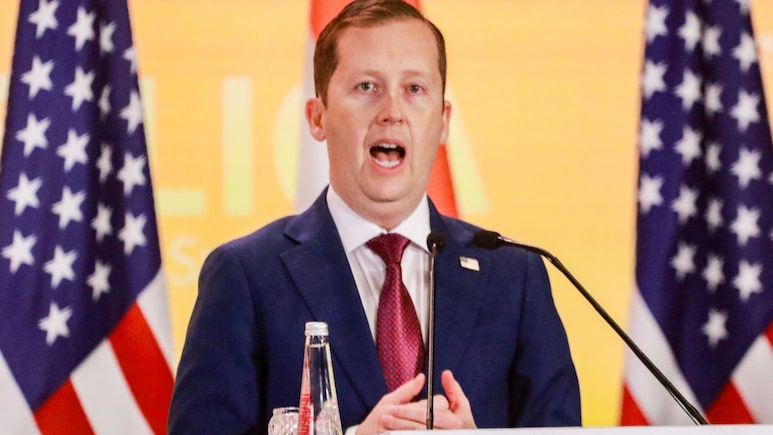
US Ambassador to India, Sergio Gor, has hinted at a major collaboration between New Delhi and Washington in the nuclear energy sector. Responding to Maharashtra Chief Minister Devendra Fadnavis's X post about his meeting with an executive delegation of the Nuclear Energy Institute and the US-India Strategic Partnership Forum under the 'US Nuclear Executive Mission to India', the American envoy wrote, "Big things ahead in India-US collaboration on nuclear energy."
Big things ahead in India-US collaboration on Nuclear energy! https://t.co/mCj9MbErAj
— Ambassador Sergio Gor (@USAmbIndia) May 20, 2026
India's push to deepen civil nuclear ties with the United States has witnessed fresh momentum in recent days, with the Maharashtra government signing memorandums of understanding (MoUs) with four corporate groups to develop nuclear power projects totalling 25,400 MW of capacity.
Representing Rs 6.5 lakh crore investments, these initiatives aim to triple India's existing atomic capacity and support national net-zero goals. Fadnavis said that Maharashtra was ready to lead the transition in the nuclear energy sector and appealed to American companies to invest in the state.
US Interest In India's Nuclear Industry
A high-level senior US delegation is currently in India, including companies' representatives from across the nuclear energy value chain.
The delegation held a "great set of meetings" with the Minister of Power, Manohar Lal Khattar, and the Minister of Finance, Nirmala Sitharaman, during their visit, said Nolty Theriot, Senior Vice President, US-India Strategic Partnership Forum (USISPF)
"With our partners, the Nuclear Energy Institute, we brought a senior delegation with some of the leading US nuclear companies, from the big reactor designers to across the entire nuclear energy supply chain. We had a great set of meetings... and it was really about strengthening the partnership, looking for ways to create joint ventures," he said.
"It gave us a good opportunity to get a better picture of the rules... The US has cutting-edge technology. India has an amazingly skilled workforce and efficient, cutting-edge EPC companies. So these partnerships are a win-win situation," he added.
India's Game Changer Act
The US delegation also noted that the recent enactment of the SHANTI Act, 2025, has opened up numerous opportunities for the commercial nuclear industry to work with India. Speaking to PTI, Maria Korsnick, president and CEO of the NEI, said the industry wants to work with the Indian commercial nuclear sector and the government to build nuclear reactors in the country.
"The SHANTI Act has given us an opening to create a relationship between the US industry and the Indian industry," Korsnick said.
"The innovation in commercial nuclear power in the United States is absolutely amazing. For many years, we have had lightwater technology. Now, we also have advanced reactors, high-temperature gas reactors and molten salt reactors," she added.
Korsnick noted that all of these innovations are happening in the United States, including large reactors, medium reactors, and small reactors. "So it is really up to India -- what it wants and what it is interested in so that we can form partnerships," she added.
It is not the first time NEI representatives have travelled to India for such talks. Their first visit came back in 2006. "Twenty years ago, we came to India for a trade mission. However, it did not take off due to nuclear liability concerns, which were different in India compared to other countries," Korsnick said.
She added that the SHANTI Act had addressed those concerns, and the nuclear industry had also evolved in the past 20 years. "Before,it was just about large reactors, and now, here are large, medium and small reactors with many different opportunities to work together," she said.
Kosnick added, "It is really a new day for the nuclear sector."
Track Latest News Live on NDTV.com and get news updates from India and around the world


