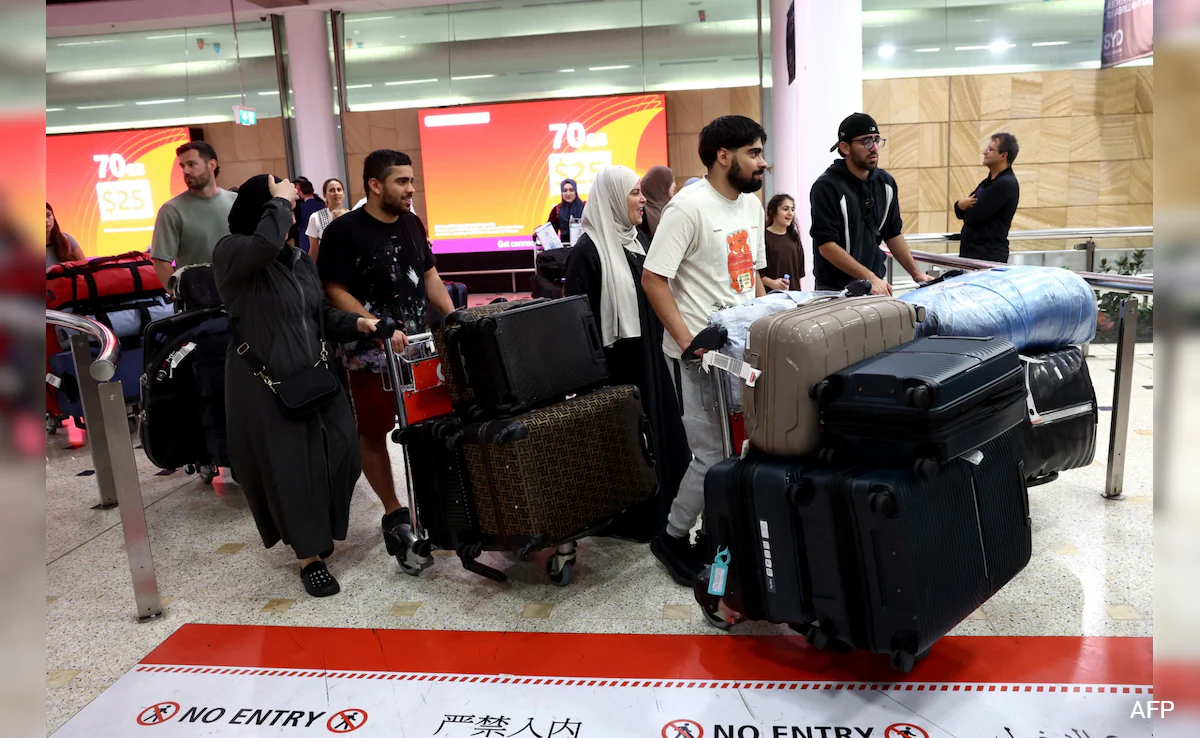
Alyssa Ramos' evacuation from Kuwait took 48 hours and carried her across four continents. The US government did not help with any part of it, the travel blogger said.
"They keep going on the news and saying they're doing everything they can to get Americans out," Ramos said after landing in Miami on Thursday. "I know for a fact they're not."
She said she repeatedly messaged the US Embassy in Kuwait before being directed to the consular section, which told her it couldn't help her leave the country and advised her to enroll in the US smart traveler program and shelter in place.
Ramos is among the many travelers who found themselves stranded in the Middle East and beyond after Israeli-US attacks on Iran almost a week ago rapidly entangled more than a dozen nearby countries. Since then, U.S. citizens have described frustrations and growing fear as they encountered closed airports, canceled flights and confusing US government guidance while Poland, Australia, France and other countries moved quickly to dispatch military or chartered planes for their citizens.
Follow LIVE Updates
As of Friday, about 27,000 Americans have returned to the US since the war began February 28, the State Department said. The vast majority of them made their own way out without US government assistance.
Chicago resident Susan Daley, who became stranded while on a work trip in the United Arab Emirates, arrived in the US on Thursday aboard the first commercial flight from Dubai to San Francisco since the conflict started.
"Having the State Department or whoever tell us, 'You need to get out immediately,'" Daley said, "but there's no help, so you're on your own to get your own travel plans. That was the most stressful thing."
President Donald Trump's administration has pushed back against criticism that the US response was too slow.
The first US-chartered repatriation flight arrived Thursday and more were expected daily, the State Department said, though officials did not say how many people were on board or where the planes departed.
Two State Department officials said 30% to 40% of Americans offered seats on charter flights had either declined them or did not show up. The officials, who spoke on condition of anonymity to discuss internal operations, could not say how many people that percentage range would cover, but noted that about 13,000 Americans had contacted the department seeking information or assistance about leaving the Middle East. Not all of them were asking for or were offered seats on charter flights, the officials stressed.
With little practical guidance from Washington or US consular offices, some travelers say they turned to WhatsApp group chats and social media for leads on commercial flights and alternative routes out of the region. Some started fundraising campaigns to help cover hotel bills and other expenses after days stranded in Gulf cities.
Ramos created several group chats Monday after followers of her travel account, "My Life's a Travel Movie," began messaging her for help leaving the region, too.
Within three days, more than 2,200 people had joined the chats. Members shared rides to airports where flights were still operating, names of trusted drivers and their prices and types of currency accepted.
In one message Thursday, a woman wrote that her family, including two children, had two flights canceled in Dubai and that her diabetic 2-year-old was running low on medication. Other members quickly jumped in to offer advice.
American Cory McKane also relied on a WhatsApp group while escaping Dubai. He eventually flew out Wednesday, but only after a long, sleepless trip across the Oman border. Rather than risk the crowds at Dubai's airports, McKane and friends rented a car and drove to the border, where he said taxi drivers were charging up to $650 to take stranded travelers to Muscat's airport where flights are still operating.
"Everyone's been sending each other resources because, quite frankly, the US has not done a single thing in any capacity. That's been really disappointing," he said.
Jason Altmire, a former three-term Democratic congressman from Pennsylvania, made it out of Dubai after the UAE partially reopened its airspace. He flew to Bangkok, where he and his wife had originally planned to start a vacation in Southeast Asia before becoming stranded.
"We never heard anything from the State Department other than the general email advising us to find our own way out," Altmire said in an email interview. "I found this, along with the 'you're on your own' State Department voicemail, to be infuriating."
In the email that Altmire received from the State Department and shared with The Associated Press, it advises Americans in the United Arab Emirates to leave "if they believe they can do so safely."
"For those who cannot or choose not to depart," the email said, "we continue to recommend that they shelter in place at their residence, hotel, or other structure, staying away from windows, and leaving only as necessary to obtain food, water, medications, and other essential items."
Democrats in Congress also criticized the US response. In a letter Tuesday to Secretary of State Marco Rubio, they wrote that "the lack of clear preparation, planning, and communication to Americans abroad is unacceptable."
Rubio said Tuesday the US had organised recovery flights but officials faced logistical challenges.
"We know that we're going to be able to help them," he said, while cautioning that "it's going to take a little time because we don't control the airspace closures."
Airspace over Iran, Iraq, Bahrain, Kuwait and Syria remained closed, according to flight-tracking service Flightradar24. Azerbaijan also shut the southern sector of its airspace Thursday after accusing Iran of a drone attack that injured four civilians and damaged an airport building.
As of Friday, more than 29,000 of roughly 51,000 flights scheduled in or out of Middle East airports were canceled, according to aviation analytics firm Cirium.
While commercial flight options have been limited since the war began, air traffic was starting to pick up.
Qatar announced Friday it would partially resume flights for passenger evacuations and cargo through designated contingency routes. Dubai Airports, which runs the UAE city's main airports, said it has facilitated more than 1,140 flights over the past three and a half days and was adding more daily.
Dubai-based Emirates said Friday it expected to restore its full flight network in the coming days, depending on airspace access and operational conditions, adding more options for passengers who have been relying on Oman, Egypt, Saudi Arabia and Jordan as key exit points because flights have remained operational in those countries.
Some travelers continued to find their own escape routes.
Trenten Higgins reached New York on Thursday after taking a taxi from Israel into Jordan and flying out of Amman. He said the State Department wasn't much help.
"Every alert that they gave and all the advice they gave was a day at least too late," he said. "Even when it wasn't too late, it was impossible to act upon and then they would just hang up."
(Except for the headline, this story has not been edited by NDTV staff and is published from a syndicated feed.)
Track Latest News Live on NDTV.com and get news updates from India and around the world


