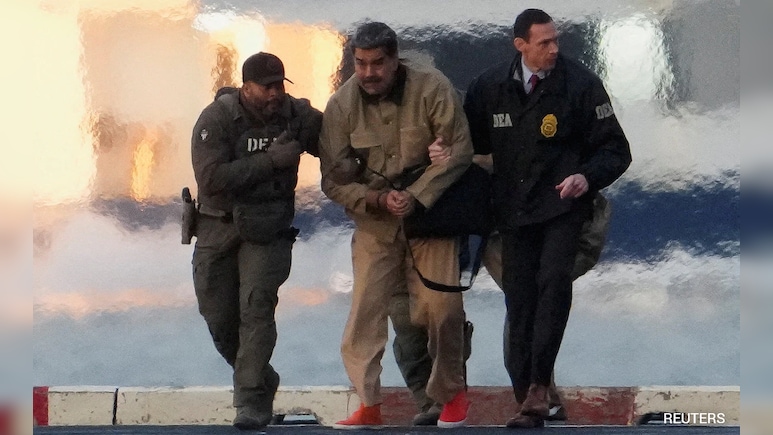
International efforts to secure a safe exit for Venezuelan President Nicolas Maduro reportedly failed before he was captured by US forces, according to a report.
On Christmas Eve, an urgent diplomatic moment happened at the Vatican. Cardinal Pietro Parolin, the Vatican's Secretary of State and a seasoned diplomatic mediator, called in the US ambassador to the Holy See, Brian Burch, according to government documents obtained by The Washington Post. Parolin sought clarity on the Donald Trump administration's plans in Venezuela. He reportedly asked if the US would target only drug traffickers or if regime change was the ultimate objective.
The cardinal had spent days trying to contact Secretary of State Marco Rubio to prevent further destabilisation in Venezuela. During his discussion with Burch, he indicated that Russia was prepared to offer asylum to Maduro.
“What was proposed to (Maduro) was that he would go away, and he would be able to enjoy his money. Part of that ask was that (President Vladimir) Putin would guarantee security,” said a person familiar with the Russian offer.
The offer went unheeded. A week later, American Special Operations forces seized Maduro and his wife in a raid, flying them to New York to face drug trafficking charges.
According to The Washington Post, the Vatican meeting is one of several previously unreported efforts by the Americans and intermediaries, Russians, Qataris, Turks, the Catholic Church and others to find a safe harbour for Maduro ahead of the US operation.
“It is disappointing that parts of a confidential conversation were disclosed that do not accurately reflect the content of the conversation itself, which took place during the Christmas period,” the Vatican press office told The Post.
Documents and interviews with nearly 20 officials reveal extensive international attempts to guide Maduro into exile and avoid military intervention. These included repeated offers for him to leave Venezuela, but the former bus driver turned president consistently rebuffed them.
“He wasn't taking the deal, He was just going to sit there and watch people create a crisis,” a source was quoted as saying.
US strategy shifted towards working with Maduro's deputy, Delcy Rodriguez, rather than opposition leader Maria Corina Machado. Trump's thinking was partly shaped by a recent classified CIA report, which found that Maduro's loyalists would be more effective at running Venezuela after Maduro than Machado and her team.
Rodriguez had developed a reputation for pragmatism in dealings with foreign oil representatives. “She wasn't anti-American; she'd even lived in Santa Monica. She was the farthest thing from an ideologue,” said a source who interacted with her.
Maduro seemed to misread signals from Washington. He believed a November 2025 call with Trump had gone well, despite being warned that his departure was expected. “The president said you can go the easy way or the hard way,” a senior White House official said. Offers of safe passage to Washington were rejected, as Maduro calculated he could survive until the next elections.
Meanwhile, Cardinal Pietro Parolin pushed for patience and restraint in US dealings with Maduro. Russia's willingness to accept Maduro came amid broader negotiations with Washington over Ukraine. Attempts to find alternative exit routes included offers of asylum in Turkey and negotiations through intermediaries such as Brazilian billionaire Joesley Batista.
“Nicolas Maduro had multiple opportunities to avoid this,” Rubio said. “He was provided very, very, very generous offers and chose instead to act like a wild man, chose instead to play around.”
Following Maduro's removal, Rodriguez has consolidated power, though authority remains fragmented. The White House maintains confidence in Rodriguez, citing her cooperation in releasing political prisoners and an agreement to export Venezuelan oil to the US.
Track Latest News Live on NDTV.com and get news updates from India and around the world


