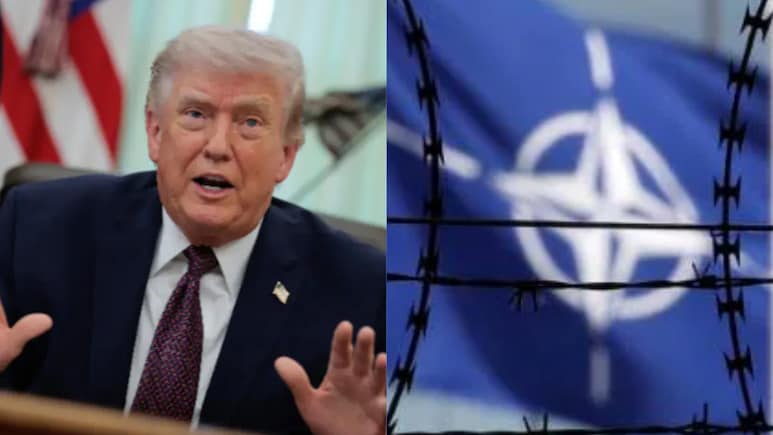
After years of criticising NATO and accusing its members of relying too heavily on the United States, Donald Trump now wants to withdraw from the alliance. He has called NATO ineffective and mulling if US should continue to remain a member. But, why?
Trump's latest statement questioning NATO's role is linked to the organisation's refusal to back the US during the Iran war. He has argued that the alliance failed to support America when it needed help. However, NATO's rules do not require member countries to support military action unless a member state is attacked. In this case, the US was not attacked and did not consult other NATO members before acting.
Trump has recently gone further in his criticism, calling NATO a "paper tiger" and said that the US withdrawal was "beyond reconsideration", suggesting he has largely made up his mind. He has also claimed that if the US was attacked, NATO countries would not come to its defence, unlike the protection the US provides to Europe.
Is NATO Still Heavily Reliant On The United States?
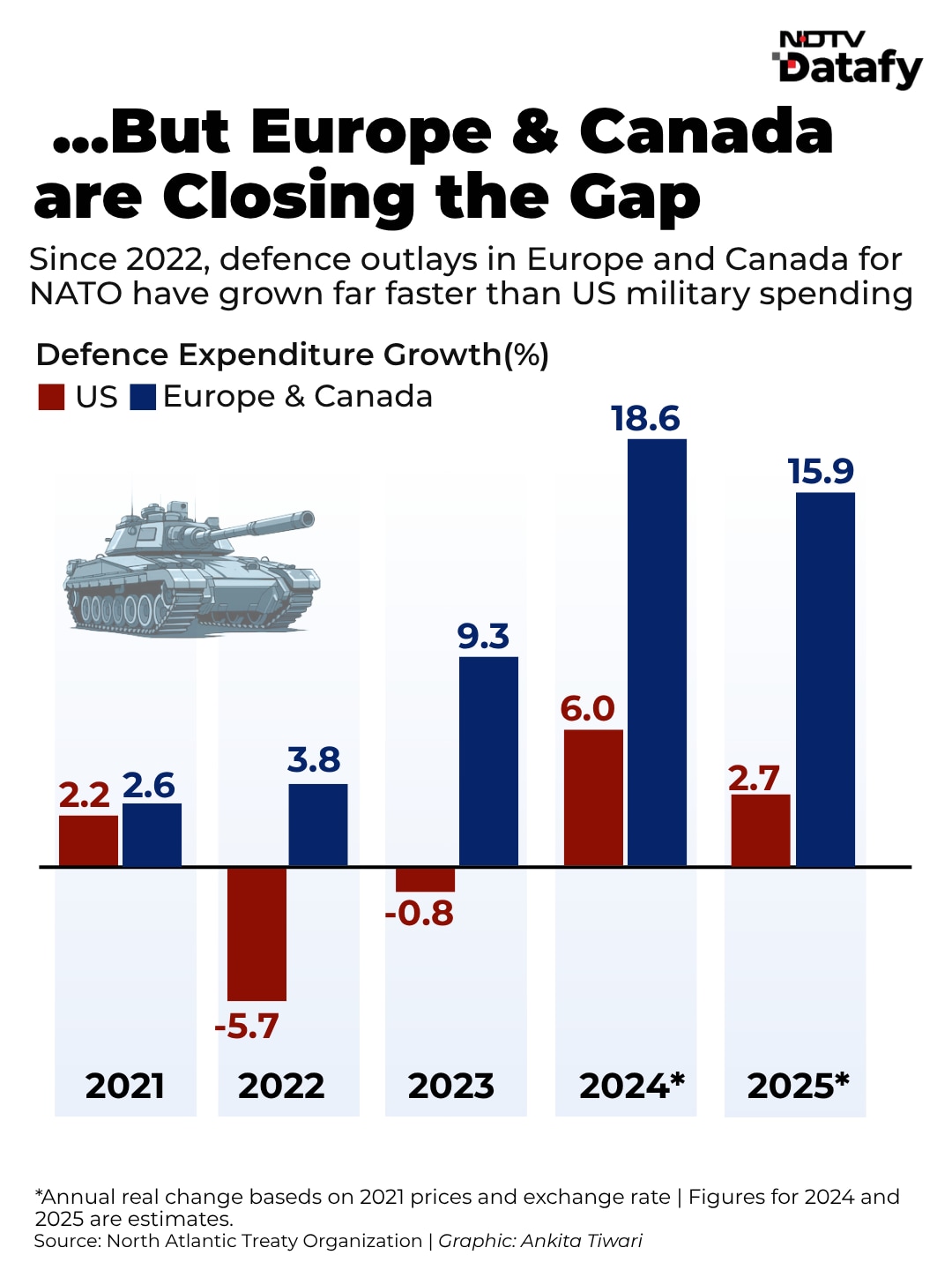
NATO defence spending trends show a growing shift towards Europe and Canada as US budgets struggle to keep pace in real terms. After inflation cut in the US defence outlays in 2022 and 2023 resulting in real-terms declines, European and Canadian allies continued to step up spending, driven by rising security concerns after Russia's invasion of Ukraine.
That gap is expected to widen further, with estimates pointing to strong double-digit real growth in Europe and Canada in 2024 and 2025, far outstripping more modest increases in the United States. The figures highlight a significant change in the alliance's internal balance, as European allies take on a larger share of the defence burden.
Can NATO Survive Without The United States?
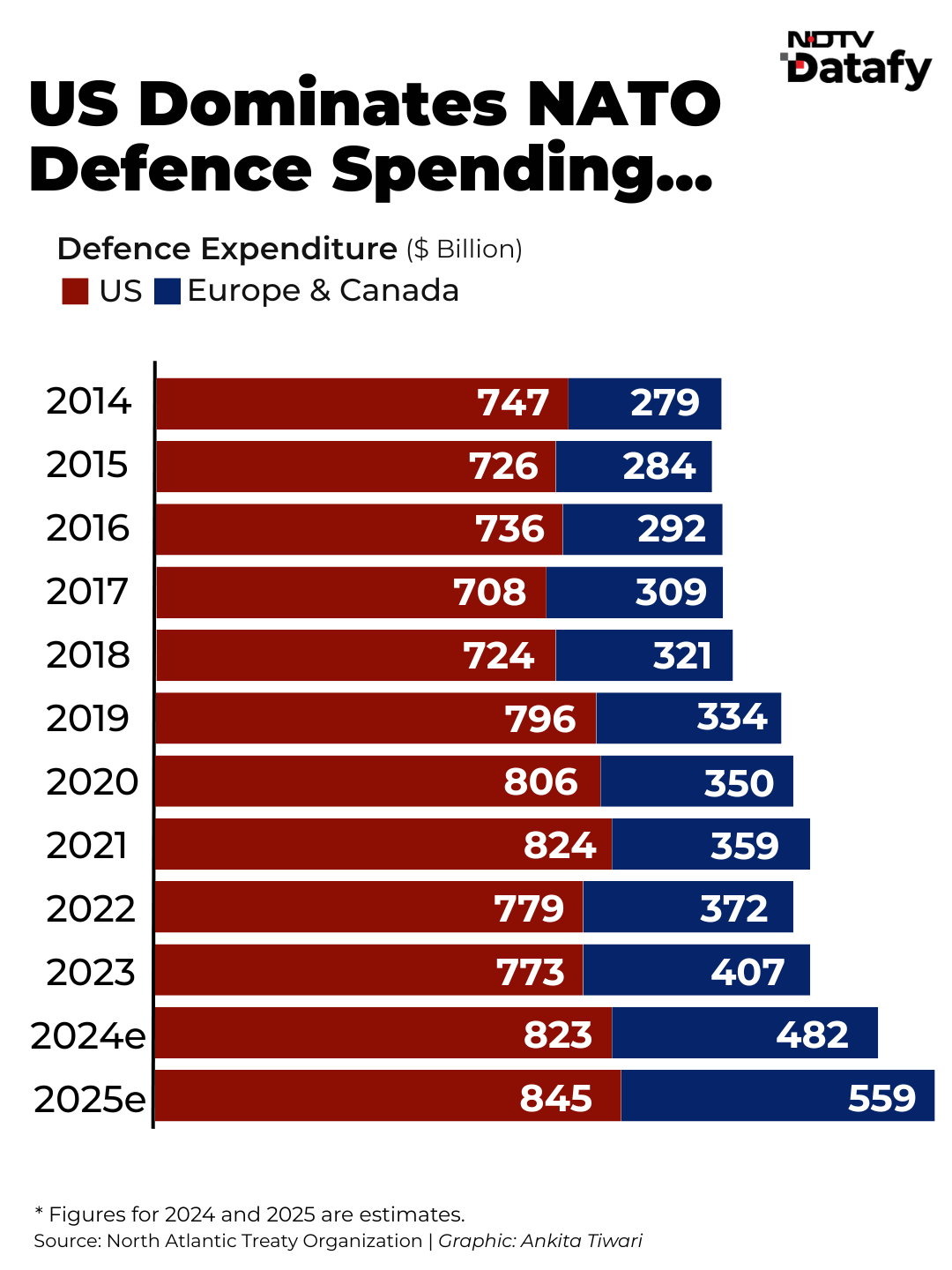
NATO's defence spending has risen steadily over the past decade, but recent growth has mainly come from Europe and Canada rather than the United States. Total spending has increased from about $1 trillion in 2014 to an estimated $1.4 trillion in 2025, even though US defence budgets dipped in real terms in 2022 and 2023.
During the same period, European and Canadian defence expenditure continued to rise and then picked up sharply after Russia's invasion of Ukraine, climbing from around $280 billion in 2014 to an estimated $560 billion in 2025. While the US still spends far more than its allies overall, the data shows Europe and Canada taking on a larger share of NATO's defence costs, signalling a gradual shift in the alliance's burden-sharing.
Who Is Relying On Whom Within NATO?
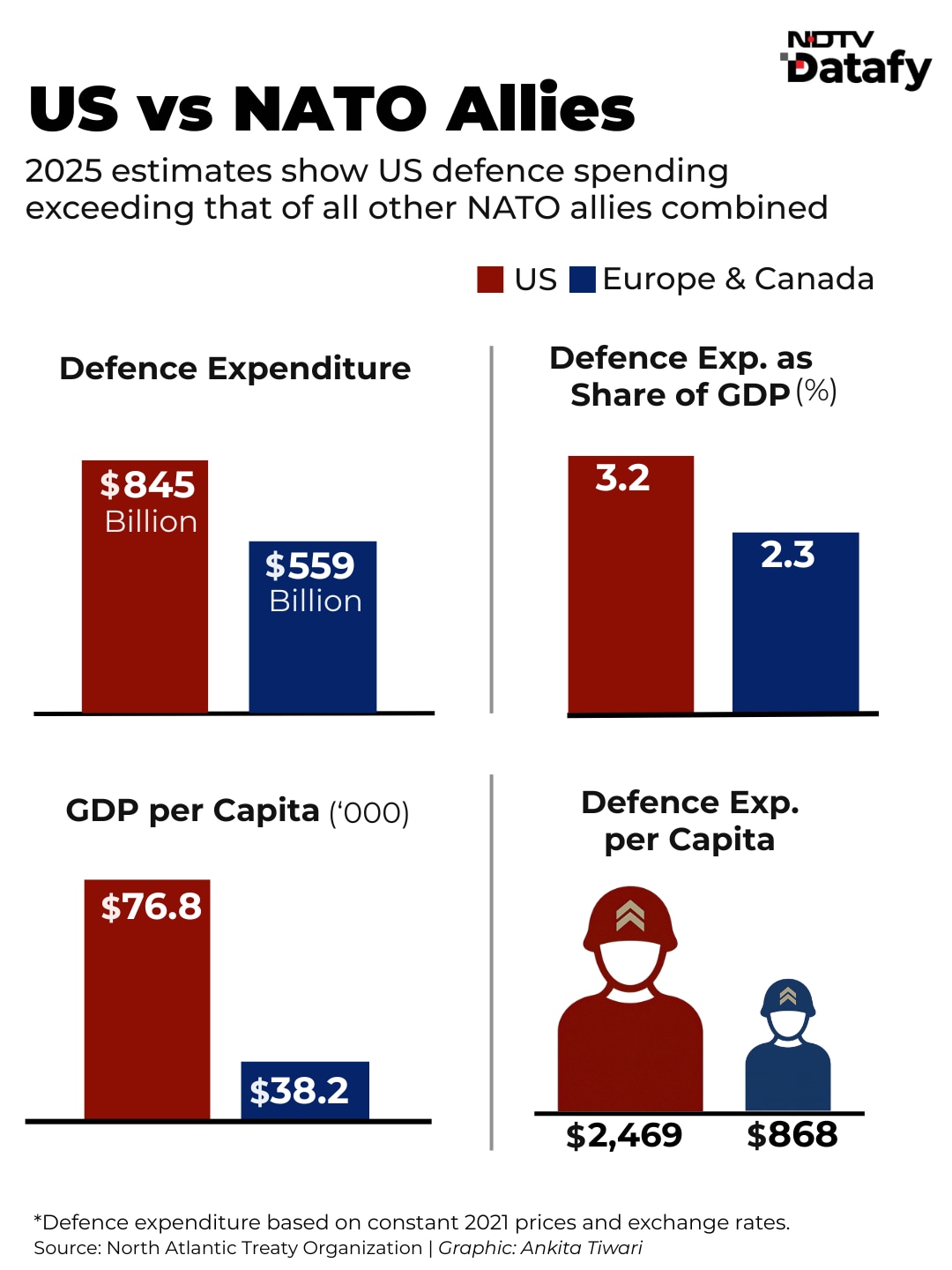
In 2025, the gap between the United States and its NATO allies remains large, but the pace of change is very different. In constant 2021 prices and exchange rates, the US is expected to spend about $845 billion on defence, compared to $559 billion by Europe and Canada combined.
While the US spends far more overall and has a much higher defence cost per person -- nearly $2,469, European and Canadian allies are increasing spending faster, with defence budgets set to grow by nearly 16 per cent in real terms, compared with only 2.7 per cent in the US.
The strong growth on the European side suggests allies are trying to close the gap by spending faster, even if they remain well behind the US in per-capita and overall defence spending.
Demand Of Five Per Cent Of GDP
Earlier the US president Trump had asked NATO allies to spend as much as five per cent of GDP on defence, to which, NATO leaders had formally agreed in June 2025 to raise their defence and security spending to five per cent of GDP by 2035, replacing the long-standing two per cent guideline.
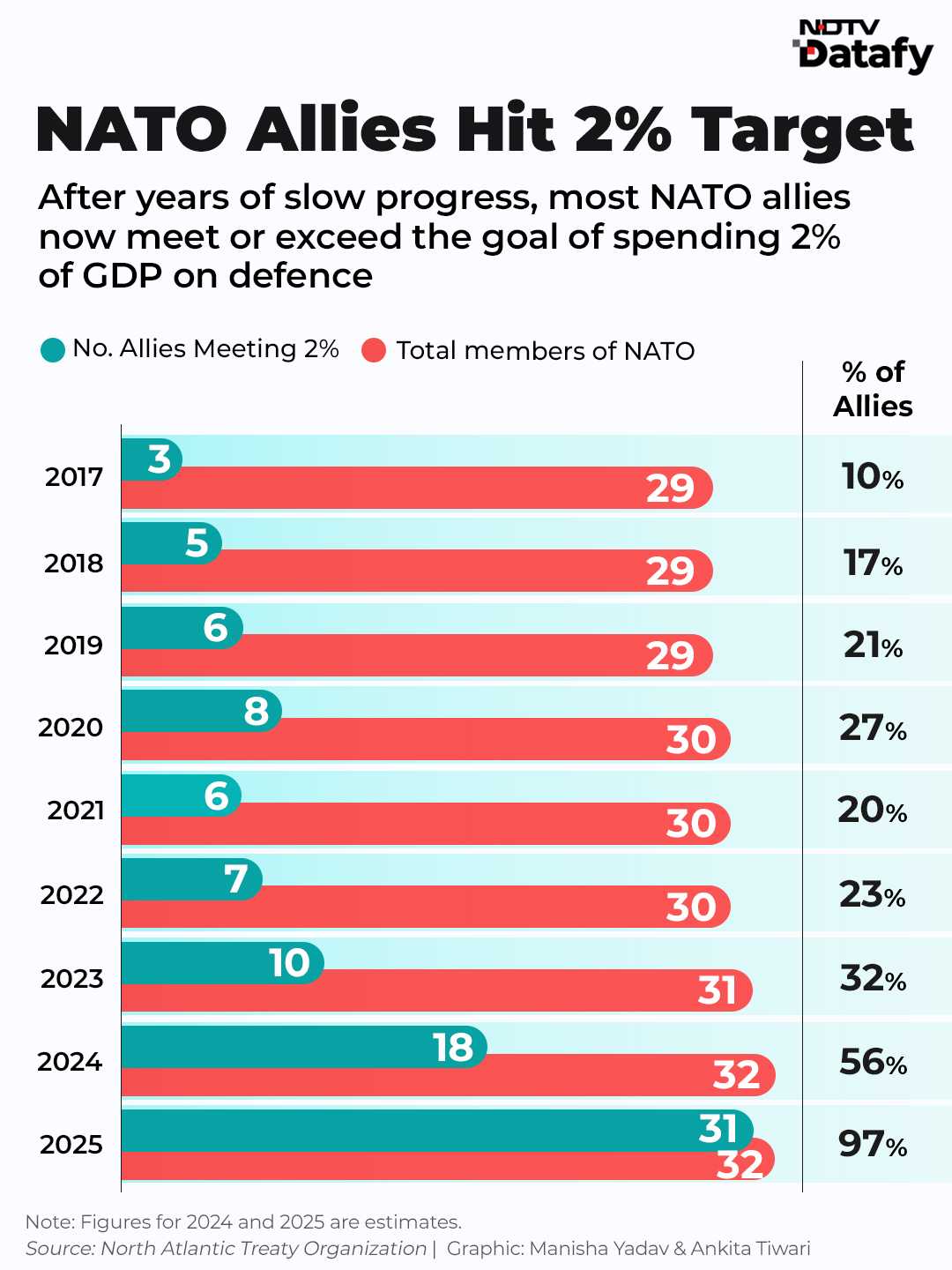
However, the alliance has only recently come close to fully meeting its original two per cent target. For much of the past decade, compliance with even this lower benchmark remained limited and uneven. In 2014, only three NATO allies met the two per cent threshold, highlighting deep reliance on the US for collective defence.
That picture has shifted gradually and then sharply over time. Progress was slow between 2015 and 2019, with fewer than a quarter of allies meeting the target. The pace picked up after 2020 and accelerated dramatically following Russia's invasion of Ukraine. By 2023, 10 of the 31 members had reached the two per cent mark, before a major jump in 2024, when 18 of 32 allies did so.
By 2025, an estimated 31 out of 32 NATO members, or 97 per cent of the alliance, were projected to meet the benchmark, signalling a structural change in defence priorities. While the five per cent goal remains far beyond reach, the data shows that Europe and NATO allies are, for the first time, close to fully delivering on the long-standing two per cent commitment
Track Latest News Live on NDTV.com and get news updates from India and around the world


