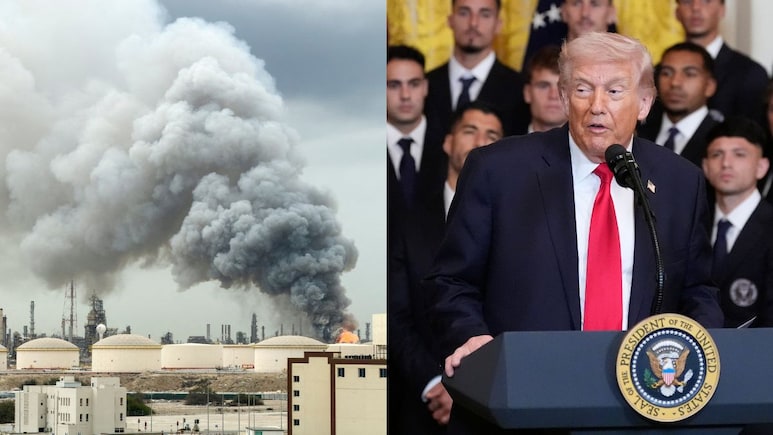
The White House on Tuesday reiterated its objectives for its operations against Iran, which it said will focus on dismantling Tehran's missile capability, crippling its navy and preventing the country from obtaining a nuclear weapon.
Speaking about Operation Epic Fury, which was launched on February 28 with strikes on Iran, White House Press Secretary Karoline Leavitt said President Donald Trump will determine if the objectives have been fully realised and if "Iran is in a position of complete and unconditional surrender, whether they say it or not". During a press briefing, she said the initial timeline for the operation was four to six weeks and its objective is also to weaken the "evil terrorist proxies in the region".
What started as joint US and Israel strikes on Iran on February and Tehran's speedy retaliation turned into a war that has now engulfed the entire Middle East region, leading to thousands of deaths across several countries.
Here are the other key takeways from the White House press briefing:
Leavitt said that Operation Epic Fury has delivered a major blow to Iran's military capacity, striking 5,000 enemy targets so far. Among the targets successfully destroyed are over 50 Iranian naval vessels, including a major drone carrier ship.
- US' strategic B-2 bombers have targeted deeply buried missile facilities using 2,000-pound penetrator bombs, she said.
- Leavitt said that the US has not ruled out the option of sending troops on ground in Iran.
- The White House Press Secretary added that Iran's retaliatory attacks are down more than 90 per cent since the start of the war.
- Trump personally approved a temporary waiver allowing India to purchase Russian oil as part of a broader effort to stabilise global energy markets amid disruptions, Leavitt said.
- The White House also stressed that the United States would ensure the continued flow of energy through the Strait of Hormuz, the world's most critical oil shipping routes through which 20 per cent of all global oil passe.
- She said the US has offered political risk insurance to tankers operating in the Gulf apart from Navy escort taken, if required to keep the waterway open. Leavitt also clarified that Washington has so far not escorted any vessels or tankers via the Strait of Hormuz
- Leavitt said President Trump had reiterated his commitment to protecting energy supply routes.
140 US Service Members Wounded
About 140 US service members have been wounded during the first 10 days of sustained attacks linked to the American military campaign against Iran, the Pentagon told IANS. "The vast majority of these injuries have been minor, and 108 service members have already returned to duty. Eight service members remain listed as severely injured and are receiving the highest level of medical care," Pentagon spokesman Sean Parnell said.
"Relative Impunity"
Chairman of the Joint Chiefs of Staff Gen Dan Caine said many of Iran's higher-end surface-to-air missile systems were no longer posing a significant threat to US aircraft. "We're able to move around fighters that are moving deeper with relative impunity," he said.
He added that there will always be some risk as the US forces press on with strikes aimed at "production facilities, research and development sites and infrastructure". "They're adapting, as are we. I think they're fighting, and I respect that, but I don't think they're more formidable than what we thought," Caine said.
Track Latest News Live on NDTV.com and get news updates from India and around the world


