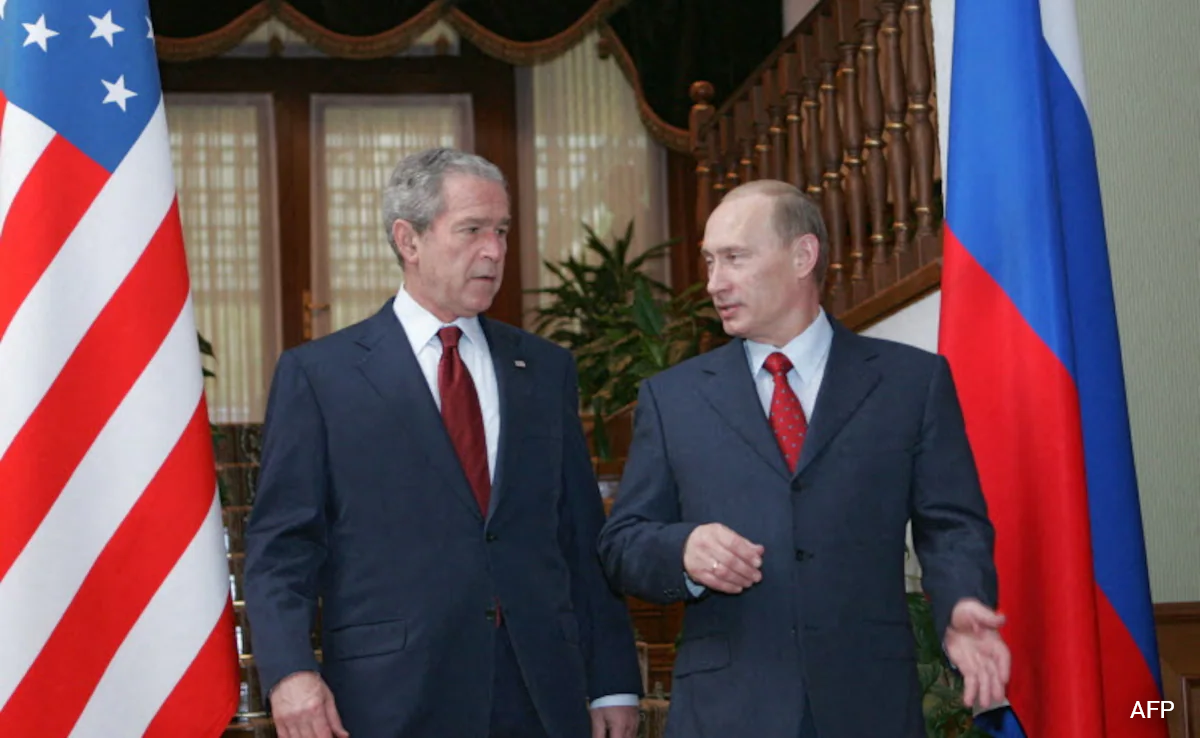
Russian President Vladimir Putin raised concerns over Pakistan's nuclear proliferation during his private talks with his US counterpart, George W Bush, over two decades ago. In their first personal meeting on 16 June 2001 in Slovenia, Putin voiced his worries over Islamabad's stability and unease over the control of its atomic assets.
A transcript of the conversation was recently released by the National Security Archive, which showed Putin labelled Pakistan's army "just a junta with nuclear weapons". The documents, covering unusually candid meetings and calls between 2001 and 2008, revealed that both leaders viewed Pakistan, under military ruler Pervez Musharraf, as a significant non-proliferation concern.
At their Slovenia meeting, Putin questioned why Pakistan did not face the same level of sustained international pressure as other countries accused of nuclear violations. He said, "It is just a junta with nuclear weapons. It is no democracy, yet the West does not criticise it. Should talk about it," a remark that revealed Moscow's scepticism about Western tolerance toward Islamabad despite its checkered proliferation record.
The Russian leader's views echoed India's concerns about Pakistan's nuclear proliferation, underscoring a shared international anxiety over regional security.
The Russian leader contrasted Pakistan's treatment with the scrutiny directed at Iran and North Korea, both of which featured heavily in the same conversations. The transcripts show that Bush did not dispute Putin's characterisation, instead acknowledging that Pakistan's role in illicit transfers remained a serious concern for the United States.
Bush later described Russia as "part of the West and not an enemy," highlighting the tone of mutual respect that summed up their early encounters, before the American famously said he had looked into Putin's soul and found him trustworthy.
Concerns Over AQ Khan Nuke Network
During the Oval Office meeting on September 29, 2005, Putin told Bush that uranium discovered in Iranian centrifuges was of Pakistani origin, a revelation that underscored long-suspected links between Islamabad's nuclear establishment and illicit proliferation networks.
Bush immediately agreed that the finding was alarming, calling it a violation and saying it made the United States "nervous", according to the transcripts.
"It makes us nervous, too," Bush said, as the two leaders discussed the risks of sensitive nuclear material spreading beyond state control. Putin responded pointedly, "Think about us," highlighting Moscow's concern that such leaks posed a direct threat to Russian security as well.
ALSO READ: Asim Munir Critic Attacked In UK After "Fear And Terror" Viral Speech
Bush told Putin he had personally raised the issue with then-Pakistani President Pervez Musharraf, explaining that Washington had pressed Islamabad hard after uncovering the activities of Abdul Qadeer Khan, the architect of Pakistan's nuclear weapons programme. Bush said Khan and several of his associates had been jailed or placed under house arrest but added that the United States still wanted to know precisely what had been transferred and to whom.
"We want to know what they said," Bush told Putin, reflecting frustration over what Washington viewed as incomplete disclosures by Pakistani authorities. The exchange suggests that even years after the AQ Khan network was exposed, doubts persisted at the highest levels about whether its full scope had been dismantled.
US's Pak Problem
The two leaders also discussed reports of ongoing cooperation between Pakistani elements and foreign nuclear programmes. Putin said Russian experts believed there had been continued interaction involving Iran's enrichment efforts, while Bush confirmed that US intelligence shared similar worries.
Although Pakistan was formally a key US ally in the post-9/11 war on terror, the transcripts reveal that behind closed doors, both Washington and Moscow viewed its nuclear stewardship with deep suspicion.
The documents reflect that the Pakistani nuclear programme was not treated as an isolated problem but as part of a wider pattern of instability involving weak controls, opaque decision-making, and the potential for catastrophic leakage.
ALSO READ: "Irresponsible": China Slams US For Report That "Sows Discord" With India
Putin repeatedly raised the dangers of nuclear weapons in the hands of regimes lacking democratic accountability, while Bush emphasised the need to prevent any further spread of sensitive technology.
The National Security Archive said the records provide "previously unavailable evidence" of the depth of concern shared privately by U.S. and Russian leaders about Pakistan, even as public statements at the time were far more restrained.
Pakistan developed its nuclear arsenal outside the Nuclear Non-Proliferation Treaty and has long been under international scrutiny, particularly after revelations in the early 2000s that the AQ Khan network had supplied nuclear technology to Iran, North Korea, and Libya.
Track Latest News Live on NDTV.com and get news updates from India and around the world


