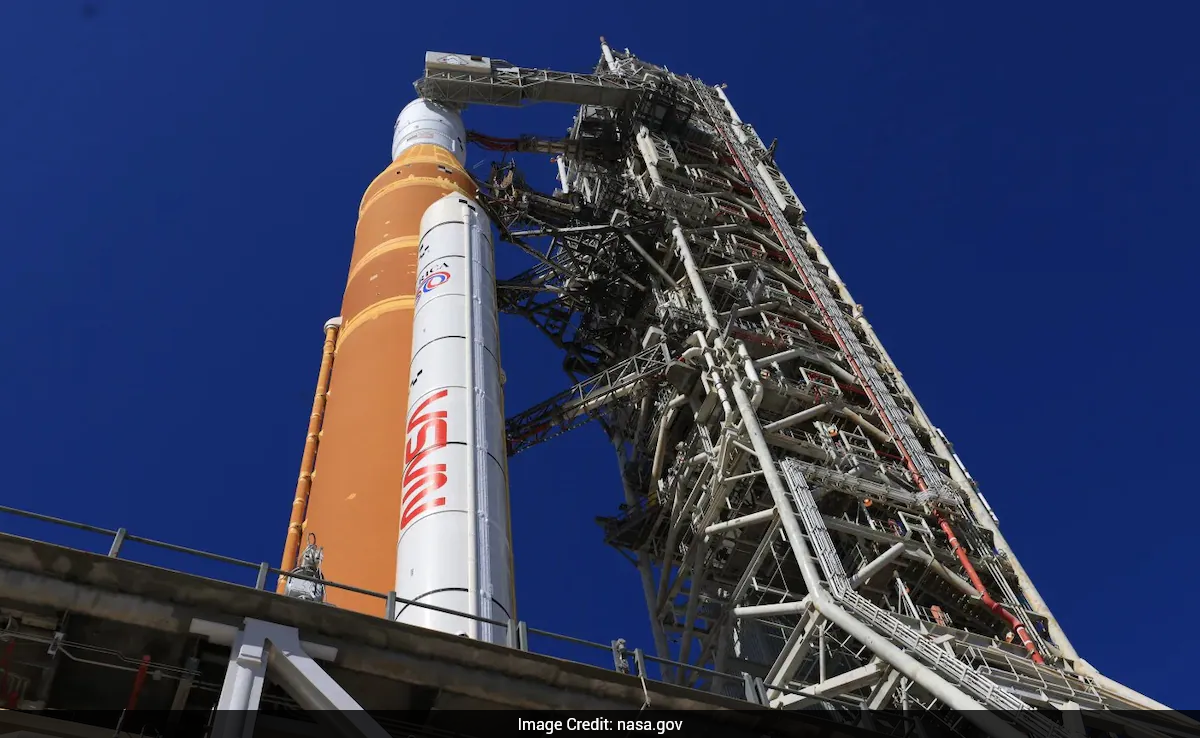
The United States is preparing to send humans back to the Moon under NASA's Artemis programme, ending a 54-year gap since the last Apollo astronauts left the lunar surface in 1972. Four astronauts will head to orbit the Moon as part of the Artemis-II mission that will be launched using the massive Space Launch System rocket and the Orion capsule as early as April 1, 2026.
India, meanwhile, has already made history with three successful probes touching the Moon: the Moon Impact Probe (MIP) on Chandrayaan-1 and the Vikram lander with the Pragyan rover on Chandrayaan-3.
Scientific papers from Chandrayaan-3 have transformed understanding of the Moon's South Polar Region, from surface chemistry and temperature behaviour to near-surface plasma.
India's next mission, Chandrayaan-4, aims to return lunar samples, positioning the country among an elite global club.
American space agency NASA's Artemis-2 will soon take humans farther from Earth than ever before, skimming past the Moon's far side and opening a new chapter in deep-space exploration.
More than half a century after humanity last walked on the Moon, the world is once again looking skyward with renewed urgency. In December 1972, Apollo-17 astronauts Eugene Cernan and Harrison Schmitt lifted off from the lunar surface, closing one of the most audacious chapters in human exploration. Since then, the Moon has been explored only by robots, until now. NASA's Artemis programme is poised to carry humans back to deep lunar space, marking America's return to the Moon and signalling that the age of sustained human presence beyond Earth orbit is about to begin.
Artemis, named after the twin sister of Apollo in Greek mythology, is designed not as a one-off spectacle but as a long-term strategy. While Apollo was about proving a point during the Cold War, Artemis is about permanence: building experience, infrastructure, and partnerships that will allow humans to live and work on and around the Moon and eventually push onward to Mars. The first uncrewed test, Artemis-1, successfully flew around the Moon in 2022. Now all eyes are on Artemis-2, the first crewed lunar mission since Apollo-17, with the launch set for no earlier than April 1.
Artemis-2 will not land on the Moon, but its significance cannot be overstated. Four astronauts will loop around the Moon on a free-return trajectory, flying past the far side, a region permanently hidden from Earth, before heading home. In doing so, they will travel farther from Earth than any humans have ever gone, surpassing even Apollo-13's distance record. The mission will test life-support systems, navigation, communications, and human endurance in deep space, laying the groundwork for future landings later in the decade.
While America prepares its return, India has already left an indelible mark on the Moon through a series of increasingly sophisticated robotic missions. India's lunar journey began with Chandrayaan-1 in 2008, which carried the Moon Impact Probe. The MIP deliberately crashed into the Moon near the South Pole, making India the first country to reach that region and providing critical evidence of the presence of water molecules on the lunar surface. That single discovery reshaped global thinking about the Moon as a potential resource rather than a barren rock.
Fifteen years later, India achieved another milestone with Chandrayaan-3. In August 2023, the Vikram lander executed a flawless soft landing near the Moon's South Polar Region, a feat no other nation had accomplished before. Soon after, the Pragyan rover rolled onto the lunar surface, making India the fourth country to soft-land on the Moon and the first to operate near its southern extremity. Unlike symbolic flag-planting missions of the past, Chandrayaan-3 was designed as a science workhorse, and the results have been profound.
Scientific papers emerging from Chandrayaan-3 have significantly advanced lunar science. The Pragyan rover's spectrometers directly measured the elemental composition of the lunar soil at high latitude, confirming the presence of elements such as aluminium, calcium, iron, titanium, chromium, and sulphur. Sulphur's unambiguous detection was particularly important, as it had not been conclusively identified at the South Pole through orbital measurements alone. These findings help refine models of how the Moon formed and evolved, especially in regions untouched by previous missions.
Equally striking were temperature measurements from the ChaSTE experiment on-board the Vikram lander. For the first time, scientists recorded in situ temperature profiles from the Moon's high-latitude South Polar Region. The data revealed that surface temperatures can be significantly higher than expected, depending on local slope and illumination. This insight has direct implications for future human missions, as it suggests that certain poleward-facing slopes could still harbour water ice just below the surface, a crucial resource for sustained lunar habitation.
Chandrayaan-3 also made the first direct measurements of near-surface plasma at the Moon's South Pole. Instruments on board Vikram detected a surprisingly dense and energetic layer of charged particles just above the surface, shaped by solar wind interactions and surface charging. Understanding this plasma environment is essential for designing future landers, habitats, and communication systems, particularly in the Moon's harsh polar regions.
Having proven its ability to land and explore, India is now preparing for its most ambitious lunar mission yet. Chandrayaan-4 is planned as a sample-return mission, aiming to collect lunar soil from the South Polar Region and bring it back to Earth. If successful, India would join a select group of nations that have physically returned lunar material for laboratory analysis. The mission will require complex technologies, including robotic sampling, ascent from the lunar surface, docking in lunar orbit, and a controlled re-entry to Earth, capabilities that are foundational for future crewed missions.
Together, Artemis and Chandrayaan represent two complementary visions of lunar exploration. One is human-centered, focused on deep-space experience and long-term presence; the other is robotic, precise, and scientifically targeted. Yet both converge on the same goal: understanding the Moon not just as a destination but as a stepping stone for humanity's expansion into the solar system.
As Artemis-2 prepares to lift off, carrying astronauts to the Moon's orbit and back, humanity stands on the threshold of another great leap. This time, the return to the Moon is not about planting flags and leaving lasting footprints. It is about staying, learning, and preparing for journeys even farther from home.
Track Latest News Live on NDTV.com and get news updates from India and around the world


