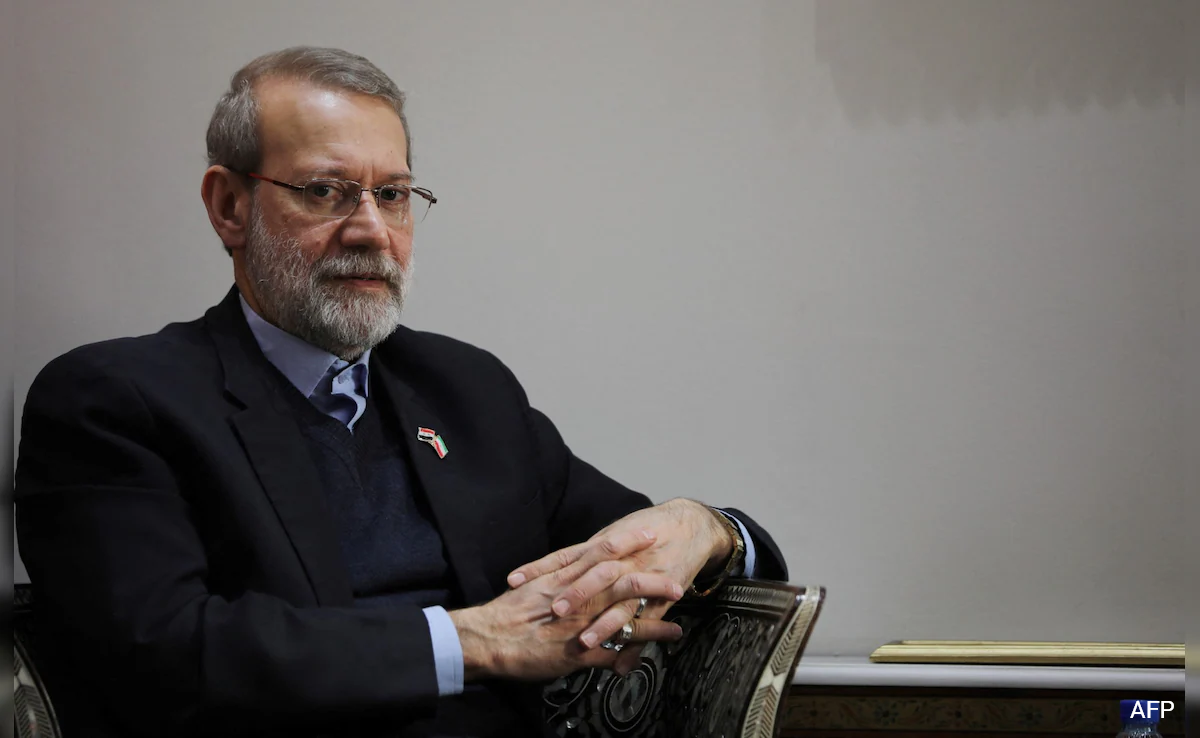
Israel's killing of Ali Larijani, a veteran Iranian politician known for his pragmatism and long experience helming national security, leaves the Islamic Republic's wartime leadership largely in the hands of hardliners who may be less likely to seek a diplomatic pathway out of the war.
Larijani was an insider of the Islamic Republic's establishment for decades. He leveraged his ties to different factions and key figures, including late Supreme Leader Ayatollah Ali Khamenei, to influence important decisions. He had emerged as the country's most senior national-security official with a central role in the talks on Iran's nuclear program, most recently shuttling between Gulf-Arab states and visiting Moscow to meet Russian President Vladimir Putin, in the weeks before the current conflict started.
As the US-Israeli war on Iran intensifies and continues to wreak havoc on the oil-rich Persian Gulf, some fear that the death of a figure like Larijani could block potential diplomatic efforts to end it quickly. Speaking before it was confirmed by Iranian authorities, US President Donald Trump didn't comment directly on the implications of Larijani's death.
"Israel seems to be turning its attention to targeting those that could push for a political solution to the current crisis," said Ellie Geranmayeh, senior policy fellow and deputy director of the Middle East and North Africa program at the European Council on Foreign Relations.
Asked about Larijani's killing, an Israel government spokesperson said: "solving the conflict involves hammering the ayatollah regime until they are gone. We will not allow one ayatollah regime to be replaced with another ayatollah regime." The spokesperson requested anonymity, a common practice for such statements in Israel.
Since the assassination of Khamenei, in the opening salvo of the war on Feb. 28, Larijani had emerged as a major component of the leadership structure that's administered Iran and managed its wartime strategy. Israel had described Larijani as the de-facto leader of Iran, a reflection of how much his influence in the Islamic Republic had increased. He was last seen alive in public on Friday when he, and several other members of the Iranian leadership, attended a mass rally in Tehran.
The war, now in its third week, shows no sign of easing.
An Emirati gas field was set ablaze by Iran on Monday after a missile attack. The UAE announced it was again closing its airspace as other missiles were launched at the country. Trump has voiced growing frustration that allies haven't committed to efforts to help vessels transit the Strait of Hormuz, the narrow crossing that's critical to the flow of oil shipments through the Persian Gulf. Its effective closure has seen oil prices spike and highlighted the economic costs of the conflict globally.
Larijani's statements since the start of the war have consistently pushed back against Trump's demands to capitulate to the US. In comments released on Monday, he sought to justify Iran's attacks on Gulf-Arab states and criticized the countries for siding with the US and Israel against the Islamic Republic. He urged them to rethink pro-Western policies that included a landmark normalization agreement between the United Arab Emirates and Israel, signed in 2020.
Yet his reputation as a shrewd insider who was broadly in favor of using diplomacy to reduce Iran's economic isolation, while strategically preserving the Islamic Republic's position in the Middle East, meant he was seen by some foreign diplomats as someone who could potentially act as a conduit to talks as the war evolved.
After the supreme leader's death his duties were initially taken over by an interim leadership council - made up of Iran's President Masoud Pezeshkian, judiciary chief Gholam Hossein Mohseni-Ejei and a top cleric from the Guardian Council. At the same time Larijani, ultra-conservative clerics and hardliner Mohammad-Baqer Qalibaf emerged as the country's top civilian decision makers.
Larijani was the only figure in the lineup of senior power-brokers with a link to the politics that characterised the presidency of moderate cleric Hassan Rouhani – who was in charge when the original nuclear deal was signed with the US and other major powers in 2015 – and Abbas Araghchi, the current foreign minister.
"If you look at how the assassination of Ali Khamenei empowered the most hardline and security elements within the Islamic Republic of Iran," Geranmayeh said, "then Larijani's death could act as an accelerator to that path."
Pivotal Role
Throughout his career Larijani had important roles in managing national security matters and dealing with foreign diplomats. This also meant he was one of the few people in the higher ranks of the regime who was deployed to meet with counterparts from other countries at times of crisis.
"Larijani was an insider who helped curate the system's war and day-to-day response. He also had relationships across the Gulf and has in the past been in touch with UK and European leaders," Sanam Vakil, director of the Middle East and North Africa program at Chatham House, said. "He is a key node that could have helped manage negotiations."
Others dispute whether Larijani would have fulfilled that role. "That he was somehow a figure who'd be instrumental in negotiating an end to the conflict. I don't think we know that," said Michael Singh, managing director at The Washington Institute.
"I don't think you're going to find too many objections right now in the American system," Singh added of the killing of Larijani. "There's a desire to really put as much pressure as possible on Iran."
There's also a question now of who succeeds Larijani as secretary of the Supreme National Security Council - a pivotal role as the war evolves. If the balance of power has now been further tipped towards the hardliners, that could mean that one of their own is named to take on that role.
More immediately, Larijani's death is likely to leave Qalibaf, the speaker of parliament, a former commander of Iran's police force and the Islamic Revolutionary Guard Corps, with more power in the current leadership structure.
Qalibaf is heavily associated with the IRGC and is known among middle class Iranians, who have long demanded reform, as someone who has pushed for repressive and violent policies against protesters and dissenters.
The former mayor of Tehran is seen, in the country, as having been an advocate of naming the late Khamenei's son, Mojtaba, to replace his father as supreme leader, a view he shared with the IRGC and some of Iran's most hardline and ultra-conservative clerics, but one that Larijani is broadly believed to have not fully backed.
The prospect of further hardline consolidation at the top raises fresh questions over the status of other senior government officials, seen as more pragmatic, including Araghchi, the foreign minister and most experienced diplomat still in office.
Other figures outside government, like Rouhani and former foreign minister Mohammad Javad Zarif, could be further marginalized by hardline opponents if foreign powers from Europe or China look for figures who might be more receptive to diplomatic efforts to de-escalate the war.
With Larijani gone "Tehran loses one of the few insiders able to connect the battlefield to politics," said Ali Vaez, director of the Iran Project at the International Crisis Group. "The result is not simple weakness, but a system that is more rigid, less strategically coherent and potentially more dangerous."
Track Latest News Live on NDTV.com and get news updates from India and around the world


