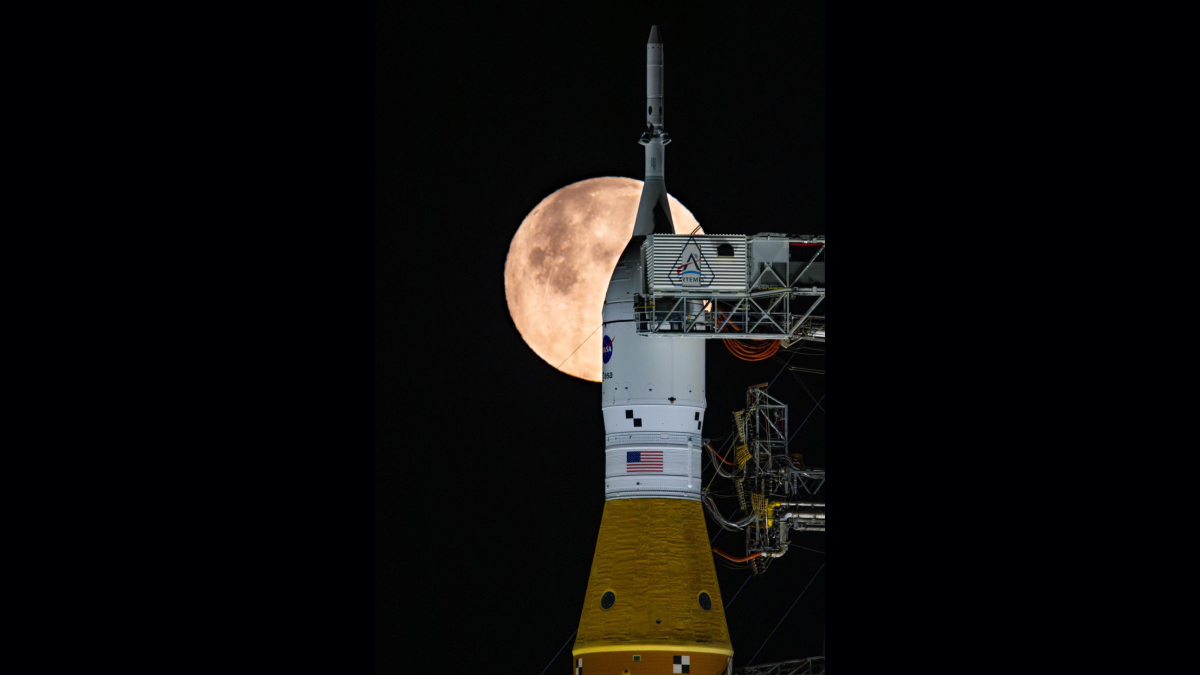
Destination Moon, on the horizon! When NASA's upcoming Artemis II mission lifts off no earlier than April 1, it will do something no human spaceflight has attempted in more than five decades: send astronauts beyond low Earth orbit toward the Moon, retracing a path last flown during the Apollo era. More than a symbolic return, Artemis II is designed as a carefully staged, crewed test flight, validating every major system required for sustained human exploration of deep space.
Artemis II is not a landing mission. Instead, NASA has crafted a lunar flyby profile that allows astronauts to experience deep-space flight, operate the Orion spacecraft in real conditions, and return safely to Earth, without yet committing to the added complexity of lunar orbit insertion or surface operations.
Launch And Earth-Orbit Checkout
The mission begins with liftoff from Launch Complex 39B at NASA's Kennedy Space Center, where the Space Launch System (SLS) rocket will propel the Orion spacecraft and its four-member crew into space. This will be the first time humans fly aboard SLS and Orion, marking a major transition from single un-crewed testing to operational human spaceflight.
After reaching space, Artemis II does not immediately head for the Moon. Instead, Orion will complete two orbits of Earth, a deliberate pause built into the mission profile. During these early orbits, astronauts and flight controllers will verify Orion's life-support, propulsion, navigation, and communication systems while the spacecraft remains relatively close to home.
This phase reflects a cautious, Apollo-inspired philosophy: test systems early, identify issues while recovery options remain available, and only then commit to deep-space flight.
Human Control In Deep Space
One of Artemis II's most important objectives comes during the Earth orbits. The crew will conduct a manual piloting demonstration, temporarily taking control of Orion from mission controllers in Houston. Astronauts will practice manoeuvres that future missions will rely on, including proximity operations that cannot be fully simulated on Earth.
NASA has emphasised that this hands-on flying is critical preparation for later Artemis missions, where crews will need to conduct complex operations near the Moon, including rendezvous and docking with future spacecraft.
Departure For The Moon
Once initial checkouts are complete, Orion will fire its propulsion system to leave Earth orbit and head toward the Moon. The spacecraft will follow a free-return trajectory, a carefully calculated path that naturally loops around the Moon and brings Orion back to Earth without the need for major propulsion burns.
This trajectory is a deliberate safety feature, ensuring that if systems fail, Orion can still return home using gravity alone, an approach first proven during Apollo and now adapted for modern deep-space missions.
As Orion travels farther from Earth than any human-rated spacecraft has gone in more than 50 years, astronauts will experience the deep-space radiation environment and communication delays that define exploration beyond Earth's protective magnetic field.
Around The Moon-And back
Unlike later Artemis missions, Artemis-II will not enter lunar orbit. Instead, Orion will swing around the Moon, passing thousands of kilometres beyond its far side before beginning the journey home. This flyby allows NASA to test navigation, communications, and spacecraft performance in a near-lunar space environment without the additional risks associated with orbit insertion and landing preparation.
NASA estimates the full mission will last about 10 days, from launch to splashdown. Throughout the flight, astronauts will evaluate Orion's life-support systems, confirming that the spacecraft can safely sustain a crew on multi-day deep-space missions, an essential prerequisite for Artemis III and beyond.
Re-Entry At Lunar Speeds
One of Artemis II's most demanding phases comes at the very end. As Orion returns from lunar distances, it will strike Earth's atmosphere at far higher speeds than spacecraft returning from low Earth orbit. The mission will validate Orion's heat shield and thermal protection systems under these extreme conditions before the capsule splashes down in the Pacific Ocean for recovery.
NASA considers this high-energy re-entry a defining feature of Orion and a cornerstone of future Mars-class missions.
Isaacman: A Stepwise Return To Deep Space
NASA Administrator Jared Isaacman has described Artemis II as a pivotal moment in the agency's return to deep-space operations. He said, "Artemis II will be a momentous step forward for human spaceflight. This historic mission will send humans farther from Earth than ever before and deliver the insights needed for us to return to the Moon, all with America at the helm."
Isaacman has repeatedly framed Artemis II as the mission that restores operational confidence beyond low Earth orbit, emphasising that it is designed to reduce risk incrementally, rather than rush toward a landing without adequate testing.
Garver: Transparency And Purpose Matter
Former NASA Deputy Administrator Lori Garver, who played a key role in shaping modern US human spaceflight policy, has stressed the importance of openness and clarity as Artemis moves forward. In a statement regarding Artemis II preparations and NASA's obligations.
"Leaning forward with transparency isn't an option; it is embedded in the NASA charter. The public is entitled to facts as they occur, not just because Artemis is expensive, but because NASA is a civilian agency funded by taxpayers," Garver wrote.
While Garver is no longer part of NASA's leadership, her comments reflect a broader expectation that Artemis II, because it carries humans into deep space, must be accompanied by clear communication about risk, purpose, and progress.
A Bridge To Lunar Landing
NASA is explicit that Artemis II is a bridge mission. It connects the engineering success of Artemis I with the ambition of Artemis III, which aims to return humans to the lunar surface. Every phase of Artemis II, from Earth-orbit checkout to lunar flyby and high-speed re-entry, is designed to validate systems and procedures that will later support landing missions and, eventually, sustained lunar operations.
More than five decades after Apollo 17, Artemis II restores a capability humanity once had and updates it for a new era of international cooperation, commercial partnership, and long-term exploration.
Track Latest News Live on NDTV.com and get news updates from India and around the world


