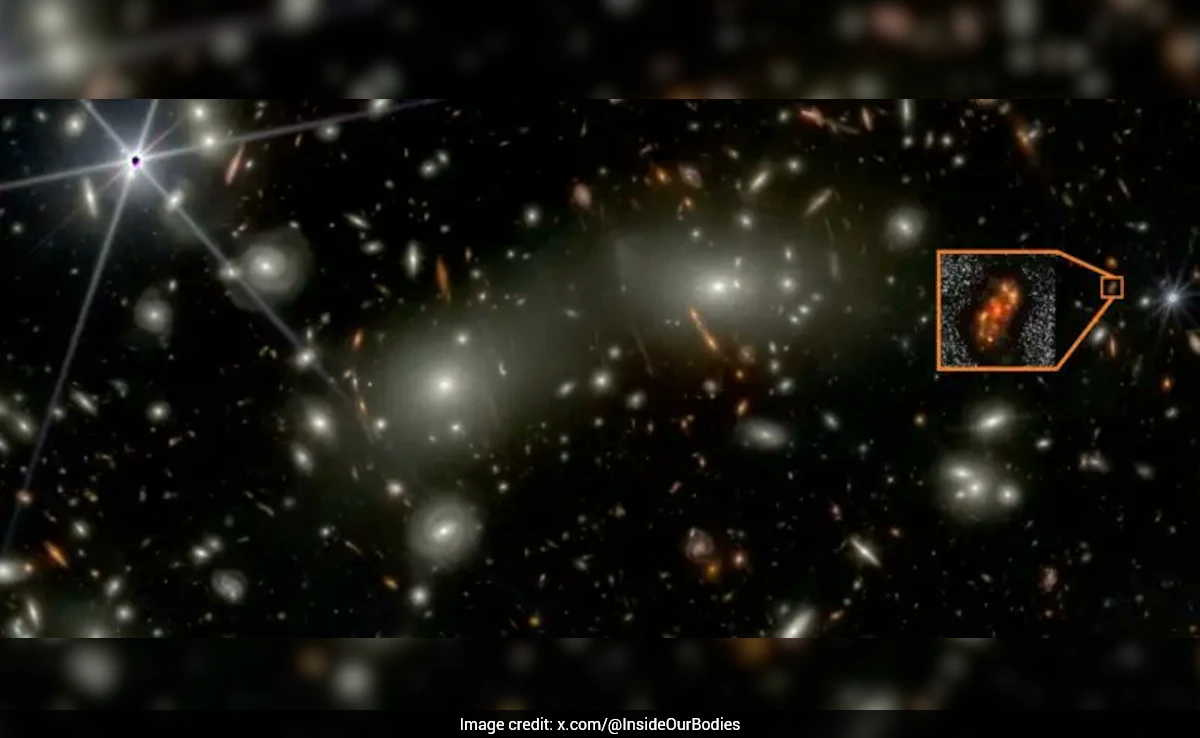
Indian scientists have discovered an ancient and massive galaxy called Alaknanda. It looks similar to our Milky Way galaxy and is special because it has clear spiral arms, even though it formed when the universe was only 1.5 billion years old. Today, the universe is 13.8 billion years old.
Announcing the discovery, Professor Yogesh Wadadekar at the National Centre for Radio Astrophysics of the Tata Institute of Fundamental Research (NCRA-TIFR) said, "This galaxy looks like a regular, well-structured system."
Such galaxies should take at least three billion years to develop stable spiral arms, he added, unlike the Milky Way, which took billions of years to form its spiral discs.
The discovery published in the European journal Astronomy & Astrophysics states that galaxies that formed this early were generally messy, small, and unstable, not having a clear shape. But the Alaknanda galaxy has classic spiral galaxies like ours with two clear, symmetric arms called a grand design spiral.
"The galaxy looks remarkably similar to our own Milky Way despite being present when the universe was only 10 per cent of its current age," said Rashi Jain, a PhD student who led this research under Wadadekar's guidance.
How was the name decided?
"Just as the Alaknanda is the sister river of the Mandakini river, which is also the Hindi name for our own Milky Way galaxy, we thought it fitting to name this distant spiral galaxy after the Alaknanda river," said Jain.
Why is Alaknanda different?
Both astronomers used the James Webb Space Telescope (JWST) to discover this Alaknanda galaxy, 12 billion light-years away and about 30,000 light-years across.
This is very surprising because it shows that complex and well-structured galaxies were forming much earlier in the universe than scientists expected, Jain said.
Scientists believed that stable spiral galaxies like the Milky Way could only appear several billion years later, after galaxies had time to cool down and settle into well-formed disks. But Alaknanda tells a different story.
According to Wadadekar, this galaxy managed to assemble 10 billion times the mass of the Sun in stars and form a large spiral-shaped disk in just a few hundred million years.
"Alaknanda reveals that the early Universe was capable of far more rapid galaxy assembly than we anticipated," he added.
Track Latest News Live on NDTV.com and get news updates from India and around the world


