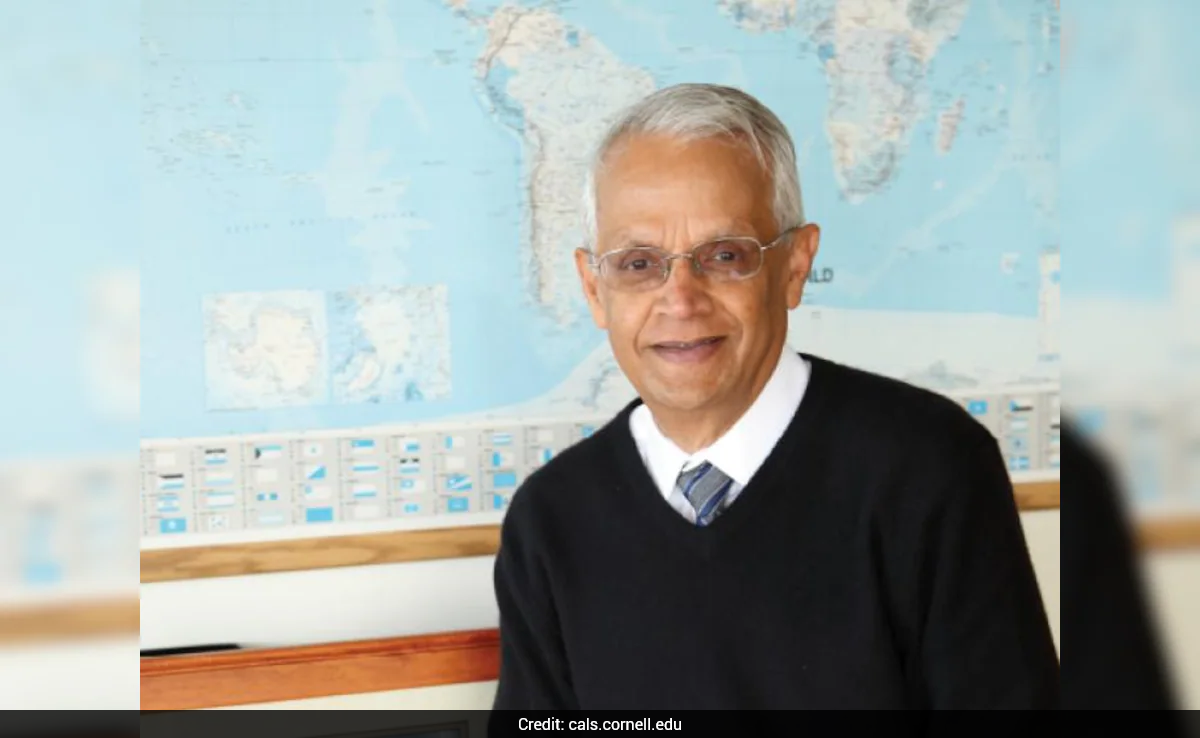
Indian-origin climate scientist Veerabhadran Ramanathan has been awarded the 2026 Crafoord Prize in Geosciences by the Royal Swedish Academy of Sciences.
Often described as the “Nobel of Geosciences,” the prize recognises Ramanathan's decades of research on super-pollutants and atmospheric brown clouds, which have reshaped understanding of global warming.
Ramanathan, 82, made a landmark discovery in 1975 while working at NASA: chlorofluorocarbons (CFCs), widely used in aerosols and refrigeration, trap heat in the atmosphere up to 10,000 times more effectively than carbon dioxide.
"Until 1975, we thought global warming was mainly from CO₂. I was shocked at the capacity of technology and human beings to change the environment," Ramanathan told the Royal Swedish Academy of Sciences.
Born in Madurai and raised in Chennai, Ramanathan began his career as an engineer in a refrigerator factory in Secunderabad, where he first handled CFCs.
He later earned degrees from Annamalai University and the Indian Institute of Science.
His Indian roots informed his work in the Indian Ocean Experiment (INDOEX), which identified atmospheric brown clouds over South Asia.
The study linked air pollution to a weakened Indian Monsoon and accelerated melting of Himalayan glaciers.
Now, a Distinguished Professor Emeritus at the Scripps Institution of Oceanography, University of California, San Diego, he has also advised global leaders and the Vatican on climate ethics.
The Crafoord Prize carries a cash award of 8 million Swedish kronor (approximately $900,000) and a gold medal. The award will be presented during Crafoord Days in Stockholm and Lund in May 2026.
Ramanathan's work underpins key international treaties, including the Montreal Protocol, which has prevented millions of tons of harmful emissions from entering the atmosphere.
(This story has not been edited by NDTV staff and is auto-generated from a syndicated feed.)
Track Latest News Live on NDTV.com and get news updates from India and around the world


