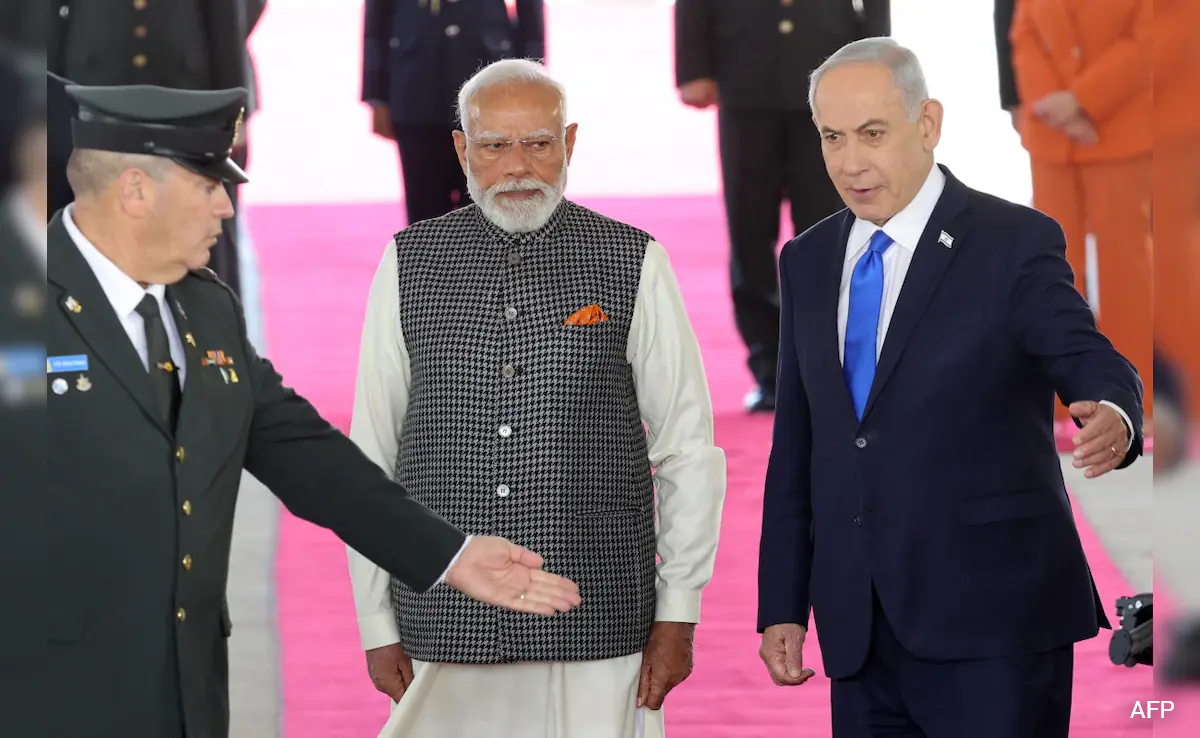
- Prime Minister Modi's visit to Israel highlights strong India-Israel relations and potential FTA progress
- Israeli minister sees India as a gateway to Asia and a key economic partner for Israel
- India-Middle East-Europe Economic Corridor aims to enhance regional trade, energy, and data links
As Prime Minister Narendra Modi began his two-day visit to Israel, Israeli Economy and Industry Minister Nir Barkat struck an upbeat, candid note in an exclusive interview with NDTV, calling India "a gateway to Asia" and predicting that a long-awaited India-Israel Free Trade Agreement could be clinched sooner than expected.
"Oh, it's really exciting. All of Israel, we love India. We love the Indian people. We love the people-to-people relationship," Barkat said, underscoring the warmth that has come to define ties between the two democracies. He pointed to the personal rapport between Prime Minister Modi and Israeli Prime Minister Benjamin Netanyahu as a force multiplier. "The fact that Prime Minister Netanyahu and Prime Minister Modi get along so well--that matters," he said.
Fast-Tracking The FTA
On the trade front, Barkat revealed that negotiations are firmly on the "fast track." "We have a mission from Israel in India negotiating the free trade agreement between us," he said, adding that momentum picked up after India's Commerce and Industry Minister Piyush Goyal visited Israel late last year.
"We really understood that we want to move on the fast track...We want to make something significant as soon as this year. And I believe it's possible."
Pressed on timelines amid India's expanding trade footprint--from interim arrangements with the US to deals with the UK, New Zealand and Oman--Barkat remained optimistic. "Hopefully so," he said of a 2026 target, before adding with a smile, "This puzzle thing is possible."
Why India Matters To Israel
Asked why India's economy is so critical for Israel, Barkat framed the relationship as deeply complementary. "What we do--we're innovative, we have new ideas, cutting-edge technology--but we're 10 million people," he said. "So it's difficult for us to scale to the magnitude that India knows how to do."
India's size and trajectory, he argued, complete the picture. "India today is becoming the third largest economy... 1.4 billion people. We view India as a gateway to Asia--that's 59 per cent of the world population."
"We are out-of-the-box thinkers, but we need to get in the box, right? And India is the box," he added.
IMEC: Beyond A Corridor
The India-Middle East-Europe Economic Corridor (IMEC), announced at the G20 and stalled by regional conflict, also featured prominently. With a ceasefire holding, Barkat said the vision could now move from concept to execution. "First of all, it's a beautiful vision. And I believe now that there's an opportunity to fulfil that vision."
IMEC, he stressed, is "not just a corridor...It's for energy, for information and data, transportation--way over and beyond just a little corridor." Israel, he said, is planning its gateways--from the Haifa port toward Europe and eastern links toward Jordan and Iraq--while acknowledging that "additional steps with the Saudis and Iraq" will be needed.
Haifa, Adani And Infrastructure
On Indian investment in Israel, Barkat welcomed the Adani Group's stewardship of the Haifa port. "Adani was very smart. We know that they own a lot of the ports in India. Now he owns one of the ports that we have in Haifa," he said. "We're here to help them succeed," Barkat added, signalling openness to more Indian bids in Israeli infrastructure. "I'm committed to helping Indian companies succeed in Israel."
'Tough Negotiators' And Ancient Ties
The minister shared a lighter moment about negotiating styles. Calling Goyal "tough on the outside, but really soft on the inside," Barkat said the two sides have "cracked how to make this work together." He also invoked shared civilisational roots. "We're two ancient people--thousands of years of history... We're also challenged by terror. We're so alike in many, many ways."
Make In India--And Defence
On manufacturing and defence cooperation, Barkat was clear that scale dictates strategy. "You're 150 times larger than Israel. We cannot produce large products and ship them to India. It doesn't make sense," he said, advocating joint ventures and local production. "If you've got big products to market, then it makes sense to go and make in India."
Asked directly about defence cooperation and the possibility of manufacturing systems like Iron Dome in India, Barkat was careful but open. "There are talks all across all sectors -- defence, economy, culture, friendship," he said. "If you're talking about a huge amount of products, then yes, it makes sense to have production in India."
Summing up Israel's priorities, Barkat said, "Side by side with what we're doing with the Americans, my highest priority is making sure that Piyush Goyal and Prime Minister Modi are happy with the relationship with Israel."
As Prime Minister Modi's visit approaches, the message from Jerusalem is clear: India is not just a partner, but a central pillar in Israel's economic and strategic future.
Track Latest News Live on NDTV.com and get news updates from India and around the world


