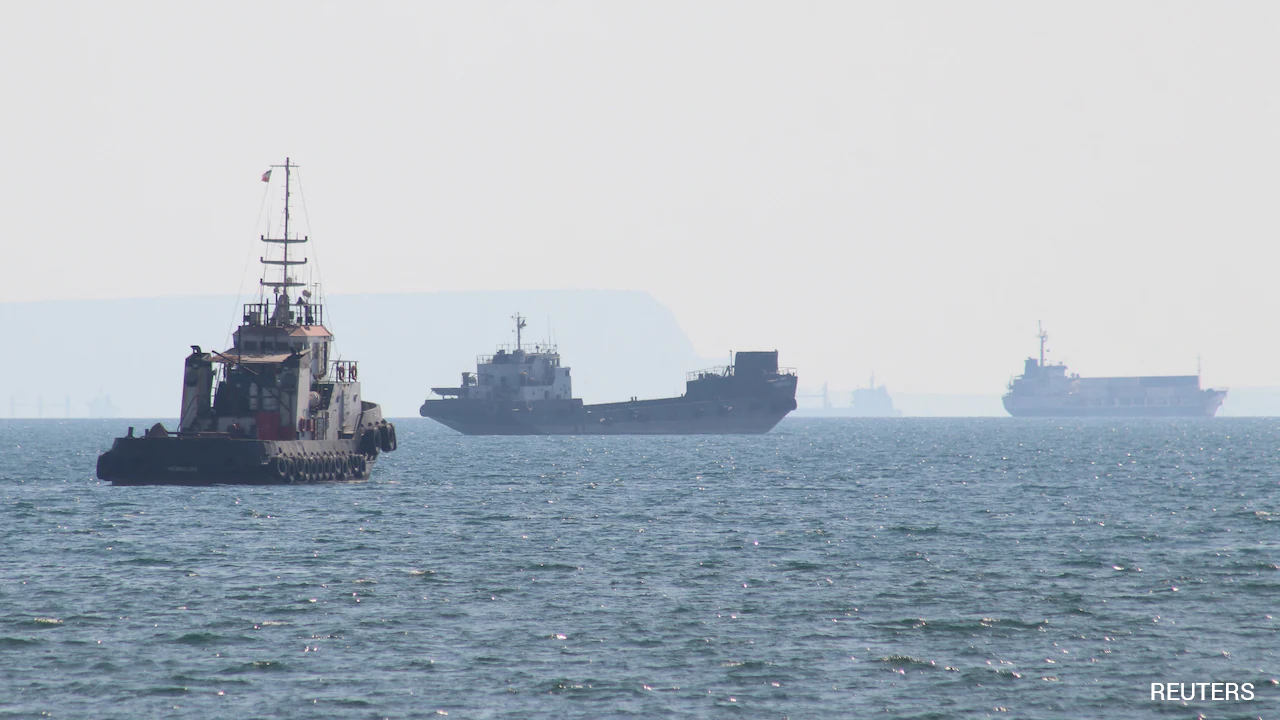
India has called for an immediate end to attacks on commercial shipping and seafarers in the Black Sea, stressing that safe navigation through international waterways must be restored at the earliest amid the ongoing Russia-Ukraine conflict.
Addressing a high-level briefing at the United Nations Security Council on Monday (local time), India's Permanent Representative to the UN, Ambassador Harish Parvathaneni, said the ongoing conflict, now in its fifth year, had far-reaching consequences because of interconnected global supply chains. He reiterated India's readiness to contribute to all efforts towards a peaceful resolution.
"The world has become inextricably interconnected. It is impossible that the implications of the conflict, that is in its fifth year now, would not be felt everywhere, given our interwoven supply chains. And India has been on record, conveying at the highest level that we are ready to contribute to all efforts towards a peaceful resolution. Every day of the war pushes humanity backwards. As Prime Minister Narendra Modi has noted, the world has to move from 'endless war to the end of war'," Parvathaneni said.
Highlighting the impact of the conflict on global food security, he said armed conflicts disrupted agriculture, displaced communities, damaged infrastructure and hindered humanitarian access, with their consequences extending to energy, fertiliser, transport and agricultural trade.
"Any conflict exacerbates food insecurity by disrupting agriculture, displacing communities, damaging infrastructure and hindering humanitarian access. Its consequences extend globally through disruptions to energy, fertiliser, transport and agricultural trade, disproportionately impacting the Global South," he said.
Parvathaneni said the Security Council must prioritise humanitarian access, the protection of civilian infrastructure and freedom of navigation to ensure that humanitarian supplies and legitimate trade were not affected.
He highlighted the importance of the Black Sea region to global food security, noting that the region and India together accounted for almost a fifth of global cereal production. Russia and Ukraine together accounted for nearly a quarter of global exports of wheat, maize and barley.
"My country's commitment to protection of Black Sea lifelines of global food supply is rooted in the appreciation that this region, just like my nation, is one of the food baskets of the world. The granaries of the Black Sea region and India combined account for almost a fifth of the global cereal production. In terms of cereal exports, the region is even more significant. Russia and Ukraine together account for almost a quarter of global exports of wheat, maize and barley," the envoy said.
He also highlighted India's humanitarian assistance to countries facing food insecurity, citing wheat supplies to Afghanistan, rice to Sudan and humanitarian aid to Palestine.
The Indian envoy said the Global South was disproportionately affected by food, fuel and fertiliser crises arising from global conflicts. He stressed that uninterrupted commercial shipping and the movement of essential supplies were particularly important for countries with limited capacity to absorb disruptions.
"India has consistently emphasised that the costs of conflict are not shared equally. Global South countries are the most adversely affected by the food, fuel and fertiliser crisis caused by today's global conflicts. That concern has sharpened as the Global South is also bearing the brunt of energy shortages. India's External Affairs Minister, Dr S Jaishankar, noted at the G20 FMM last month that fertiliser shortages stem partly from the Black Sea and partly from the Gulf and Red Sea. For India, this is why dialogue and diplomacy, safe commercial shipping, and uninterrupted grain and energy flows are practical necessities," Parvathaneni said.
Recalling the Bengal famine of 1943, which killed more than three million people in India, he said the tragedy demonstrated how distant conflicts and wartime priorities could have devastating human consequences.
"The pain and suffering caused by the devastating Bengal famine of 1943 in India that killed over 3 million people in India is a stark reminder of the terrible human cost of a distant conflict caused by unchecked wartime priorities and calculations," he said.
Raising concerns over attacks on merchant vessels in the Black Sea, Parvathaneni referred to incidents involving four ships and the loss of Indian lives.
"In the Black Sea, the MV Omorfi was attacked on 18 July, and an Indian crew member lost his life. In October, three Indian nationals were aboard the MV Royad Mammadov when it came under attack. Additionally, two more ships, MV Golden Leo and MV AGN RAGNAR, were struck, resulting in four (04) dead and two (02) missing Indian seafarers," he said.
He thanked partner countries for their assistance in repatriating Indian seafarers from attacked vessels and providing care to those who had sustained injuries.
"We call for an end to the targeting of commercial shipping and seafarers and for safe navigation through international waterways to be restored at the earliest," Parvathaneni said.
He also highlighted India's efforts to strengthen international cooperation on maritime safety, noting that India and Liberia had launched the Group of Friends on Safety and Security of Shipping and Seafarers at the United Nations during the high-level week earlier this month.
The voluntary mechanism supports the International Maritime Organisation (IMO) and the International Labour Organisation (ILO) in addressing the safety and security of commercial shipping and seafarers.
Emphasising India's direct engagement on the issue, the envoy said New Delhi was working with both sides on the safety of shipping and seafarers in the Black Sea and grain export corridors.
"India is moving beyond advocacy and engaging both sides directly on the safety of shipping and seafarers in the Black Sea and grain export corridors. Our leadership has reiterated support for an early end to the conflict and for an 'enduring peace'. My Prime Minister was firmly on the side of the Global South when he noted that 'this is not an era of war'. For the Global South, peace is not in the abstract. It is achieved when hungry mouths are fed, when a ship reaches the port, and when a seafarer returns home safe," Parvathaneni said.
(Except for the headline, this story has not been edited by NDTV staff and is published from a syndicated feed.)
Track Latest News Live on NDTV.com and get news updates from India and around the world


