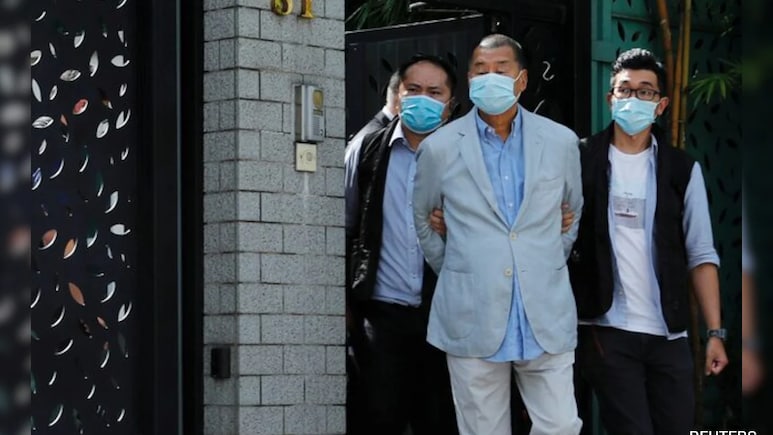
Jimmy Lai, the pro-democracy former Hong Kong media tycoon and a fierce critic of Beijing, was sentenced to 20 years in prison in one of the most prominent cases prosecuted under a China-imposed national security law that has virtually silenced the city's dissent.
Judge Esther Toh said 18 years of Lai's sentence should be served consecutively to his jail term in his fraud case, for which he received a jail term of five years and nine months. Lai can appeal his case. His co-defendants received jail terms between 6 years and 3 months and 10 years.
Three government-vetted judges spared the 78-year-old Lai the maximum penalty of life imprisonment on charges of conspiring with others to collude with foreign forces to endanger national security, and conspiracy to publish seditious articles. He was convicted in December. Given his age, the prison term still could keep him behind bars for the rest of his life.
As Lai entered the courtroom Monday morning, he waved and smiled at his supporters sitting in the public gallery. Hong Kong's outspoken Roman Catholic Cardinal Joseph Zen sat next to Lai's wife there.
The democracy advocate's arrest and trial have raised concerns about the decline of press freedom in what was once an Asian bastion of media independence. The government insists the case has nothing to do with a free press, saying the defendants used news reporting as a pretext for years to commit acts that harmed China and Hong Kong.
Lai was one of the first prominent figures to be arrested under the security law in 2020. Within a year, some of Apple Daily's senior journalists also were arrested. Police raids, prosecutions and a freeze of its assets forced the newspaper's closure in June 2021. The final edition sold a million copies.
Lai's sentencing could heighten Beijing's diplomatic tensions with foreign governments. His conviction has drawn criticism from the US and the UK
US President Donald Trump said he felt "so badly" after the verdict and noted he spoke to Chinese leader Xi Jinping about Lai and "asked to consider his release." British Prime Minister Keir Starmer's government also has called for the release of Lai, who is a British citizen.
Lai's daughter, Claire, told The Associated Press that she hopes authorities see the wisdom in releasing her father, a Roman Catholic. She said their faith rests in God. "We will never stop fighting until he is free," she said.
Lai founded Apple Daily, a now-defunct newspaper known for its critical reports against the governments in Hong Kong and Beijing. He was arrested in August 2020 under the security law that was used in a yearslong crackdown on many of Hong Kong's leading activists.
During his 156-day trial, prosecutors accused him of conspiring with six former Apple Daily staffers, two activists and others to request foreign forces to impose sanctions or blockades or engage in other hostile activities against Hong Kong or China. Lai testified for 52 days in his own defense, arguing he had not called for foreign sanctions after the law's introduction.
In December, the judges ruled Lai was the mastermind of the conspiracies and never wavered in his intention to destabilize the ruling Chinese Communist Party. They took issue with what they called his "constant invitation" to the United States to bring down the Chinese government with the excuse of helping Hong Kongers.
Urania Chiu, lecturer in law at Oxford Brookes University, said the case is significant for its broad construction of seditious intent and application of the term "collusion with foreign forces" to certain activities by the media. The implication is particularly alarming for journalists and those working in academia, she said.
"Offering and publishing legitimate critiques of the state, which often involves engagement with international platforms and audiences, may now easily be construed as 'collusion,'" Chiu said.
Lai is serving a nearly six-year prison term over fraud allegations in a separate case and has been in custody for more than five years. In January, lawyer Robert Pang said Lai suffered health issues including heart palpitations, high blood pressure and diabetes. Although Lai's condition was not life-threatening, Pang argued his client's health, age and solitary confinement, which the prosecution said Lai requested, would make his sentence "more burdensome."
The prosecution said a medical report noted Lai's general health condition remained stable.
The former Apple Dailly staffers and activists involved in Lai's case entered guilty pleas, which could help reduce their sentences to be handed down Monday. Under the security law, reporting on offenses committed by others may result in reduced penalties and some of the staff members served as prosecution witnesses.
The convicted journalists are publisher Cheung Kim-hung, associate publisher Chan Pui-man, editor-in-chief Ryan Law, executive editor-in-chief Lam Man-chung, executive editor-in-chief responsible for English news Fung Wai-kong and editorial writer Yeung Ching-kee.
The two activists convicted in the case, Andy Li and Chan Tsz-wah, also testified for the prosecution.
Before sunrise, dozens of people were in line outside the court building to secure a seat in the courtroom.
Former Apple Daily employee Tammy Cheung said she could only support them spiritually by seeing them. Cheung hopes the defendants will be released from prison soon, saying it would be great if they could reunite with their families before the Lunar New Year next week.
"Whatever happens, it's an end - at least we'll know the outcome," she said.
Lai founded Apple Daily in 1995, two years before Hong Kong returned to Chinese rule after 156 years as a British colony. The publication drew a strong following with reports that were occasionally sensational, investigative scoops and short, animated video reports. Articles supporting the city's democracy movement, including anti-government protests that rocked the city in 2019, attracted many pro-democracy readers.
In 2022, Hong Kong plunged 68 places to 148th out of 180 territories in the press-freedom index compiled by media freedom organization Reporters Without Borders. The city's latest ranking was 140th, far from 18th place in 2002.
(Except for the headline, this story has not been edited by NDTV staff and is published from a syndicated feed.)
Track Latest News Live on NDTV.com and get news updates from India and around the world


