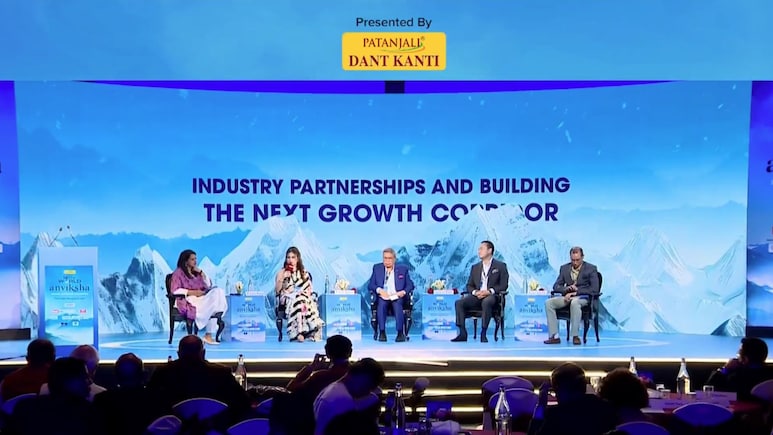
India and Nepal can scale up economic partnership in several sectors, according to industry leaders at a panel discussion on NDTV's Anviksha event. The discussion focused on the topic, "Nepal-India Industry Partnership: Building the Next Growth Corridor."
At the event, Vidushi Rana, Member of Nepal's Parliament and Director of Branding and Marketing at Goldstar Shoes, highlighted the historic and cultural ties between the two countries. She claimed that trade with India was Nepal's "biggest economic opportunity" as the two countries share an over 1,700 km-long open border.
NDTV World today launched its new dialogue series, "NDTV Anviksha: Ideas Across Borders".
India And Nepal Can "Co-Produce" Things
Rana said that enormous opportunities exist in IT, tourism, hospitality and agroprocessing, but standardisation and certifications remain a big concern. She asked for easier processing of Bureau of Indian Standards (BIS) certifications.
Rana was optimistic that India and Nepal can co-produce things together. She said, "India brings scale, capital, digital economy and all of that and Nepal also brings a young population, cheaper labour and clean energy. If we combine these things, we are not just trade partners, we become business partners who co-produce things."
She cited Britannia and Haldiram's as companies that were manufacturing products in Nepal.
#NDTVWorldAnviksha | Nepal-India Industry Partnership: Building the Next Growth Corridor
— NDTV (@ndtv) August 27, 2026
On the panel with @manogyaloiwal: Vidushi Rana, Kamlesh Agrawal, Ujjwal Kumar Shrestha, Paras Kharel pic.twitter.com/CuL7e9IaOF
India-Nepal Can Create "Integrated" Ecosystem
Kamlesh Agarwal, the President of the Nepal Chamber of Commerce, said that India and Nepal are "complementary economies" who are "well-positioned to create an integrated manufacturing, logistics, energy and technology ecosystem."
According to Agarwal, under the South Asian Free Trade Area (SAFTA) agreement, Nepal is exporting products such as soybean oil and importing several items as well. However, he claimed that to develop economic corridors, there is a need to facilitate duty-free access in both countries.
"If we go on an unified, economic integrated system, with India giving priority to Nepal and Nepal to India, then we can develop this economic corridor," he stated.
Ujjwal Kumar Shrestha, Executive Director, Panchakanya Group, said that energy partnerships can be increased between India and Nepal when it comes to electricity and hydropower. He also cited Nepal's youth population or its Gen-Z as a strength, especially in the IT sector.
"We have already surpassed a billion dollars of IT back office work from Nepal, and it's very scalable. That's where the Gen Z population is coming in." He said that the sector could be pivotal to both countries, and many Indian IT firms can have their back offices in Nepal as well.
Paras Kharel, Executive Director of the South Asia Watch on Trade, Economics, and Environment (SAWTEE), said that there is an opportunity for Nepal to identify small sections within India's supply chain where it can fit in and increase exports. This can feed on to India's exports to the European Union and the US.
"Most of Nepal's exports are SMEs, including those that cater to the Indian market," Kharel said, adding that there is potential to scale up there.
He called on the Indian and Nepalese governments for more certainty on non-tariff measures such as certification issues.


