
China's swift growth and diversification of its nuclear capabilities have led to concerns that Beijing might engage in "nuclear blackmail" or even nuclear conflict with Western countries if they intervene in a Taiwan dispute, reminiscent of the warnings from the Kremlin during its incursion into Ukraine, as reported by Central News Agency (CNA).
During the military parade on September 3 in Tiananmen Square, China showcased three missiles capable of carrying nuclear payloads: the JL-1 air-launched ballistic missile, the JL-3 submarine-launched intercontinental missile, and the DF-61 surface-to-surface intercontinental missile.
-

-
 "High Inflation Is Like Tax On Everyone": RBI Governor At NDTV World Summit
-
 AI Agents To Outnumber Humans Soon? What Futurist Mike Walsh Told NDTV
-
 This Delhi Boy Has 3 Michelin Stars. His Heart Still Goes To Rajindar Da Dhaba
-
 Ashwini Vaishnaw Explains Semiconductor Complexity: 'Everything On This Tiny Nail'
-
 Indian-Branded Mobile Phones By October 23, 2028, Says Ashwini Vaishnaw
-
 AI Law In India Soon? What Ashwini Vaishnaw Said At NDTV World Summit
-
 'Need To Look At Next 10 Years': Bondada Chairperson To NDTV On Solar Energy
-
 World's 1st AI Actor Tilly Norwood Was Asked If She Knew Hindi. A Conversation Followed
-
 AI Law In India Soon? What Ashwini Vaishnaw Said At NDTV World Summit
-
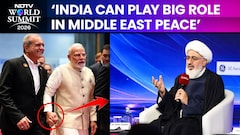 Iran's Supreme Leader's Representative Says India Can Play 'Big Role' In Middle East Peace
This threatening exhibition of what analysts characterise as a potential Chinese "nuclear triad", the capacity to launch nuclear weapons via air, land, and sea, has heightened alarms among democratic nations. Previously, China did not possess the capability to conduct airborne nuclear strikes, according to CNA's report.
Eric Heginbotham, a key research scientist at MIT's Security Studies Program, stated that China's advanced tactical nuclear arms, such as the DF-26, offer a "more credible" deterrence compared to its strategic weapons, which Washington might perceive as actually usable by Beijing in retaliation for a US tactical nuclear strike.
"This not only reduces US escalation dominance in overall capabilities but also equips [China] with more realistic options to respond proportionately against potential US use of tactical nuclear arms," Heginbotham noted, as cited by the CNA report.
Previously, China's solely strategic retaliatory options implied that any nuclear response to the US would equate to a "suicidal" act, given it would provoke a devastating US counterattack, resulting in massive casualties.
"All of this enhances China's capacity to engage in conventional warfare 'safely', with diminished fear of a US nuclear retaliation towards Taiwan," Heginbotham remarked.
Yang Tai-yuan, the chairman of the Secure Taiwan Associate Corporation, cautioned that these advancements could render the US less inclined to deploy forces in defence of Taiwan if a Chinese invasion occurs.
"The Chinese Communist Party may have drawn lessons on nuclear intimidation from Russia during the Ukraine conflict and could threaten to deploy tactical nuclear weapons against major powers that get involved in its regional disputes, including those in the Taiwan Strait," Yang indicated, as referenced by the CNA report.
If the US were to dispatch troops to support Taiwan, China might utilise its tactical nuclear arsenal to intimidate American forces present in the western Pacific, he mentioned.
"The US would probably take such threats seriously and assess its choices between deploying troops to the Taiwan Strait or limiting its reaction to diplomatic actions, such as showing support via the United Nations, to prevent direct conflict," he added, according to the CNA report.
(Except for the headline, this story has not been edited by NDTV staff and is published from a syndicated feed.)
Track Latest News Live on NDTV.com and get news updates from India and around the world


