- Muhammad Yunus-led government urges resistance to mob violence amid Bangladesh unrest
- Protesters torched media houses and Sheikh Hasina-linked sites following Sharif Osman Hadi's death
- Government condemns attacks on journalists and promises justice for targeted media workers
As unrest grips Bangladesh, the Muhammad Yunus-led interim government has urged people to resist acts of mob violence, warning that such actions threaten to derail the country's democratic process. Violence broke out in the South Asian nation after Sharif Osman Hadi, a radical youth leader of the country's 2024 pro-democracy uprising, died following an assassination attempt.
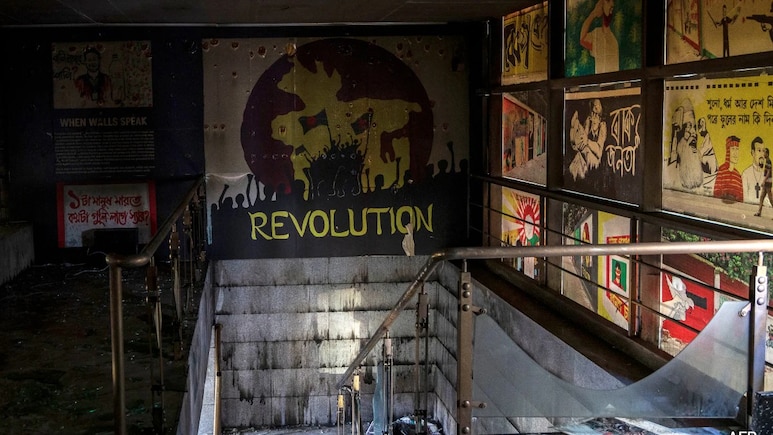
Thousands of protesters took to the streets of Dhaka and other cities, torching buildings of leading media houses and premises linked to former premier Sheikh Hasina, including her father Sheikh Mujibur Rahman's house, 32 Dhanmandi.
What the Statement Said
In a statement, the Yunus government said it "strongly and unequivocally" condemns all forms of violence, intimidation, arson and destruction of property and urges all citizens of Bangladesh to resist all forms of mob violence, which it said was committed by a few fringe elements.
"This is a critical moment in our country's history. We cannot and must not allow it to be derailed by those few who thrive on chaos and reject peace," it said, highlighting the nation's ongoing democratic transition.
The government also expressed solidarity with journalists targeted by mobs and said, "To the journalists of The Daily Star, Prothom Alo, and New Age: we stand with you. We are deeply sorry for the terror and violence you have endured."
"The nation has witnessed your courage and tolerance in the face of terror. Attacks on journalists are attacks on truth itself. We promise you full justice," it said.
Highlighting the nation's ongoing democratic transition, the statement said, "This is a critical moment in our country's history. We cannot and must not allow it to be derailed by those few who thrive on chaos and reject peace."
The government also stressed the significance of the upcoming elections and referendum, calling them "not merely political exercises, but a solemn national commitment."
Labelling Hadi a martyr, it added, "This promise is inseparable from the dream for which Shaheed Sharif Osman Hadi gave his life. Honouring his sacrifice demands restraint, responsibility, and a firm commitment to reject hatred."
The statement also condemned a recent lynching of a Hindu man in Mymensingh, saying, "There is no space for such violence in the new Bangladesh. The perpetrators of this heinous crime will not be spared."
"We wholeheartedly condemn the lynching of a Hindu man in Mymensingh. There is no space for such violence in the new Bangladesh. The perpetrators of this heinous crime will not be spared, the statement said.
"At this critical hour, we call upon every citizen to honour Saheed Hadi by rejecting and resisting violence, incitement and hatred," it added.
Why Journalists Are On Mob's Target
Witnesses and media reports said hundreds of protesters took to the streets of Dhaka immediately after the news of Hadi's death, rallying on Shahbagh Square near the Dhaka University campus, where many chanted slogans such as 'Allahu Akbar', or 'God is great' in Arabic. There were also similar protests elsewhere in the country.
Later, a group of protesters gathered outside the head office of the country's leading Bengali-language daily, Prothom Alo, in Dhaka's Karwan Bazar area. They then surged into the building, vandalised it and set fire to it, according to online portals of various leading media outlets.
A few hundred yards away, another group of protesters pushed into the premises of the country's leading English-language Daily Star and set fire to the building, according to footage from Kaler Kantha, another mainstream newspaper.
Soldiers and paramilitary border guards deployed outside the two buildings but did not take any action to disperse the protesters. Security officials tried to convince them to leave peacefully as firefighters arrived at the scene outside the Daily Star building.
The blaze trapped the newspaper's staff working inside the building late Thursday. One of the Daily Star's journalists, Zyma Islam, wrote on Facebook that she was inside the building.
By early Friday, the fire was brought under control. Both dailies stopped updating their online editions after the attacks, and they did not publish broadsheets on Friday.
At the Prothom Alo, executive editor Sajjad Sharif said he was "deeply saddened" that the newspaper could not be published due to vandalism and arson.
"This attack is not merely an attack on Prothom Alo and the Daily Star, it's an attack on freedom of the press, expression, dissent and diversity of opinion," he said.
Critics of the papers, the largest in the South Asian country, accuse them of favouring neighbouring India, where Bangladesh's ousted prime minister Sheikh Hasina has taken refuge since quitting in 2024.
Rise Of Anti-India Sentiment In Bangladesh
Hadi was a fierce critic of both India and former Prime Minister Sheikh Hasina, whose 15-year rule of Bangladesh ended in last year's uprising.
The Inqilab Moncho group, formed after the ouster of Hasina last year, has been organising street protests and campaigns denouncing Hasina and India. The country's Islamists and other Hasina opponents have blamed her government for being subservient to India during her rule.
Hadi had planned to run as an independent candidate in a major constituency in Dhaka in the next national elections, which the country's interim government has announced for February.
Since Hasina's ouster, the Inqilab Moncho group has promoted anti-Indian sentiment in the Muslim-majority country, under the nose of the Yunus government, which has been accused of giving free rein to radical voices.
Attempts are also being made in Bangladesh to pass off the murder as one which was carried out by pro-India elements, despite India's strong objection to the narrative. In Chattogram, stone pelting was reported at the Deputy High Commission's office as well as the residence. Videos are in circulation that show the radical elements at work.
In Dhaka, a radical group attempted to march to the Indian High Commission. They broke through the barricades, raised anti-India slogans and issued threats. They were, however, contained by the police.
Track Latest News Live on NDTV.com and get news updates from India and around the world


