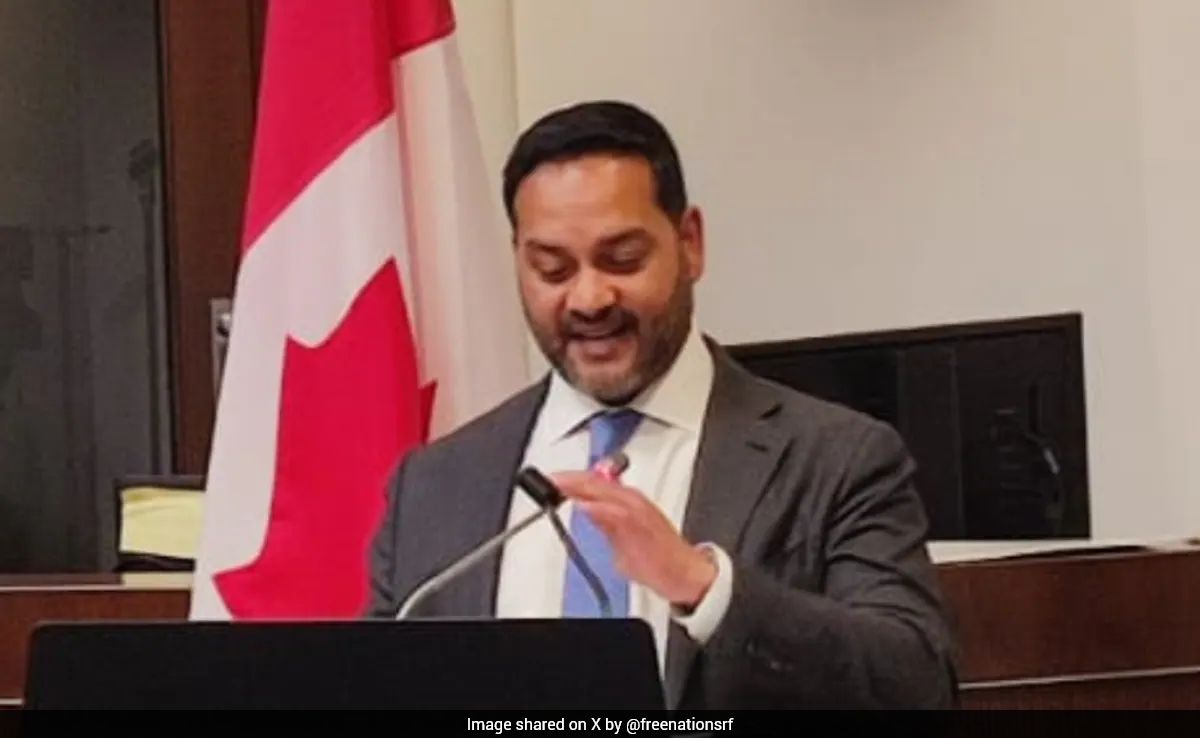
- A Canadian MP slamed Bangladesh's interim government for rising violence against minorities, especially Hindus
- The MP condemned the brutal lynching of Dipu Chandra Das and the failure of state institutions to act
- Violence has escalated since Sheikh Hasina's ouster, targeting Awami League supporters and minorities
A Canadian lawmaker has issued a stinging indictment of the Muhammad Yunus-led Bangladesh interim government, warning that the country is facing a grave breakdown of law and order as violence against minority communities -- particularly Hindus -- continues to escalate, even a year after the political transition that followed the ouster of former Prime Minister Sheikh Hasina.
Speaking to NDTV's Aditya Raj Kaul, Shuvaloy Majumdar, Member of Parliament from Calgary Heritage and Vice Chair of Canada's International Human Rights Subcommittee, described recent visuals of mob violence in Bangladesh as "absolutely horrific" and reflective of a deeper moral and institutional collapse.
Majumdar was reacting to the lynching of Dipu Chandra Das, an incident that surfaced widely on social media. He said the brutality – where the victim's body was desecrated and set on fire – represented "a different level of horror, a different level of evil." He noted with concern that the victim's family reportedly learnt of the killing through social media rather than law enforcement, underscoring the failure of state institutions.
The Canadian MP stressed that the violence was not an isolated episode. "Immediately after Sheikh Hasina was ousted, we saw widespread political violence against Awami League supporters, but also against minorities – Hindus, Christians, Ahmadis and Buddhists," he said.
According to Majumdar, instead of subsiding, the violence has continued over the past year and has now culminated in extreme acts such as public lynching.
Directing his remarks at Bangladesh's interim leadership under Chief Adviser Muhammad Yunus, Majumdar posed a blunt question: "Who's in charge?"
He argued that the interim authorities have had sufficient time to restore calm and establish a credible transition, but have failed to ensure equal citizenship and protection for all Bangladeshis. "If you're not in charge, then please advise who is, so the world can focus on accountability," he said.
On the prospect of elections, which Yunus recently told a US envoy would be held on time in February, Majumdar struck a cautious note. He said that without the rule of law and a clear acknowledgement of persecution faced by minorities, free and fair elections would be difficult. He also flagged concerns over the banning of the Awami League, one of Bangladesh's oldest political parties, calling the current environment "a very difficult one to have an election."
Majumdar linked the present crisis to what he termed "generational trauma" rooted in the events of 1971. He recalled mass displacement, killings and the use of sexual violence during Bangladesh's liberation war, arguing that unresolved extremism has continued to percolate beneath state institutions for decades. The recent surge in attacks, he said, represents a "recreation of what happened half a century ago."
The MP also expressed alarm over attacks on media houses, editors and liberal voices, warning that Bangladesh's secular fabric is under severe strain amid the resurgence of Islamist groups. "This is the test of Bangladesh today," he said, adding that fundamentalism had been "contained, not defeated," and is now re-emerging with dangerous consequences.
Calling for a stronger international response, Majumdar urged foreign governments, the media and the United Nations to stop equivocating and confront the ideological roots of the violence. "Every Bengali – Muslim, Hindu, Christian – will be imperilled if this continues," he warned.
Track Latest News Live on NDTV.com and get news updates from India and around the world


