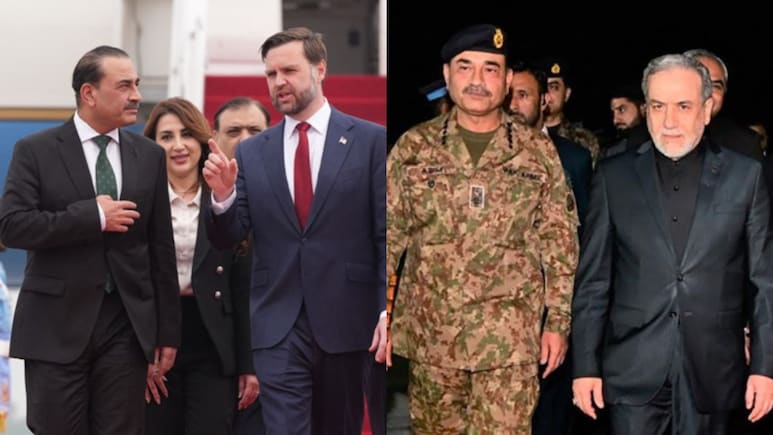
As the world closely watches the outcome of the Islamabad Talks between the US and Iran, Pakistan Army Chief Field Marshal Asim Munir's sartorial choices while receiving delegates from Tehran and Washington, DC have sparked a buzz.
US Vice President JD Vance has said the two sides had failed to reach an agreement to end the war in the Middle East, which has disrupted peace in the Gulf region, a global economic powerhouse, and sparked energy security concerns in Asian markets such as India and China. Iran's state media has blamed "unreasonable demands" by the US for the failure to reach a breakthrough. Pakistan has urged both countries to continue respecting the temporary truce.
Meanwhile, Asim Munir's dress choices have attracted attention. The Pakistani Field Marshal, who is known to have played a key role in getting the two sides to the negotiation table, wore his Army uniform while receiving the Iranian delegation, including Iranian Parliament Speaker Mohammad Bagher Ghalibaf and Foreign Affairs Minister Abbas Araghchi. Hours later, when he went to receive the US delegation, led by Vice President Vance, Munir was seen in a suit.
In diplomacy, decisions such as these are rarely taken on a whim. So, the suit-uniform difference has become a talking point as geopolitical experts point to the Pakistan Army chief's 'dress diplomacy'. It is also significant that it was Munir, and not Pakistani Prime Minister Shehbaz Sharif, who went to receive the foreign delegations ahead of the geopolitically significant dialogue. This clearly indicates that it is the Pakistani Army establishment, and not the political leadership, that has taken the lead in brokering peace in the Middle East.
Two Looks, Two Messages
When Munir received the Iranian delegation at the Nur Khan Air Base in Rawalpindi, he was dressed in his Field Marshal's uniform, complete with his medals and stars. The messaging was clear: the Pakistani Army chief wanted to project his military authority. This is significant against the backdrop of border disputes between Tehran and Islamabad. Munir donning his combat uniform while receiving the Iranian delegation is a message of strength.
With the US, the equations are different. Munir's choice of a formal suit is being seen as a move to project balance and statesmanship as Pakistan mediates a dialogue the world has its eyes on. US President Donald Trump has earlier praised Munir as his "favourite Field Marshal" and his representation of Pakistan, along with his choice of dress, are signicant.
What Experts Said
Major General Ashok Kumar (retd) told NDTV that Munir's sartorial choices convey different messages to Iran and the US. A formal suit is to communicate to Washington DC that he represents both Pakistan's civil and military leadership, he said. "On the other hand, Munir's decision to wear his Army uniform while receiving the Iranian delegation could be interpreted as an awareness that it is the Islamic Revolutionary Guard Corps, not Iran's political leadership, that is calling the shots in the ongoing conflict. Against the backdrop, the Army fatigue represents a military-to-military engagement," he said.
Former diplomat Yogesh Gupta said Munir's combat uniform while receiving the Iranian delegation is an assertion of his military authority, while his choice of suit when meeting the US team was to stress the depth of Islamabad-Washington ties.
Experts say Munir's sartorial choices are unlikely to have an impact on the outcome of the talks, but they definitely send telling messages on the nature of Pakistan's relationship with Iran and the US.
Track Latest News Live on NDTV.com and get news updates from India and around the world


