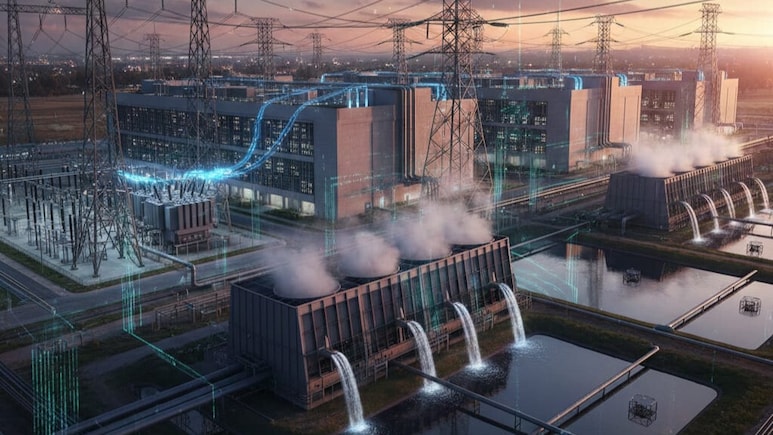
- AI systems generate billions of daily prompts, creating significant environmental impact
- Each AI prompt consumes about 0.34 watt-hours of electricity, similar to a LED bulb use
- Google's data centres used 6.1 billion gallons of water in 2023, mainly for cooling
What's in a prompt? More than you might think. As millions of people turn to artificial intelligence tools for everyday answers, the process often feels invisible - just a few keystrokes and a response appears. But behind every reply generated by systems from OpenAI or Google lies a vast physical infrastructure of data centres that consume electricity, use water for cooling and generate carbon emissions.
Also Read | From Polite Prompts To Power Grids: The Growing Debate Over AI's Energy Use
Individually, a single query may seem trivial. At scale, it is anything but. OpenAI recently said users send around 2.5 billion prompts every day to its AI systems - a number that highlights the environmental footprint of our growing dependence on artificial intelligence.
Estimates suggest each prompt uses about 0.34 watt-hours of electricity - roughly the energy required to power a standard LED bulb for two minutes. For an individual user, that can add up to around 6.8 watt-hours per day, depending on usage patterns.
The numbers become more striking when multiplied across millions. One million daily users would consume approximately 6,800 kilowatt-hours of electricity, enough to power about 225 homes in the United States for a day. At 100 million users, the figure rises to roughly 680,000 kilowatt-hours, equivalent to the daily consumption of around 22,000 households. With tens of millions of users in countries like India, the scale becomes easier to grasp.
Water consumption is another concern. Google's 2024 environmental report showed its data centres used 6.1 billion gallons of fresh water in 2023 - a 17% increase from the previous year - largely due to cooling requirements for high-performance computing infrastructure.
However, some experts argue that context matters. Speaking at an event organised by NDTV, AI pioneer Stuart Russell noted that while AI infrastructure consumes significant resources, other industries still use far more. For example, golf courses in the United States collectively consume hundreds of billions of gallons of water annually - far exceeding the global water use of AI data centres.
The comparison does not eliminate concerns, but it does highlight a broader reality: as AI adoption accelerates, understanding - and managing - its environmental cost will become increasingly important.
This is the reason why former UK Prime Minister Rishi Sunak drew attention to the energy demands of AI through a personal anecdote about his daughters' interactions with chatbots. Speaking to NDTV's Editor-in-Chief Rahul Kanwal, he said the girls often include polite phrases such as "please" and "thank you" in conversations with AI systems, which he advised against.
"It's polite, but it's not a person. And by the way, it takes up a lot of compute power, so better if you don't," Sunak said.


