Planet Orbits
- All
- News
-
NASA’s ESCAPADE Mission to Study Space Weather Between Earth and Mars
- Friday February 27, 2026
- Written by Gadgets 360 Staff
NASA’s ESCAPADE mission will send two identical orbiters to Mars to study how solar wind and space weather strip away the planet’s atmosphere. Launching in 2025 and arriving in 2027, the twin spacecraft will measure solar wind conditions and Mars’s atmospheric response simultaneously, helping scientists understand how the Red Planet lost its ...
-
www.gadgets360.com
-
Astronomers Discover "Inside-Out" Planetary System With Rocky World Beyond Gas Planets, Challenging Formation Theories
- Sunday February 15, 2026
- Science | Edited by Astitva Raj
Since the 1990s, scientists have discovered approximately 6,100 planets outside our solar system, called exoplanets.
-
www.ndtv.com
-
Astronomers Discover Massive Metal Cloud Orbiting Unknown Planet
- Saturday January 31, 2026
- Science | Edited by Astitva Raj
Analysis of the wind speed and direction revealed that the cloud is moving at a different speed from its host star, confirming that it is bound to an external secondary object.
-
www.ndtv.com
-
Scientists Discover 'Potentially Habitable' Earth-Like Planet Candidate
- Wednesday January 28, 2026
- Science | Edited by Srishti Singh Sisodia
If confirmed, this exoplanet would be the only known rocky world in the habitable zone of a Sun-like star.
-
www.ndtv.com
-
Kepler Data Reveals Earth-Size Exoplanet on the Edge of Its Star’s Habitable Zone
- Wednesday January 28, 2026
- Written by Gadgets 360 Staff
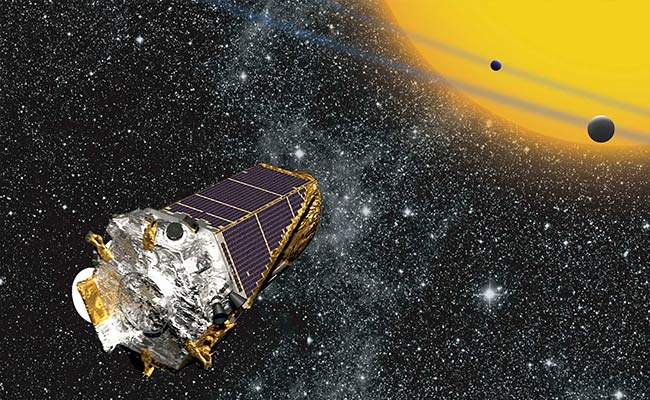
Scientists studying Kepler telescope data have identified HD 137010 b, a possible Earth-sized planet orbiting a Sun-like star. While the planet follows a year-long orbit and may sit near the habitable zone, limited starlight could leave it colder than Mars. Future observations will determine whether this icy world truly exists.
-
www.gadgets360.com
-
VLT’s GRAVITY Instrument Detects ‘Tug’ from Colossal Exomoon; Could Be Largest Natural Satellite Ever Found
- Saturday January 24, 2026
- Written by Gadgets 360 Staff
Astronomers have spotted a subtle orbital wobble around the massive exoplanet HD 206893 B, hinting at the presence of a gigantic moon nearly half Jupiter’s mass. If confirmed, it would be unlike any moon known, potentially redefining how scientists distinguish between moons, planets, and brown dwarfs.
-
www.gadgets360.com
-
Scientists Discover "Iron Bar" In Space That May Reveal Earth's Future
- Sunday January 18, 2026
- Science | Edited by Astitva Raj
The team said they plan to do further studies to find out what exactly this iron bar is, where it came from and what it indicates
-
www.ndtv.com
-
JWST Reveals Powerful Winds and Dense Atmosphere on Scorching Exoplanet TOI-561b
- Wednesday December 31, 2025
- Written by Gadgets 360 Staff
Astronomers using NASA’s James Webb Space Telescope have found compelling evidence that TOI-561b, an ultra-hot rocky exoplanet orbiting its star every 11 hours, still retains a dense atmosphere. Temperatures measured on both its day and night sides are far lower than expected for a bare rock, implying powerful winds and efficient heat transport. ...
-
www.gadgets360.com
-
NASA’s ESCAPADE Mission to Study Space Weather Between Earth and Mars
- Friday February 27, 2026
- Written by Gadgets 360 Staff
NASA’s ESCAPADE mission will send two identical orbiters to Mars to study how solar wind and space weather strip away the planet’s atmosphere. Launching in 2025 and arriving in 2027, the twin spacecraft will measure solar wind conditions and Mars’s atmospheric response simultaneously, helping scientists understand how the Red Planet lost its ...
-
www.gadgets360.com
-
Astronomers Discover "Inside-Out" Planetary System With Rocky World Beyond Gas Planets, Challenging Formation Theories
- Sunday February 15, 2026
- Science | Edited by Astitva Raj
Since the 1990s, scientists have discovered approximately 6,100 planets outside our solar system, called exoplanets.
-
www.ndtv.com
-
Astronomers Discover Massive Metal Cloud Orbiting Unknown Planet
- Saturday January 31, 2026
- Science | Edited by Astitva Raj
Analysis of the wind speed and direction revealed that the cloud is moving at a different speed from its host star, confirming that it is bound to an external secondary object.
-
www.ndtv.com
-
Scientists Discover 'Potentially Habitable' Earth-Like Planet Candidate
- Wednesday January 28, 2026
- Science | Edited by Srishti Singh Sisodia
If confirmed, this exoplanet would be the only known rocky world in the habitable zone of a Sun-like star.
-
www.ndtv.com
-
Kepler Data Reveals Earth-Size Exoplanet on the Edge of Its Star’s Habitable Zone
- Wednesday January 28, 2026
- Written by Gadgets 360 Staff
Scientists studying Kepler telescope data have identified HD 137010 b, a possible Earth-sized planet orbiting a Sun-like star. While the planet follows a year-long orbit and may sit near the habitable zone, limited starlight could leave it colder than Mars. Future observations will determine whether this icy world truly exists.
-
www.gadgets360.com
-
VLT’s GRAVITY Instrument Detects ‘Tug’ from Colossal Exomoon; Could Be Largest Natural Satellite Ever Found
- Saturday January 24, 2026
- Written by Gadgets 360 Staff
Astronomers have spotted a subtle orbital wobble around the massive exoplanet HD 206893 B, hinting at the presence of a gigantic moon nearly half Jupiter’s mass. If confirmed, it would be unlike any moon known, potentially redefining how scientists distinguish between moons, planets, and brown dwarfs.
-
www.gadgets360.com
-
Scientists Discover "Iron Bar" In Space That May Reveal Earth's Future
- Sunday January 18, 2026
- Science | Edited by Astitva Raj
The team said they plan to do further studies to find out what exactly this iron bar is, where it came from and what it indicates
-
www.ndtv.com
-
JWST Reveals Powerful Winds and Dense Atmosphere on Scorching Exoplanet TOI-561b
- Wednesday December 31, 2025
- Written by Gadgets 360 Staff
Astronomers using NASA’s James Webb Space Telescope have found compelling evidence that TOI-561b, an ultra-hot rocky exoplanet orbiting its star every 11 hours, still retains a dense atmosphere. Temperatures measured on both its day and night sides are far lower than expected for a bare rock, implying powerful winds and efficient heat transport. ...
-
www.gadgets360.com