


Auroral Lights
- All
- News
-
NASA’s GNEISS Mission Will Map Electric Currents Behind the Aurora
- Sunday February 8, 2026
- Written by Gadgets 360 Staff
NASA’s GNEISS mission will launch from Alaska in early 2026 to probe the electric currents that drive auroras. Two rockets will fly through glowing auroral arcs, releasing sub-payloads whose radio signals act like a CT scan. By mapping electron density and direction, scientists aim to improve space weather forecasting and better protect satellite...
-
www.gadgets360.com
-
Massive Coronal Hole on Sun Sends High-Speed Solar Wind Toward Earth
- Tuesday February 4, 2025
- Written by Gadgets 360 Staff
A giant 800,000 km coronal hole on the Sun is unleashing high-speed solar wind toward Earth, potentially triggering a G1 geomagnetic storm on January 31 and February 1. The NOAA has issued a watch, predicting enhanced auroras in higher latitudes. While G1 storms are minor, they can impact satellites and power grids. The storm’s intensity remains ...
-
www.gadgets360.com
-
Unusual White Streaks in Northern Lights Raise Questions About Atmospheric Phenomenon
- Friday January 31, 2025
- Written by Gadgets 360 Staff
White streaks have been observed weaving through the northern lights, presenting a new atmospheric puzzle. Captured by the TREx mission, these eerie white glows appear alongside traditional red and green auroras or in areas where colourful displays have faded. The phenomenon is not considered an aurora, but its emission pattern shares similarities ...
-
www.gadgets360.com
-
NASA's Dual Rocket Launch to Uncover Mysteries of Alaska's Auroras
- Tuesday January 28, 2025
- Written by Gadgets 360 Staff
NASA is set to launch two rockets from the Poker Flat Research Range in Alaska, aiming to study the aurora borealis. The missions will focus on flickering auroras and the mysterious dark patches known as "black auroras." Led by Marilia Samara and Robert Michell, the rockets will collect data on auroral behaviour and electron movement. Precision tim...
-
www.gadgets360.com
-
NASA Rockets Set to Journey Through Flickering, Disappearing Auroras
- Thursday January 23, 2025
- Written by Gadgets 360 Staff
NASA is set to launch two groundbreaking rocket missions in January 2025 to unravel the mysteries of auroras. The GIRAFF mission will study fast-pulsating and flickering auroras, while the Black and Diffuse Aurora Science Surveyor mission will focus on dark auroral patches or "black auroras." By using advanced instruments to measure electron activi...
-
www.gadgets360.com
-
AI Enhances Northern Lights Classification and Geomagnetic Storm Forecasting
- Friday January 10, 2025
- Written by Gadgets 360 Staff
A breakthrough in auroral research, powered by artificial intelligence, has allowed scientists to classify over 700 million auroral images. This effort, using NASA's THEMIS dataset, will significantly enhance the prediction of geomagnetic storms, which can disrupt Earth's communication and security systems. Led by the University of New Hampshire, t...
-
www.gadgets360.com
-
Massive Solar Flare Closes 2024 With Radio Blackouts and Auroral Possibilities
- Tuesday December 31, 2024
- Written by Gadgets 360 Staff
An X1.1-class solar flare on December 29, 2024, caused strong radio blackouts on Earth, marking another significant event in the increasingly active Solar Cycle 25. Detected by NOAA's GOES-16 satellite, the eruption raises questions about a potential coronal mass ejection, which could amplify auroras during New Year celebrations. While impactful, t...
-
www.gadgets360.com
-
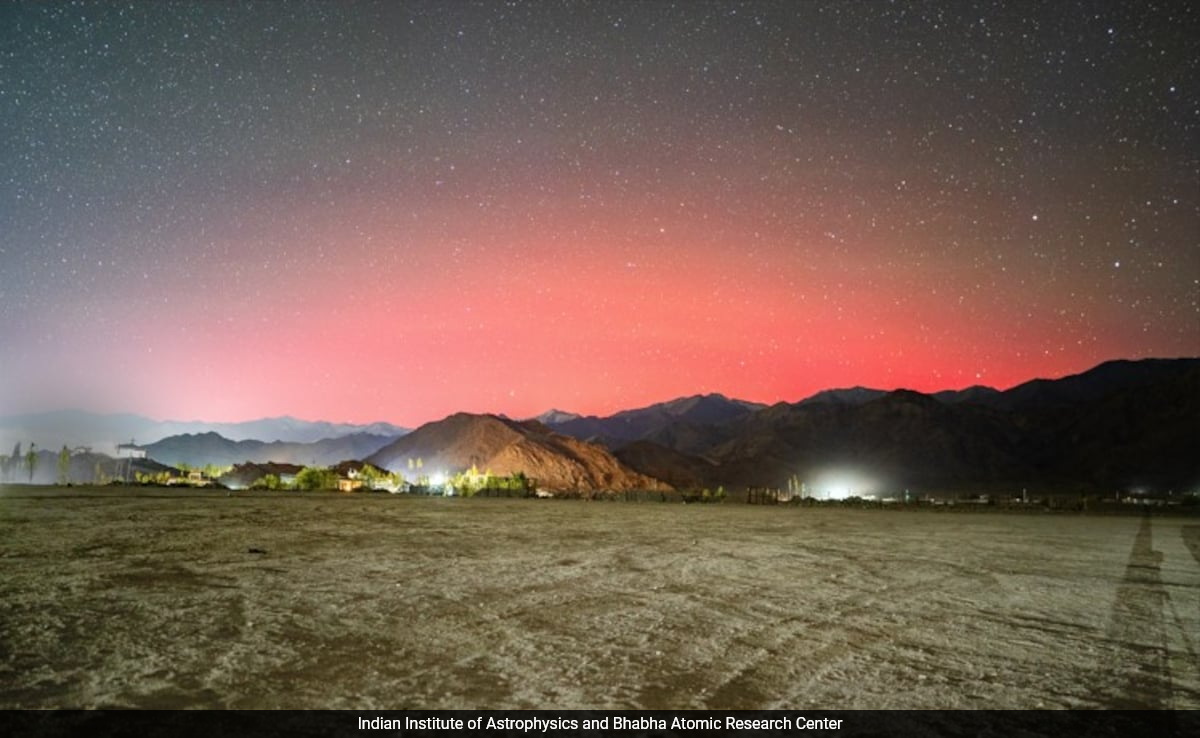
In Pics: Rare Celestial Lights Seen In Ladakh After Intense Solar Storms
- Friday October 11, 2024
- India News | Written by Pallava Bagla
Rare celestial lights are seen at Leh in Ladakh as the Sun is in an active phase, throwing out charged particles towards Earth in the form of an intense solar storm.
-
www.ndtv.com
-
Severe Solar Storm Warning: NOAA Predicts Auroras Across US, Possible Power Grid Impact
- Friday October 11, 2024
- Written by Gadgets 360 Staff
NOAA has issued a warning for a severe solar storm expected to hit Earth on October 10-11, 2024. This storm, classified as G4, is caused by a coronal mass ejection from the sun, travelling at nearly 2.9 million miles per hour. It has the potential to disrupt power grids, radio communications, and satellites. Additionally, the storm could enhance au...
-
www.gadgets360.com
-
NASA’s GNEISS Mission Will Map Electric Currents Behind the Aurora
- Sunday February 8, 2026
- Written by Gadgets 360 Staff
NASA’s GNEISS mission will launch from Alaska in early 2026 to probe the electric currents that drive auroras. Two rockets will fly through glowing auroral arcs, releasing sub-payloads whose radio signals act like a CT scan. By mapping electron density and direction, scientists aim to improve space weather forecasting and better protect satellite...
-
www.gadgets360.com
-
Massive Coronal Hole on Sun Sends High-Speed Solar Wind Toward Earth
- Tuesday February 4, 2025
- Written by Gadgets 360 Staff
A giant 800,000 km coronal hole on the Sun is unleashing high-speed solar wind toward Earth, potentially triggering a G1 geomagnetic storm on January 31 and February 1. The NOAA has issued a watch, predicting enhanced auroras in higher latitudes. While G1 storms are minor, they can impact satellites and power grids. The storm’s intensity remains ...
-
www.gadgets360.com
-
Unusual White Streaks in Northern Lights Raise Questions About Atmospheric Phenomenon
- Friday January 31, 2025
- Written by Gadgets 360 Staff
White streaks have been observed weaving through the northern lights, presenting a new atmospheric puzzle. Captured by the TREx mission, these eerie white glows appear alongside traditional red and green auroras or in areas where colourful displays have faded. The phenomenon is not considered an aurora, but its emission pattern shares similarities ...
-
www.gadgets360.com
-
NASA's Dual Rocket Launch to Uncover Mysteries of Alaska's Auroras
- Tuesday January 28, 2025
- Written by Gadgets 360 Staff
NASA is set to launch two rockets from the Poker Flat Research Range in Alaska, aiming to study the aurora borealis. The missions will focus on flickering auroras and the mysterious dark patches known as "black auroras." Led by Marilia Samara and Robert Michell, the rockets will collect data on auroral behaviour and electron movement. Precision tim...
-
www.gadgets360.com
-
NASA Rockets Set to Journey Through Flickering, Disappearing Auroras
- Thursday January 23, 2025
- Written by Gadgets 360 Staff
NASA is set to launch two groundbreaking rocket missions in January 2025 to unravel the mysteries of auroras. The GIRAFF mission will study fast-pulsating and flickering auroras, while the Black and Diffuse Aurora Science Surveyor mission will focus on dark auroral patches or "black auroras." By using advanced instruments to measure electron activi...
-
www.gadgets360.com
-
AI Enhances Northern Lights Classification and Geomagnetic Storm Forecasting
- Friday January 10, 2025
- Written by Gadgets 360 Staff
A breakthrough in auroral research, powered by artificial intelligence, has allowed scientists to classify over 700 million auroral images. This effort, using NASA's THEMIS dataset, will significantly enhance the prediction of geomagnetic storms, which can disrupt Earth's communication and security systems. Led by the University of New Hampshire, t...
-
www.gadgets360.com
-
Massive Solar Flare Closes 2024 With Radio Blackouts and Auroral Possibilities
- Tuesday December 31, 2024
- Written by Gadgets 360 Staff
An X1.1-class solar flare on December 29, 2024, caused strong radio blackouts on Earth, marking another significant event in the increasingly active Solar Cycle 25. Detected by NOAA's GOES-16 satellite, the eruption raises questions about a potential coronal mass ejection, which could amplify auroras during New Year celebrations. While impactful, t...
-
www.gadgets360.com
-
In Pics: Rare Celestial Lights Seen In Ladakh After Intense Solar Storms
- Friday October 11, 2024
- India News | Written by Pallava Bagla
Rare celestial lights are seen at Leh in Ladakh as the Sun is in an active phase, throwing out charged particles towards Earth in the form of an intense solar storm.
-
www.ndtv.com
-
Severe Solar Storm Warning: NOAA Predicts Auroras Across US, Possible Power Grid Impact
- Friday October 11, 2024
- Written by Gadgets 360 Staff
NOAA has issued a warning for a severe solar storm expected to hit Earth on October 10-11, 2024. This storm, classified as G4, is caused by a coronal mass ejection from the sun, travelling at nearly 2.9 million miles per hour. It has the potential to disrupt power grids, radio communications, and satellites. Additionally, the storm could enhance au...
-
www.gadgets360.com