



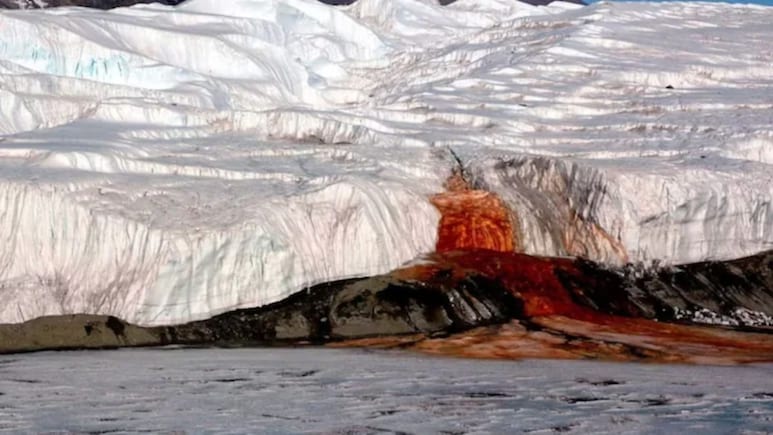
- Scientists linked Blood Falls in Antarctica to changes in Taylor Glacier's surface and water flow
- Blood Falls are caused by iron-rich brine emerging from beneath Taylor Glacier and oxidizing red
- Researchers observed glacier surface sinking and rising due to brine discharge beneath the ice in 2018
Scientists have discovered a link between a mysterious red-stained water flow in Antarctica, known as Blood Falls, and changes in the glacier above it. This unusual phenomenon has intrigued researchers for more than a century. Blood Falls are located in Antarctica, in front of Taylor Glacier, a massive ice river flowing through the McMurdo Dry Valleys. This unique natural phenomenon was first observed and recorded in 1911 by Australian geologist Thomas Griffith Taylor during the Terra Nova expedition, reported Newsweek.
According to researchers, Blood Falls are formed by iron-rich salt water (brine) that occasionally emerges from a source beneath the glacier. The glacier's weight and motion cause this water to rise to the surface. Upon reaching the surface, this water oxidizes and leaves a red stain, which flows toward the West Lobe of Lake Bonney, an ice-covered Antarctic lake.
The study found that this brine is not just a surface stain. It indicates changes in pressure and hidden movement of water beneath the glacier. Peter T Doran, a geologist at Louisiana State University and lead author of the study, linked the glacier's surface drop to brine discharge and the resulting pressure drop.
For several weeks, Doran and his team observed the glacier's surface slowly sink and then rise, indicating the discharge of water beneath the ice.
In September 2018, researchers made important observations using a GPS tracker on Taylor Glacier, a time-lapse camera recording the Blood Falls, and a thermistor installed in Lake Bonney.
The camera footage showed a red stain beginning to form on September 19, 2018, and it gradually spread across the glacier. Meanwhile, the thermistor in the lake recorded the drop in water depth that occurred during this discharge event.
How Blood Falls Form
When saline water becomes trapped beneath heavy ice, pressure increases, and the glacier cannot always contain it. The water that forms Blood Falls comes from tubes beneath the glacier that are closed by the wind and open with the movement of the ice. The weight of the ice and its slow movement push the salt water toward the crevasses, where it suddenly erupts in pulses.
The study also found that during this event, the glacier's surface dropped by 0.6 inches and its forward motion slowed by about 10 percent.
The researchers concluded that a long-term discharge event, accompanied by periodic brine pulses from beneath Taylor Glacier for about a month, reduced subglacial water pressure, causing the surface to drop and slowing the ice's movement.
Track Latest News Live on NDTV.com and get news updates from India and around the world

