





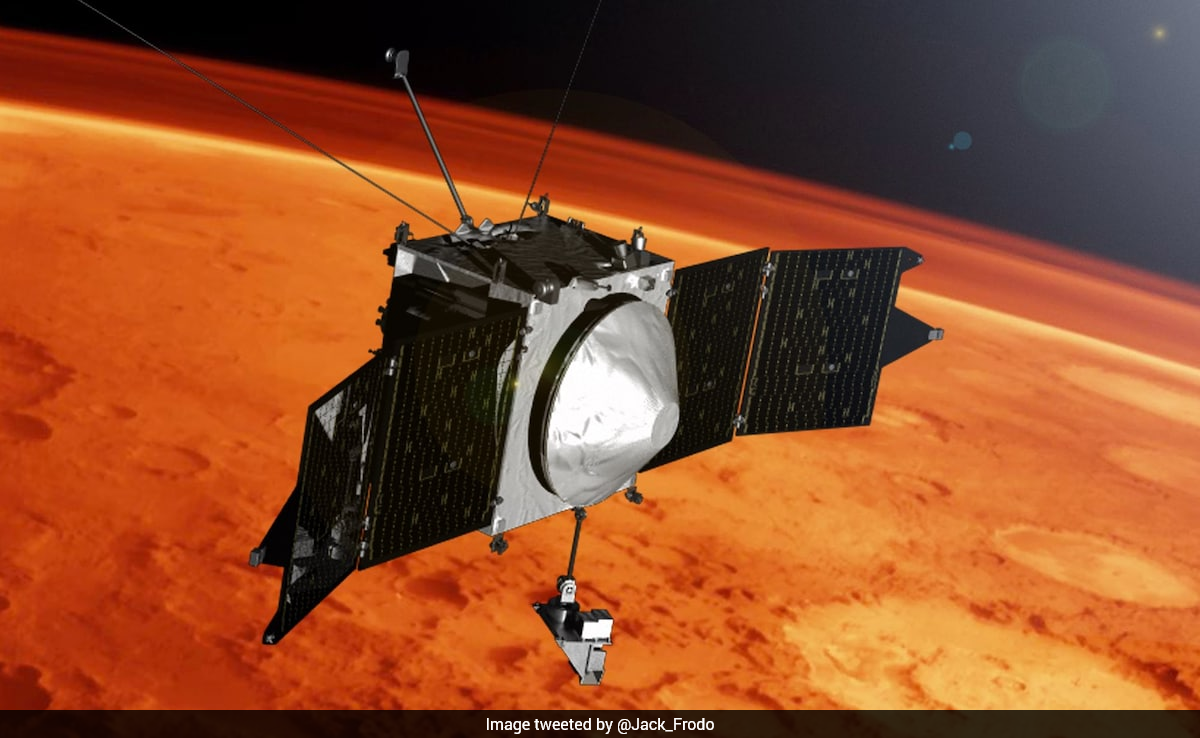
NASA has lost contact with MAVEN, a spacecraft that has been studying Mars since 2014. The Mars Atmosphere and Volatile Evolution (MAVEN) probe went silent on December 6, 2025, as it passed behind Mars - a routine part of its orbit. While the spacecraft was operating normally before the event, NASA was unable to reestablish communication once it reemerged from behind the planet.
The sudden loss of contact has prompted concern among mission scientists. On December 9, NASA confirmed it is actively investigating the issue and working to regain a signal from the probe.
"NASA's MAVEN (Mars Atmosphere and Volatile EvolutioN) spacecraft, in orbit around Mars, experienced a loss of signal with ground stations on Earth on Dec. 6. Telemetry from MAVEN had showed all subsystems working normally before it orbited behind the Red Planet. After the spacecraft emerged from behind Mars, NASA's Deep Space Network did not observe a signal," NASA said in a statement.
"The spacecraft and operations teams are investigating the anomaly to address the situation. More information will be shared once it becomes available," NASA added.
NASA Teams Work MAVEN Spacecraft Signal Loss
— NASA Watch (@NASAWatch) December 10, 2025
NASA'S MAVEN (Mars Atmosphere and Volatile EvolutioN) spacecraft, in orbit around Mars, experienced a loss of signal with ground stations on Earth on Dec. 6. Telemetry from MAVEN had showed all subsystems working normally before it… pic.twitter.com/Sm45hXnOPA
MAVEN spacecraft
Maven, launched in 2013, entered Mars' orbit in September 2014 to study the upper atmosphere and its interaction with the solar wind. The mission revealed that the sun's influence led to Mars losing its atmosphere over time, transforming the planet from a warm, wet world to the cold, dry environment we see today.
MAVEN has played a crucial dual role, not only studying Mars's upper atmosphere but also serving as a communication relay for NASA's rovers, Curiosity and Perseverance. Its scientific contributions have been significant in shaping our understanding of the Red Planet.
MAVEN's data was key in uncovering how Mars lost much of its water, showing that during intense dust storms, water can be lifted high into the atmosphere and then stripped away by solar wind. The spacecraft also helped map global wind patterns, discovered Mars's invisible magnetic "tail," and identified a process called "sputtering" that accelerates the loss of atmospheric gases. It even detected a rare form of proton aurora, previously unseen on Mars.
These insights have deepened our understanding of planetary evolution, showing how Earth and Mars, diverged dramatically in terms of climate and habitability. MAVEN's findings are also valuable for guiding future missions to Mars.
2 other spacecrafts orbiting Mars
NASA's Mars Reconnaissance Orbiter (MRO) and Mars Odyssey are still operational, providing valuable data and serving as communication relays for Mars missions. MRO, launched in 2005, has been studying the Martian surface and atmosphere, while Mars Odyssey, launched in 2001, is the longest-running spacecraft at Mars, focusing on geological and climate research.
The Mars Odyssey's mission is to study "clouds, fog and frost, and mapping surface rocks to make future Mars landings safer," according to NASA.
Track Latest News Live on NDTV.com and get news updates from India and around the world

