





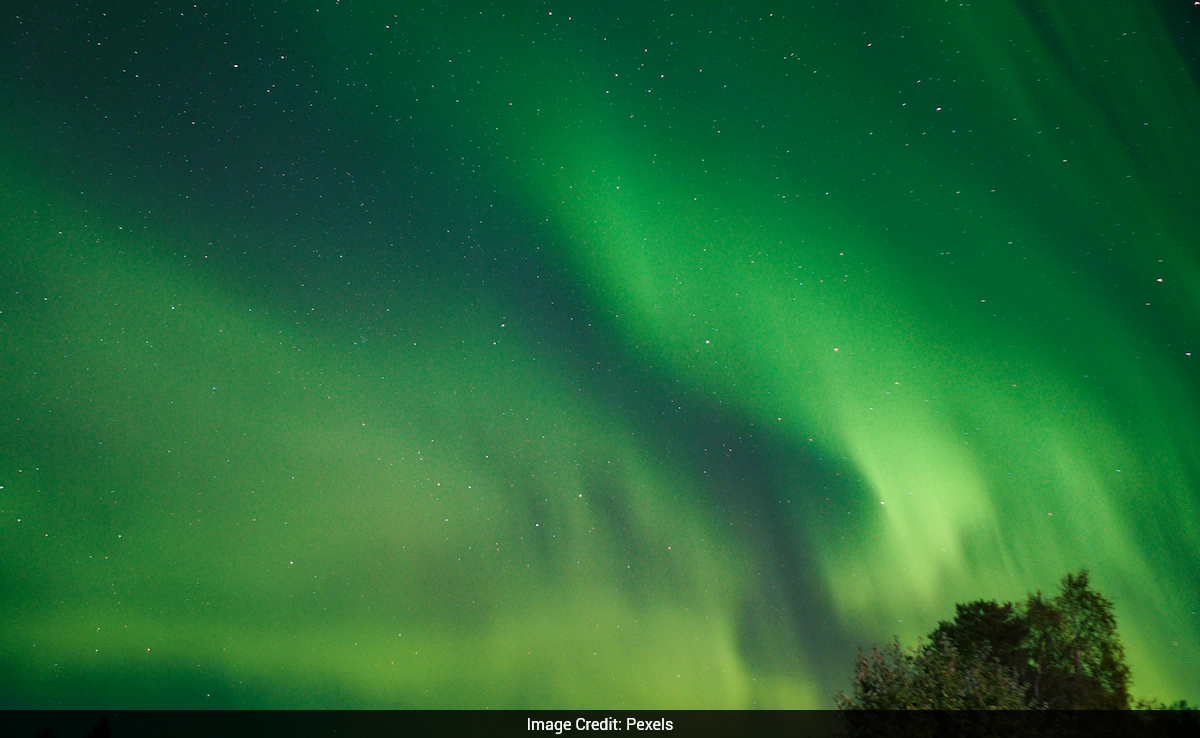
- Auroras form when solar particles collide with Earth's atmosphere near the poles
- Oxygen collisions produce green light while nitrogen causes purple, blue, or pink hues
- Rare red auroras occur from oxygen collisions at very high altitudes
In recent years, glowing waves of green and purple lights moving across the night sky have caught the attention of people around the world. These natural light displays, known as the aurora borealis in the north and the aurora australis in the south, have become so popular that special tours, watch parties and mobile apps now exist to help people track them.
Although many people are mesmerized by the beauty of these glowing lights, there are many interesting facts behind their formation and the different colours they appear in, reported DW.
How Auroras Form
Auroras are the result of intense solar storms on the Sun. During these storms, a large amount of electrically charged particles are released from the Sun into space. Some of these particles move toward Earth and are deflected toward the North and South poles by the Earth's magnetic field.
When these particles enter Earth's atmosphere, they collide with atoms and molecules in the air. This collision heats the gases and causes them to glow, just as heating causes gas to emit light.
Why Do The Lights Change Colours
The colours of auroras depend on which gases in the atmosphere the solar particles collide with. Oxygen, which constitutes about 21 percent of the atmosphere, typically produces a green colour when heated. Nitrogen reacts with them, resulting in purple, blue, or pink colours.
Sometimes, when solar particles collide with oxygen at very high altitudes, auroras can also appear deep red, although this is rare.
Normally, auroras are only visible near the Arctic Circle or around Antarctica. However, recently, the Earth experienced an 11-year cycle of intense solar activity, known as a solar maximum. During this period, more solar energy reached the Earth, increasing the range of auroras around the poles.
This is why these lights have been seen farther than usual recently. Recent auroras have been seen in places like Hungary, Switzerland, Florida in the United States, southern Australia, and New Zealand.
Scientists at the Kjell Henriksen Observatory in Svalbard, Norway, the world's northernmost aurora research center, are conducting research on the solar energy particles present in the northern lights. This study focuses on whether these particles can have any impact on the Earth's ozone layer.
As enthusiasm for viewing the aurora grows, scientists are also working to understand their beauty as well as their environmental impacts.
Track Latest News Live on NDTV.com and get news updates from India and around the world

