





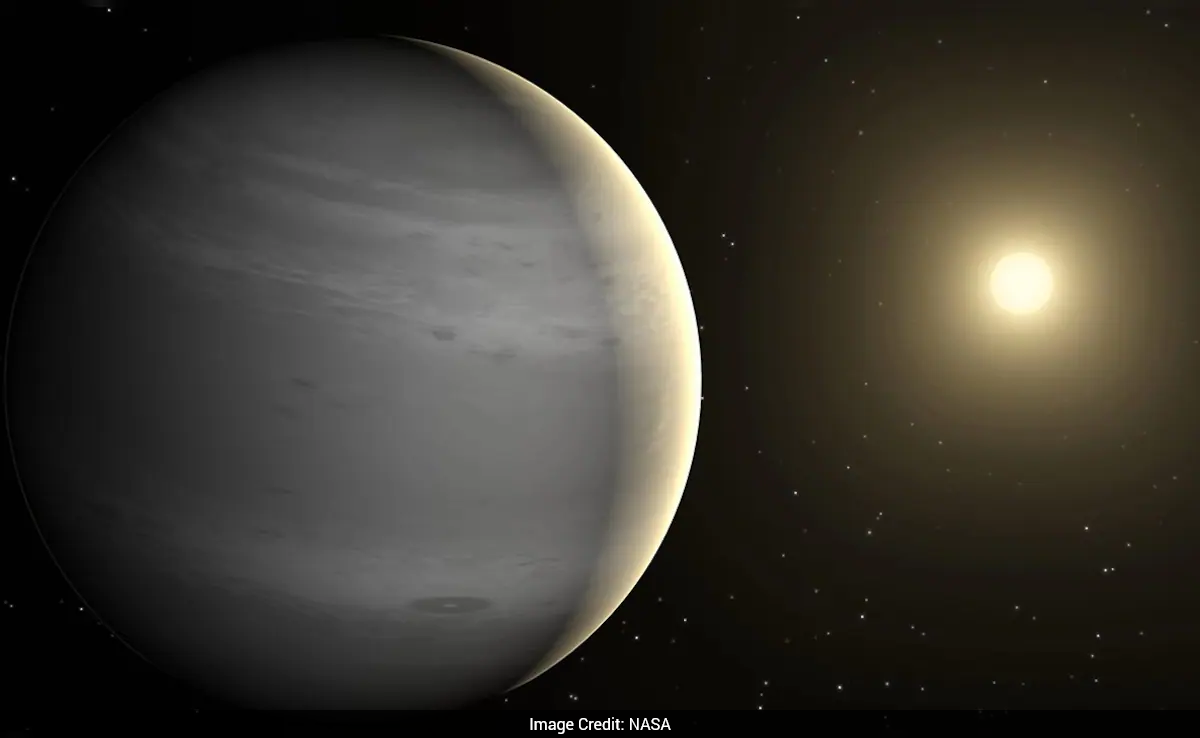
- TOI 5205b is a Jupiter-sized planet orbiting a red dwarf 280 light-years from Earth
- The planet challenges star formation theories due to insufficient material in its disk
- Its atmosphere has fewer heavy elements than both its host star and Jupiter
Located 280 light-years from Earth, TOI 5205b continues to baffle scientists over its genesis. The unusually large planet, which is the size of Jupiter and orbits a red dwarf star (TOI-5205), that is 40 per cent the size of our Sun, has been called a 'forbidden planet' ever since it was discovered by scientists in 2023. A new study published in The Astronomical Journal has shed further light on how this exoplanet's existence challenges the conventional stellar rules about the formation of stars and planets.
Ever since the exoplanet's discovery, scientists have wondered how a host star like TOI-5205 somehow managed to form a Jupiter-sized planet. Typically, stars form from massive clouds of gas and dust in space. The leftover material from star formation swirls around the star and creates a rotating disk where planets are born.
However, TOI-5205b's discovery challenged this theory as scientists said there was not enough rocky material in the disk to form the initial core, which in turn makes it even more perplexing how it managed to turn into a massive gas giant planet as we know today.
The new study states that the planet's atmosphere has a lower concentration of heavy elements, such as carbon and oxygen, compared to both its host star and gas giants like Jupiter.
"These findings have implications for our understanding of the giant planet formation process that occurs early in a star's lifespan. The planet having a lower metallicity than its own host star makes it stand out among all the giant planets that have been studied to date," study co-author and University of Birmingham astronomer, Dr Anjali Piette, explained in a statement.
Watch: Passenger Captures 'Once-In-A-Lifetime' Video Of Artemis II Launch From Plane, NASA Reacts
Using advanced scientific methods, the researchers then found that TOI-5205b's overall composition may be up to 100 times richer in heavy elements than its atmosphere. In short, it indicates that heavier materials sank deep into the planet's interior during formation and were no longer mixing with the outer layers.
"We observed much lower metallicity than our models predicted for the planet's bulk composition," said study co-author and Carnegie Science astronomer Shubham Kanodia. "This suggests that its heavy elements migrated inward during formation, and now its interior and atmosphere are not mixing."
TOI-5205b is one of seven planets that scientists are currently studying to provide greater context on how such gas giants are formed.
Track Latest News Live on NDTV.com and get news updates from India and around the world

