





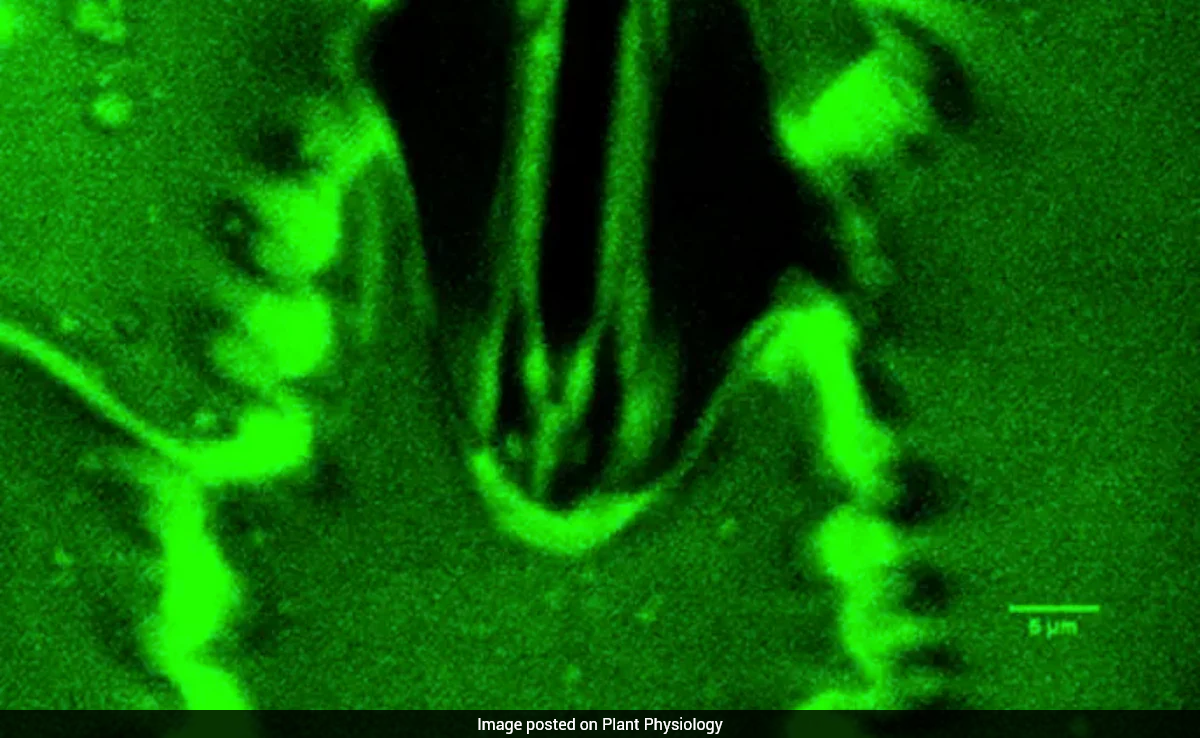
- The University of Illinois developed Stomata In-Sight to observe plant breathing in real time
- The device uses microscopy, gas-exchange systems, and machine learning for detailed stomata analysis
- It tracks stomatal response to light, humidity, temperature, and water availability precisely
For centuries, scientists have known that plants 'breathe' through tiny leaf pores called stomata, which balance CO₂ intake for photosynthesis with water vapour loss. Researchers at the University of Illinois Urbana-Champaign have now created a groundbreaking tool that lets them observe plants "breathing" in real time under controlled conditions. This research marks the first time these processes have been directly observed and recorded in such detail.
The device called 'Stomata In-Sight' reveals how microscopic pores on leaves, known as stomata (often called the plant's mouths), manage the exchange of carbon dioxide, oxygen, and water vapour. These tiny openings open and close to balance gas intake for photosynthesis with water loss through transpiration, playing a key role in how plants cope with heat, drought, and other stresses.
The breakthrough technology integrates a high-resolution confocal microscope, a precise gas-exchange measurement system, and advanced machine-learning software for image analysis. Experiments involve placing small leaf sections inside a compact, palm-sized chamber that precisely controls temperature, humidity, light, CO₂ levels, and water availability.
The team recorded a video that captures the dynamic movement of gases as plants absorb CO₂ and release oxygen and water vapor, a crucial process for photosynthesis and plant health. Using advanced imaging and sensors, researchers tracked subtle cellular changes as stomata respond to light, humidity, and temperature, offering insights into plant adaptation, water regulation, and internal balance.
Watch the video here:
Seeing Plants Breathe
— Brian Roemmele (@BrianRoemmele) January 15, 2026
Researchers have achieved a breakthrough in plant biology by developing a way to watch plants
"breathe" in real time.
While we have known for centuries that plants exchange gases through microscopic pores called stomata, we have never before been able to… pic.twitter.com/j62H8y6mtk
Andrew Leakey at the Department of Plant Biology and the Institute for Genomic Biology at the University of Illinois told Fox News, "For example, they open the pore in the light and close it in the dark. This happens in order to allow photosynthesis to happen when conditions are favorable but to minimize the loss of water from the interior of the leaf to the atmosphere. When plants don't have access to enough water, because the weather is hot and dry, or because we forget to water them - they start to dry out and don't grow as well."
Developing the system required nearly five years of refinement, overcoming challenges like eliminating even minor vibrations that could distort the ultra-fine microscopic views. After testing several prototypes, the team achieved a stable, reliable design.
Why does this breakthrough matter?
This breakthrough in understanding plant function has the potential to revolutionise crop breeding strategies. By gaining insight into the intricate mechanisms that govern stomatal behavior, including the physical and chemical signals that regulate opening and closing, as well as the impact of stomatal density, scientists can identify key genetic traits associated with enhanced water-use efficiency.
This knowledge is particularly significant given that water scarcity poses the most substantial environmental constraint on agricultural productivity. By developing crops that optimize water utilisation, researchers can help mitigate the adverse effects of rising temperatures and drought, ultimately bolstering crop resilience.
The University of Illinois Urbana-Champaign has patented the technology. Although not yet available commercially, the researchers hope it will soon be manufactured for broader scientific use.
This study has been published in the journal Plant Physiology.
Track Latest News Live on NDTV.com and get news updates from India and around the world

