






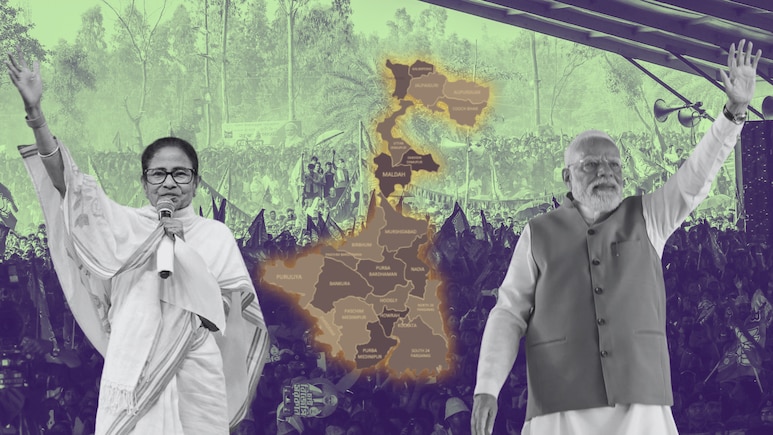
It is more than an election. It is a dispute over the grammar of belonging - who gets to be "us," and what "us" is allowed to mean when power is at stake. In West Bengal, the coming count does not merely decide seats in an assembly; it tests two rival imaginations of identity, both confident, both mobilizing, both speaking in the language of moral rightness. One imagines the region as a Bengali home. The other imagines the nation's spiritual centre as a Hindu home. Between them lies the fragile hinge of everyday life: jobs, safety, dignity, and the right to be counted as a full citizen.
Consider how history hides inside the smallest gestures - how a slogan can become a mood, how a crowd can feel like weather. Here, too, the "mood" has formed. The central conflict of the election can be summarized almost like a thesis statement: Bengali identity versus Hindutva identity. And yet it is never only ideology. It's also memory, and grievance, and a carefully shaped sense of who is inside the room - and who is being ushered out.
Trinamool pitches Bengali identity
The Trinamool Congress pitched a Bengali identity not as an abstract cultural badge but as a claim to sovereignty over the meaning of citizenship. Their Bengali slogan - "Jato karo Hamla, Ebar jitbe Bangla" ("However much you attack, this time Bangla will win") - sounds like defiance, but it does something subtler: it turns politics into resistance. It suggests that identity is under assault, and that the only way to survive is to vote as if Bengali-ness were not a festival but a lifeline.
In that pitch, Trinamool organized its campaign around a set of deliberate pillars - "two M's" and an attempt to turn procedure into grievance. The two M's are Mahila (women) and Muslim. These were not merely demographic notes; they were framed as moral responsibilities and guarantees. And then there was SIR, pushed as the main agenda - not just as an administrative matter, but as an indictment. Mamata Banerjee even argued in the Supreme Court about the unfairness of the SIR process. Trinamool argued that the category of "logical discrepancies" affecting 27 lakh voters was unfair and unconstitutional, and they tied the grievance to a larger story: that the process was effectively imposed by the Centre and outsiders, thereby robbing Bengali voters of rights.
This is how identity becomes a courtroom in electoral form. A technical classification turns into a narrative of betrayal. A voter list turns into an emblem of dignity. The claim is not simply "we are right," but "you are being robbed" - and if you are being robbed, then anger becomes duty.
TMC's Women's welfare
Women's empowerment formed one of the emotional engines of the campaign. Trinamool placed an array of welfare initiatives at the centre of its messaging: Lakshmi Bhandar, Jyotir Alo, Kanyashree Prakalpa, Rupashree Prakalpa, Swasthya Sathi, among others - programmes described as money and support flowing directly to poor women voters. In political terms, the message was: the state reaches you in the ways that matter, and when violence or neglect is the opposition's theme, Trinamool can answer with care, cash, and concrete naming of benefits.
BJP is the Bahiragoto party, claims Trinamool
Alongside this was their promise of protection to 30 per cent Muslim voters - again, not only as policy but as reassurance. But perhaps the most distinctive feature of Trinamool's identity politics was that it insisted Bengali identity is not merely ethnic; it is constitutional, social, and local. The opposition party was not steeped enough in Bengali tradition to claim moral authority over Bengal's future. Hence the repeated charge that the BJP is an "outsider/bahiragoto" party - a force that may bring slogans, but not understanding.
BJP focuses on Hindutva identity
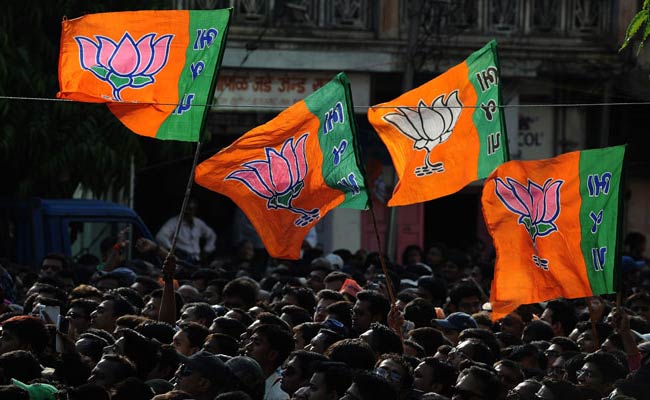
Now consider the counter-mosaic assembled by the BJP: Hindutva identity, organized around themes that reach for unity by narrowing the boundaries of belonging. Their campaign's standout issue was "Ghushpaiti" - illegal immigration from Bangladesh - treated not simply as governance but as an existential pressure on cultural and political space. This is a familiar mechanism in identity politics: when boundaries feel threatened, unity is offered as protection.

The BJP then aimed to puncture Trinamool's Muslim outreach. Their claim was that Trinamool was appeasing Muslim voters unfairly, and from that accusation they built a broader attempt to polarize Hindu voters. Cultural mobilization became part of the strategy: Jagran, Ram Navami processions, and slogans that tried to gather disparate communities under a single chant-line - "Jai Shri Ram," "Jai Maa Durga," "Jai Maa Kali." These phrases act like emotional tokens. They convert faith into a public signal and political loyalty into visible participation.
BJP's powerful pitch on Porivorton
The BJP also pressed the powerful theme of "Porivorton" - a total transformation of Bengal, a remake of the past into a present that can be owned again. In this framing, West Bengal is not simply improving; it is being restored to a "true" image - often described through the longing phrase "Sonar Bangla". Women's issues were addressed too, but with a different route: the BJP highlighted its attempt to pass a Women's Reservation Bill via Parliament, then blamed Trinamool and other parties of the INDIA alliance for failure. The underlying logic remained consistent: if the state cannot protect women's futures, then political change becomes necessary.
BJP highlighted the failure of women's safety
And finally, the BJP brought the question of women's safety into the foreground with reference to the RG Kar rape case in 2024 and other reported incidents of violence. The narrative offered by such messaging is clear: the opposition party is the embodiment of protection - protection of women, protection of law, protection of a public order that feels unstable.
PM Modi's attack on Trinamool as perpetuating "Maha Jungle Raj"
Above all, Prime Minister Narendra Modi calling Bengal under Trinamool's 15-year tenure "Maha Jungle Raj" attempted to make governance itself morally indictable. Jungle is the opposite of civilization; it implies a breakdown in responsibility. If Trinamool is jungle, then the audience must yearn for discipline, and discipline is promised through a Hindutva-coded consolidation.
So both sides performed a similar act of transforming political questions into moral identities. The Trinamool said: the heart of Bengal is women's welfare, Muslim protection, constitutional fairness in voter rights, and the defence of Bengali culture against outsiders. The BJP said: the centre of the nation is Hindu unity, the security of borders, the protection of women through law and order, and the restoration of Bengal through total transformation.
Unprecedented 92 per cent turnout
The result was a level of mobilization that felt, in its intensity, almost beyond ordinary campaigning. The election drew an unprecedented 92 per cent turnout - a number that signals not only administrative participation but emotional urgency. People did not simply vote; they enrolled. They treated identity as a fate.

Then comes the counting tomorrow. In election reporting terms, the mandate will reveal which pitch won: the Bangla pitch of Trinamool or the Hindutva pitch of BJP. But in deeper terms, the count will show how Bengal has decided to hear itself.
Will Bengali-ness continue to be framed primarily as a lived civic home - language plus welfare plus the right to be counted? Or will it increasingly be reframed through the older national register of Hindutva - unity through religious-cultural markers, strengthened by fear of threat and the promise of restoration? Both sides are offering belonging; both sides are insisting their belonging is the truer one.
Contest between two ways of feeling "at home"
And perhaps the best way to read the moment: not as a contest between two parties, but as a contest between two ways of feeling "at home." One says home is the province's language, its women's lives, and its local dignity under strain. The other says home is the nation's spiritual boundary, guarded through collective solidarity and a recalibration of who counts as legitimate.
On May 4, numbers will become stories. The stories will then become lessons. And the lesson - whether it settles into "Bangla wins" or "Hindutva prevails" - will be about how quickly modern electorates turn identity into destiny.
(The author is Editor, Research, NDTV)
Views are personal.

