






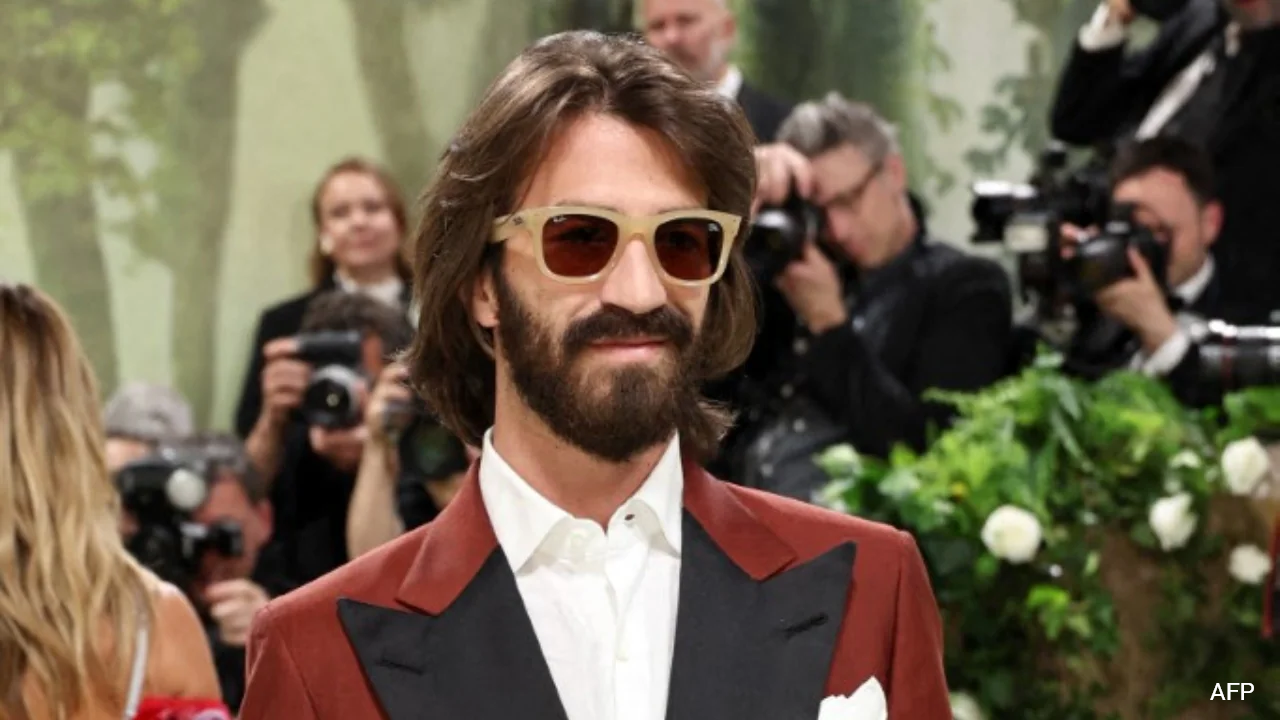
There are car crash interviews, and then there is Leonardo Maria Del Vecchio's podcast appearance this week.
The 31-year-old son of EssilorLuxottica SA founder Leonardo Del Vecchio, one of eight heirs to his fortune, made a series of remarkable revelations on the popular rapper-hosted Pulp Podcast, including his struggles with drug abuse and his extremely active sex life.
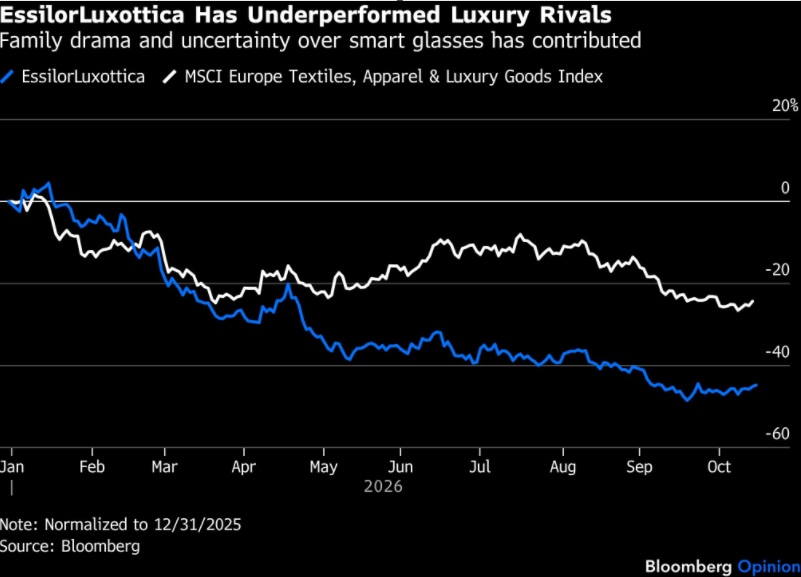
This was just the latest episode in a broader corporate drama unfolding at the Franco-Italian company -- owner of Ray-Ban, and partner to Meta Platforms Inc. on AI smart glasses -- which has contributed to a near halving of its share price in the space of a year.
The young Del Vecchio has in effect become an activist stakeholder in his family's firm, railing against its management and trying to become its most powerful investor. He hoped going on the podcast would show his human side, away from the name and money. Instead he deepened concerns about his judgment and wellbeing. The bizarre spectacle has harmed his campaign, even if his representatives insist otherwise.
EssilorLuxottica was already the stuff of Italian capitalist legend. Its creator Leonardo was put into an orphanage by his widowed mother because she could not afford to feed him. He went on to build the world's largest eyewear group, and effectively the modern optical industry.
In the years before his death at 87 in 2022, he put in place a structure at the family's holding company, Delfin, which would pay out handsome dividends to his heirs but effectively stop them selling out. Delfin owns roughly a third of EssilorLuxottica, as well as hefty stakes in Italian banks and insurers.
The holding company's ownership is split between eight heirs: six children born to three mothers; Leonardo's widow Nicoletta Zampillo; and Rocco Basilico, her son from a separate marriage. Any big decisions on ownership or strategy must be unanimous. That achieving such a consensus was nigh on impossible suited the patriarch. He wanted EssilorLuxotttica to continue unchanged, helmed by his closest adviser, Francesco Milleri, who also chairs Delfin.
This all held together until this year, when tensions between the beneficiaries finally erupted. Some of them are frustrated about not being able to make changes that would let them monetize their holdings or get more of a say in how things are run. Leonardo Maria offered to buy the Delfin stakes of two of his siblings to make himself a dominant shareholder. His -10 billion ($11.2 billion) plan was approved by a family vote in April, but the financing was complicated by a drop in EssilorLuxottica shares.
Delfin subsequently decided it wouldn't backstop the transaction. And Leonardo Maria's half-brother Basilico has proposed a rival deal: separating the core eyewear stake from Delfin's other financial and insurance holdings, allowing the latter to be sold to raise cash for family members or to reorganize Delfin.
With all of this going on, it's hard to see how this week's interview helped Leonardo Maria. He resigned in August from his roles as the group's chief strategy officer and president of Ray-Ban, launching a broadside against Milleri and other top EssilorLuxottica managers.
He doubled down on his complaints on the podcast, indicating that stepping away from day-to-day management had strengthened his own ability to challenge the company's current regime. "I am a shareholder. I took a step up, let that be very clear, I didn't take a step down," he said. EssilorLuxottica "has a name, Del Vecchio, and I cannot put my face behind it when salaries are frozen and shares are dropping 50%."
Alongside comments that his father "gave us all but love," and that "I have filled the gaps I felt with drugs," he revealed that he had -1 billion in debt, and was selling one of his two yachts.
EssilorLuxottica spokespeople declined to comment for this column. Representatives for Leonardo Maria said the interview was intended to show "a side of him that is not usually visible in the financial and corporate context in which he is normally portrayed. We do not believe that this has affected his credibility as a shareholder. His positions, investment decisions and actions in that role should be evaluated on their own merits and substance."
And yet his outburst may have strengthened Milleri, whose contract expires in April. Perhaps the other Delfin shareholders will decide a steady hand is needed, not more upheaval. Last month the board said it had "full confidence" in Milleri as EssilorLuxottica's chief executive officer and chairman. If he stays around, he should use the fresh mandate to break the Delfin deadlock.
A sensible option would be to cut its stakes in Banca Monte dei Paschi di Siena SpA, UniCredit SpA and Assicurazioni Generali SpA, and use the proceeds to buy out family members who want to exit Delfin. This is not too dissimilar from Basilico's proposal.
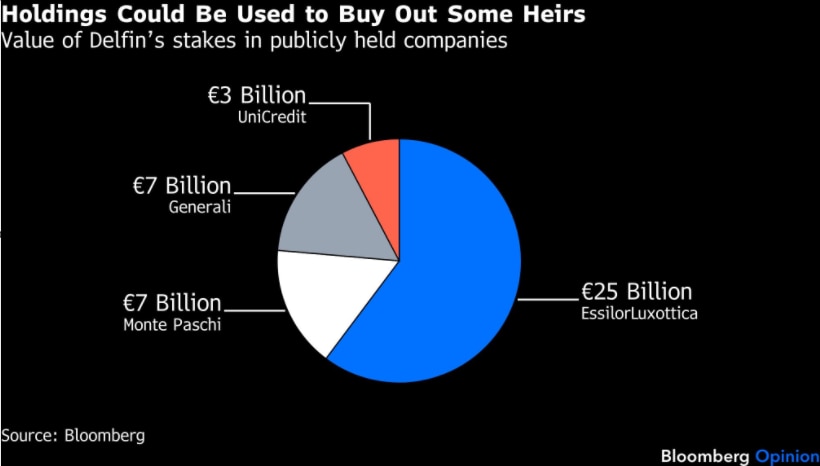
One difficulty is that Delfin might not want to be a forced seller of financial assets that are strategically important to Italy and not easy to dispose of. This is especially true at a time when the country is trying to reshape its finance sector. But if a shake-up does materialize, it could open the door for the holding company to rejig its structure and allow some clan members to cash out. Delfin is already studying a plan to buy parts of the stakes of two heirs, using bank financing, according to Corriere della Sera.
Whatever the eventual outcome, a period of stability is needed to try to hammer out a fix, not least for the fading jewel in the crown, EssilorLuxottica. Leonardo Maria says he was advised against appearing on the podcast. He may come to regret ignoring that wise counsel.

