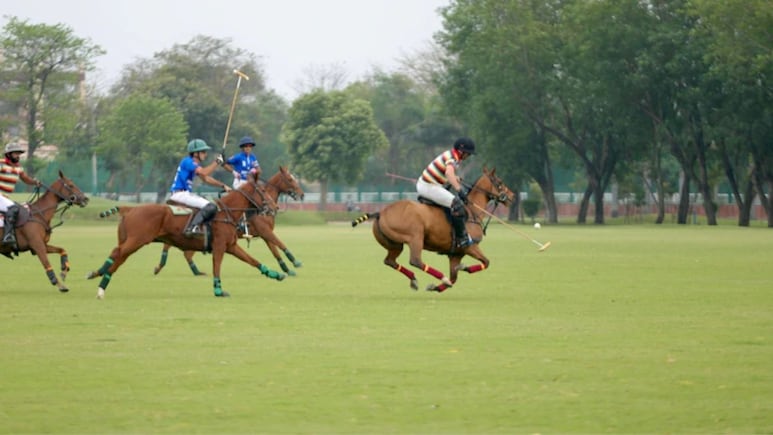
At the heart of Lutyens' Delhi lies the Jaipur Polo Ground, a nearly century-old sporting venue rooted in royal patronage and elite polo culture. It is now back in the headlines following a land dispute.
Jaipur Polo Ground, along with the Race Course Ground, has been asked by the Land and Development Office (L&DO) to vacate acres of land as the lease period has expired.
After the Delhi Gymkhana Club controversy, this eviction order puts elite institutional land in Lutyens' Delhi in the spotlight. Both colonial-era institutions, while serving different purposes, structures, and subcultures, have exposed a broader pattern of land disputes.
Jaipur Polo Ground
The Jaipur Polo Ground is an equestrian property that traces its roots to around 1930 when the 15.2-acre property was gifted by Maharaja Sawai Man Singh II of the erstwhile princely state of Jaipur to the Delhi Polo Club.
After the Delhi Polo Club dissolved in 1983, the ground came under the Indian Polo Association, which was recognised as the national governing body for the sport and took over the management and possession of the ground, where the 'sport of kings' - polo - was hosted. The massive property was designed not just for polo matches but also for stabling, hosting events like the Delhi Horse Show, and training elite horses.
The open-air facility consists of a manicured green grass field, a VIP pavilion, stables for horses, and the iconic white-stone horse statue. Unlike the Gymkhana clubs, it does not have indoor clubhouses, residential suites, or other such amenities.
When it comes to memberships, the crowd here has roots in royal families, the military, and billionaires, who can keep and transport polo ponies or bear the cost of breeding. But when it comes to matches, they are sponsored by celebrities, diplomats, and business owners, layering fashion with intense sport.
Jaipur Polo Ground's History With Imperialists And Royals
Before the Independence of India in 1947, the Jaipur Polo Ground served as a key spot for elites, royals, and imperialists to socialise. Erstwhile princely rulers, military officers, and foreign diplomats frequented the ground and played matches.
After the Partition, the glory of the Jaipur Polo Ground and the Delhi Race Club endured. Horse races and polo matches attracted thousands of spectators, with pictures printed in newspapers.
In January 1952, when Delhiites were grappling with biting cold, noted cricketer Iftikhar Ali Khan Pataudi (senior) arrived at the Jaipur Polo Ground with his son, Mansur Ali Khan Pataudi. The young Pataudi was celebrating his 11th birthday, which ended in a tragedy.
After a few minutes of arriving at the ground, Iftikhar Ali Khan Pataudi reportedly mounted a horse to play polo. Within moments, he fell from the horse and was seriously injured. Before medical aid could reach him, he succumbed to his injuries as his son witnessed his last moments from the sidelines.
His death at the Jaipur Polo Ground made headlines. In a 1995 interview, Mansur Ali Khan Pataudi confessed that every time he visited the ground, he relived the moment of his father's accident.
In 1975, Charles III (then Prince Charles) was visiting India when he participated in a polo match. Needless to say, the game was organised at the Jaipur Polo Ground, New Delhi. From military officers and diplomats to the capital's elite, spectators turned up in huge numbers.
Recent Land Dispute
The Jaipur Polo Ground is currently caught up in a major legal dispute regarding colonial-era leases in Lutyens' Delhi and land use. Through the Land and Development Office, the central government said that the IPA's official lease expired in March 1993, making the subsequent occupancy for over three decades unauthorised.
The L&DO passed the eviction notice on May 20. The IPA has argued that a 1992 agreement guaranteed yearly extensions until the association is provided with an alternative site. It further claimed that it had prepaid the ground's rent of Rs 30,400 for the period from April 2025 through March 2030. The payment was accepted through the government's online portal.
Following a long legal battle, a Delhi sessions court and the Delhi High Court declined an interim stay on the eviction order. Thus, the L&DO officials arrived with 150 personnel from the CRPF and Delhi Police at 9 am and sealed the ground "for a larger public purpose and benefit" on June 13. The Centre has, however, not shared the details of the said purpose or benefit.
The IPA called the eviction "wrongful, arbitrary and contrary to law" and added that it will continue to fight the legal battle to protect its interests.
Track Latest News Live on NDTV.com and get news updates from India and around the world
