





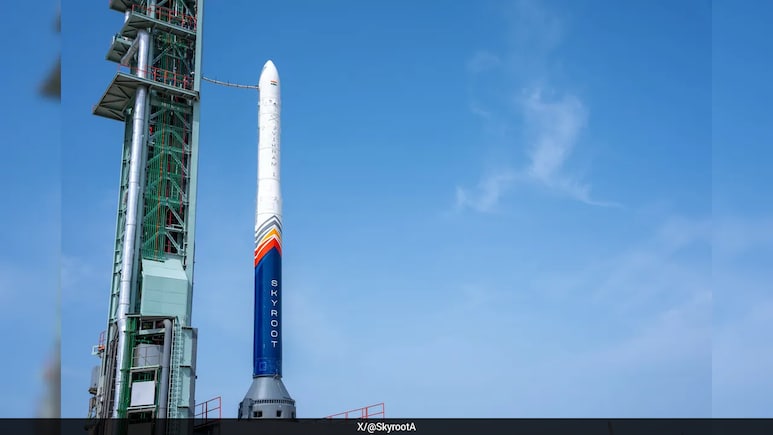
- Skyroot Aerospace aims to launch India's first private orbital rocket, Vikram-1, on July 18
- Vikram-1 can carry 300 kg to low Earth orbit, marking a major private sector milestone
- The company was founded by ex-ISRO scientists and valued at $1.1 billion currently
India's space story is on the cusp of a historic milestone. For decades, access to space was the exclusive domain of national space agencies backed by governments and vast public resources. If all goes well on July 18 at 11.30 am, Hyderabad-based Skyroot Aerospace hopes to join a small and elite group of global companies that have successfully developed and launched orbital rockets.
If all goes according to plan, Skyroot's Vikram-1 rocket will become the first privately developed Indian rocket to attempt an orbital mission, marking a defining moment not just for the company but also for India's rapidly emerging private space sector.
As Vikram-1 towers on the launch pad at Sriharikota, Skyroot Aerospace CEO and co-founder Pawan Chandana reflected on a journey that began with a handful of engineers and a bold dream.
"Years of effort by amazing people brought us here. We are soon going to lift off India's first private orbital rocket, Vikram-1, named after Dr. Vikram Sarabhai," Chandana told NDTV.
Named after the father of India's space programme, Vikram Sarabhai, the Vikram-1 vehicle represents the next step in Skyroot's ambitions after the company's successful Vikram-S suborbital mission in November 2022. That launch, called Prarambh, made Skyroot the first private Indian company to launch a rocket and demonstrated that India's startup ecosystem could build credible launch vehicles.
Now comes a much tougher challenge.
"Vikram-1 has the capacity to eventually put 300 kilograms into low Earth orbit. It will be the first test flight or developmental flight of an orbital rocket from the private sector from India. It is also one of the very few companies which have attempted it globally as well," Chandana said.
That last point is particularly significant.
While dozens of companies around the world advertise launch ambitions, very few have actually developed, tested and routinely operated orbital rockets. Reaching orbit remains one of the most difficult engineering achievements undertaken by humankind.
Space scientist and former ISRO engineer Dr. Guru Prasad, currently Director of the Nehru Planetarium in Bengaluru, puts the achievement into perspective.
"About 40 have been listed but the ones that matter are the private companies in the US, Boeing Corporation and Lockheed Martin of US together selling Atlas launch vehicle, SpaceX and now Blue Origin of Jeff Bezos, and Northrop Grumman. In Russia Glavkosmos, in India NSIL as well as start ups Agnikul Kosmos and Skyroot Aerospace, both yet to prove orbit capability, in Europe Arianespace, in Japan Mitsubishi, CALT of China and a handful of private companies there and US-New Zealand company Rocket Lab. In Toto, about a dozen companies in USA, Russia, China, Europe, India and Japan and US-New Zealand, both in the government and private sector really matter. Fully in the private sector less than a handful, so Skyroot Aerospace is pioneer of sorts."
In other words, the club of orbital launch providers is remarkably small.
For Skyroot, reaching orbit would place the company in a rare category of aerospace firms that have mastered one of the most complex technological challenges ever attempted.
Chandana is quick to acknowledge the magnitude of the task. "It is literally the rocket science. It is one of the toughest feats in engineering. There are hundreds of systems, all very complex individually. All need to come together at the same time, work synchronously and work perfectly in a few minutes of flight to orbit."
The challenge involves igniting powerful rocket motors, navigating through the atmosphere, separating stages with split-second precision, guiding the vehicle through space and deploying payloads into orbit while travelling at speeds exceeding 28,000 kilometres per hour.
"Putting something into orbit is a marvellous feat in engineering," Chandana said. "We are very proud that we have come so far, years of effort culminating into a lift off soon."
Founded in 2018 by former ISRO scientists Pawan Chandana and Naga Bharath Daka, Skyroot is among the most prominent faces of India's new space economy. The company has raised more than $100 million from investors and built advanced facilities in Hyderabad to manufacture rocket structures, propulsion systems and avionics. Today valued at $ 1.1 billion.
What makes Skyroot's rise particularly remarkable is that it coincides with a fundamental shift in India's space policy.
For decades, ISRO alone carried the responsibility of developing and launching Indian rockets. Today, thanks to policy reforms opening space activities to private players, startups can access testing facilities, launch pads and decades of accumulated expertise.
Chandana leaves little doubt about ISRO's role in Skyroot's journey. "ISRO has been phenomenal. We came so far thanks to ISRO support. A lot of our testing used those facilities and even the launch happens to be ISRO's."
He added that access to space infrastructure and technical expertise significantly accelerated the company's development.
"It saves us a lot of time and capital so that we can focus on building the rocket and getting into the market." Skyroot has used the 400 plus private vendors cultivated over years by ISRO.
The upcoming Vikram-1 mission will carry a mix of domestic and international payloads, including commercial and experimental satellites. Success would pave the way for regular commercial operations.
While Chandana says the company's immediate focus remains small satellite launch vehicles, the long-term ambitions are much bigger. "Our aspiration is to open space for all. We will eventually get to much bigger rockets as well."
That vision includes larger launch vehicles, reusable rockets and eventually supporting human spaceflight capabilities.
For now, however, all eyes are on Vikram-1.
The rocket embodies a new India where young entrepreneurs are tackling challenges once considered possible only for governments. It demonstrates that advanced aerospace engineering can emerge not only from national programmes but also from startups driven by talent, innovation and ambition.
As Chandana admits, every launch brings a mix of excitement and anxiety.
"Years of effort culminating into a launch and rockets are so complex. Things can go wrong as well. Fingers crossed. But we are very excited that the rocket has come out well and we are looking forward to learning from this flight."
Whether Vikram-1 achieves orbit on its first attempt or requires further refinement, the significance of the mission is already clear.
Skyroot Aerospace has helped redefine what is possible for private enterprise in India. A successful orbital launch would not merely be a victory for one company. It would mark the arrival of India as a serious participant in the global commercial launch market and demonstrate that Indian startups can compete in one of the world's most demanding technological arenas.
Small in size compared to the giant rockets of established space powers like Elon Musk's SpaceX, Vikram-1 nevertheless carries enormous significance.
In many ways, Skyroot Aerospace is punching far above its weight and helping define a new India, one that is confident, innovative and determined to break barriers.
Track Latest News Live on NDTV.com and get news updates from India and around the world

