





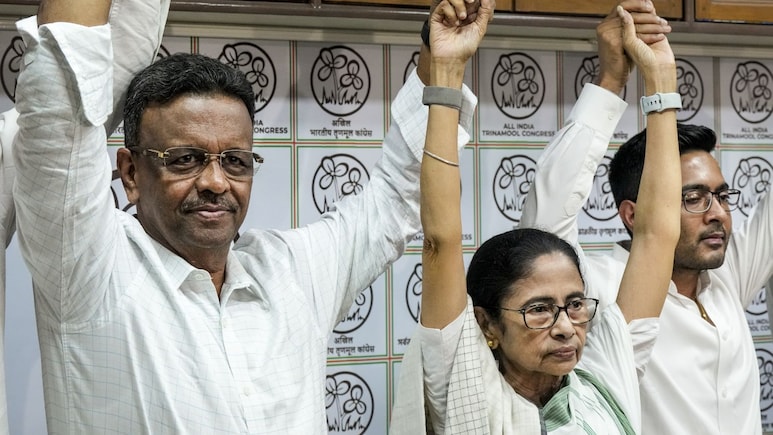
- Firhad Hakim resigned as Kolkata Mayor after seeking Mamata Banerjee's reluctant consent
- His resignation signals deeper crisis within Trinamool Congress amid growing internal dissent
- Muslim leadership's unity behind Mamata Banerjee appears to be weakening following the exit
Recently, Firhad Hakim, popularly known as Bobby Hakim, resigned from the post of the Mayor of Kolkata Municipal Corporation. Before taking this decision, he sought permission from former Chief Minister and Trinamool Congress supremo Mamata Banerjee, who reportedly gave her consent reluctantly. The resignation has nevertheless created a major ripple within the Trinamool Congress.
What has made the development even more politically significant is its timing. Bobby Hakim took this decision shortly after attending the administrative meeting convened by Chief Minister Suvendu Adhikari. Around the same time, several Trinamool MLAs and senior leaders were either openly expressing dissent or quietly distancing themselves from the party leadership. Political observers are now reading Bobby Hakim's resignation not merely as an administrative move but as a symptom of a much deeper crisis brewing inside the TMC.
Kunal Ghosh, Nayana Bandopadhyay and several other leaders had already begun sensing the changing mood within the party after witnessing the declining cohesion among TMC legislators. Simultaneously, Bobby Hakim and two MLAs attended the meeting called by Suvendu Adhikari, which further intensified speculation regarding the internal instability of the ruling camp.
But why exactly did Bobby Hakim resign? That is where the story becomes more complicated.
Inside the TMC, there is now a feeling that the party has moved from a "war room" situation to an "ICU" condition. The organisation is somehow surviving through emergency support, as if political oxygen is being administered merely to keep the patient alive. In that atmosphere, Bobby Hakim's resignation has come as another shock, another blow to an already weakened structure.
In Bengali, there is a phrase: "Morar upor kharar gha", the blow of death on the head. That is how many within the party are viewing this development.
The resignation has also exposed another uncomfortable reality for the Trinamool Congress: sections of the Muslim leadership, once considered firmly loyal to Mamata Banerjee, are no longer politically united behind her.
At a time when agencies such as the Income Tax Department and Enforcement Directorate are reportedly investigating Bobby Hakim's properties and financial matters, several Muslim leaders within the party have begun taking independent positions. During Eid, for example, Javed Khan accepted the administration's decision to shift the namaz venue from Red Road and publicly argued that the alternate arrangement would accommodate more people. Rather than opposing the government's move, he appeared to support it.
At the same time, Javed Khan, along with Rituparna Ganguly and others, gradually moved closer to the new political power centre. Sabina Yasmin, another minister from North Bengal and a prominent Muslim face in the Mamata government, also aligned herself with this emerging trend.
For years, many believed that Muslim voters and Muslim political leaders would never leave Mamata Banerjee politically. That psychological certainty now appears to be weakening. Bobby Hakim's resignation has therefore acquired a symbolic dimension beyond Kolkata Corporation politics. It has raised questions whether Mamata Banerjee's hold over minority leadership is beginning to erode.
There is also an emotional and personal angle to this episode.
Bobby Hakim is not merely a senior TMC leader. His relationship with Mamata Banerjee goes back decades, long before the Trinamool Congress came to power. During elections, Mamata herself repeatedly highlighted the closeness between their families. Bobby's home, his wife, and his daughters were all seen as part of an extended political family around Mamata Banerjee.
However, after the election results, Bobby Hakim's daughters reportedly made statements that were interpreted as critical of sections of the TMC leadership. That immediately triggered internal discussions inside the party. Some leaders argued that Bobby's political decisions were being influenced by the increasing pressure of central investigations by agencies such as the CBI and ED.
But Bobby Hakim's own explanation to Mamata Banerjee was somewhat different.
According to sources, he argued that remaining the mayor no longer gave him any real administrative authority. Under the Municipal Act, the mayor is essentially the policy-making head, but administrative powers are exercised largely through the Municipal Commissioner. Kolkata Municipal Corporation Commissioner Smita Pandey has become extremely proactive after the election results.
Legally, the Commissioner reports to the Chief Secretary on administrative matters, not directly to the Mayor.
In other words, Bobby Hakim may have felt that he was increasingly being held politically accountable for decisions over which he had little actual control. Continuing in office under those circumstances could have damaged his credibility even further.
At the same time, there is another crucial political calculation behind his resignation.
Most councillors within the Kolkata Municipal Corporation have now become openly vocal against the present TMC leadership, especially against Abhishek Banerjee and what many describe as the "IPAC-style corporatisation" of the party organisation during elections. Many traditional party workers believe that grassroots political culture has been replaced by consultant-driven election management.
In this atmosphere, a significant number of councillors were reportedly preparing for open revolt. There were growing fears that if Bobby Hakim did not resign voluntarily, a no-confidence motion could eventually be brought against him. If that happened and he lost the vote, it would have become a major public embarrassment not only for him personally but also for the entire TMC leadership.
Bobby Hakim may therefore have decided that resigning strategically was the safer political option. By stepping down voluntarily, he could position himself as someone who was also affected by the internal crisis, rather than appearing isolated and defeated.
There is also another layer of political concern.
If Kolkata Municipal Corporation elections are held later this year, possibly around November or December, the current anti-incumbency mood could create serious difficulties for the Trinamool Congress. The party leadership understands that the anger is no longer limited to opposition politics. Dissatisfaction is emerging from inside the organisation itself.
At the same time, suspicion is growing among leaders close to Mamata Banerjee that Bobby Hakim may be playing a "double role." Some within the TMC believe he has quietly opened communication channels with the BJP and may eventually shift sides depending on how the political situation evolves.
These discussions have intensified after his interactions with the new administration. However, the BJP officially claims that it no longer needs any "Operation Lotus" in Bengal because the public mood is shifting due to anti-incumbency against 15 years of TMC rule.
That is perhaps the most worrying sign for the Trinamool Congress leadership.
Earlier, the party could dismiss criticism as opposition propaganda. But now the discontent is coming from within the organisation, from councillors, MLAs, former loyalists, and even sections of the minority leadership that once formed Mamata Banerjee's strongest support base.
Whether Bobby Hakim's resignation ultimately becomes an isolated event or the beginning of a larger political realignment remains to be seen. But there is little doubt that his exit from the Mayor's post has added fresh fuel to an already intensifying crisis inside the Trinamool Congress.
And at this moment, the party appears less like a confident organisation and more like a structure struggling to contain an internal fire before it spreads beyond control.
Track Latest News Live on NDTV.com and get news updates from India and around the world

