





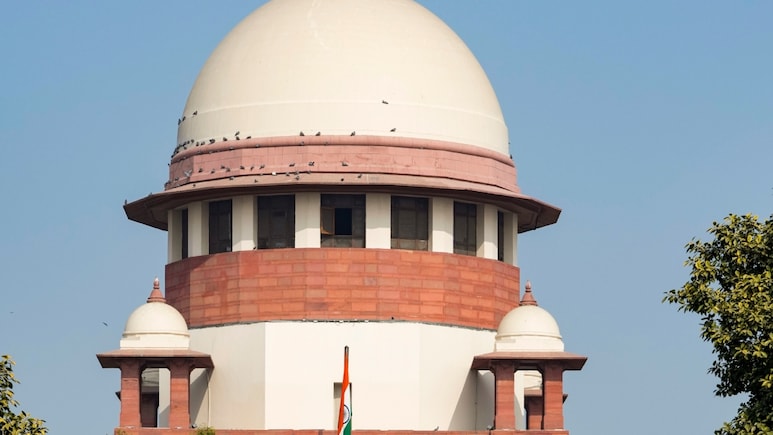
A famous couplet by Urdu poet Mirza Ghalib - emphasising that most religious confusions are created by human beings themselves - sounded out in the Supreme Court Tuesday during arguments on 'essential religious practice', or ERP, in Islam.
Justice Prasanna B Varale, part of a nine-judge bench, responded to submissions on the applicability of the ERP in a lighter vein. "Na tha kuch toh Khuda tha, kuch na hota toh Khuda hota, duboya mujh ko hone ne, na hota main toh kya hota."
Roughly translated, the couplet says: "When there was nothing, God existed. If nothing existed, God would still exist. It is my very existence that drowned me - Had I not been, what would have been the loss?"
The remarks came during arguments by advocate Nizam Pasha, who was appearing for review petitioners opposing the entry of women into the sanctum sanctorum of the Hazrat Nizamuddin Dargah in Delhi.
Justice Varale resorted to Ghalib while replying to Pasha's arguments against the ban of hijabs in schools.
Hijab debate raised
Mr Pasha argued the ERP test - often used by courts to determine if a religious practice deserves constitutional protection - cannot be applied to Islam. He contended issues like the wearing of hijab had been wrongly subjected to school discipline by being assessed under the ERP framework.
Pasha argued the Quran is a minimalist document. "It doesn't prescribe how one prays or how many times one has to pray. It was not written in life of Prophet... Quran is a skeleton but prophetic practices is flesh and blood of religion," he argued.
Chief Justice Surya Kant, however, intervened to clarify that the hijab issue was not under consideration in the present case.
And then Justice Varale pointed out these are complexities created by humans.
Case background: Sabarimala to Nizamuddin
The matter traces back to the 2018 Sabarimala verdict, which allowed women of all ages to enter the Kerala temple. Following that judgment, a law student filed a petition before the Delhi High Court after being denied entry into the inner sanctum of the Hazrat Nizamuddin Dargah.
She argued the restriction violated fundamental rights as recognised in Sabarimala.
The plea sought a declaration that prohibiting women from entering the sanctum sanctorum of the dargah is unconstitutional.
Can non-believers challenge faith practices?
Pasha told the court the case raises a crucial constitutional issue - whether a "complete third party" or non-believer can enter a place of worship and demand that established religious practices be altered to suit individual rights.
He described the situation as a "stark example" of courts being asked to adjudicate deeply faith-based questions.
Dargah as a religious denomination
Explaining the religious context, Mr Pasha said that a dargah is the burial site of a Sufi saint and holds deep spiritual significance, particularly in Sufi traditions.
He argued that the Chishtiya order - to which Hazrat Nizamuddin Auliya belongs - constitutes a distinct religious denomination under the Constitution. He pointed to established Islamic practices such as namaz, roza, zakat, and hajj as integral to this belief system.
Addressing the argument that open access to dargahs dilutes their denominational character, he cited earlier rulings to assert that allowing non-adherents does not negate a religious institution's distinct identity.
Entry, rights, and constitutional balance
Pasha framed the issue of entry as lying at the intersection of Articles 25 and 26 of the Constitution - which guarantee religious freedom and the right of religious groups to manage their affairs.
He argued that while Article 25 protects individual religious practice, Article 26(b) safeguards the collective right of a denomination to manage its internal affairs, including regulating entry.
At the same time, he acknowledged that Article 25(2)(b), read with Article 17 (abolition of untouchability), allows for state intervention in ensuring access to places of worship for historically oppressed groups.
Court: Regulation necessary, but not absolute
Justice Ahsanuddin Amanullah, responding to the arguments, emphasised the need for structure and regulation in religious institutions.
"The right to manage cannot mean absence of structure," he said, adding that every place of worship - whether a temple or a dargah - requires norms governing rituals, access, and administration.
He noted that while regulation is essential to prevent "anarchy," such rules must still operate within constitutional limits and cannot justify discrimination.
"Every institution must have norms," Justice Amanullah observed, "but those norms cannot be individually determined. There has to be a recognised body - and that is what the Constitution protects."
Larger constitutional questions continue
The nine-judge bench is currently examining broader questions arising from the Sabarimala judgment, including the scope of judicial review over religious practices and the balance between individual rights and denominational autonomy under Articles 25 and 26.
The hearing will continue as the court considers competing claims of faith, equality, and constitutional morality.
Track Latest News Live on NDTV.com and get news updates from India and around the world

