





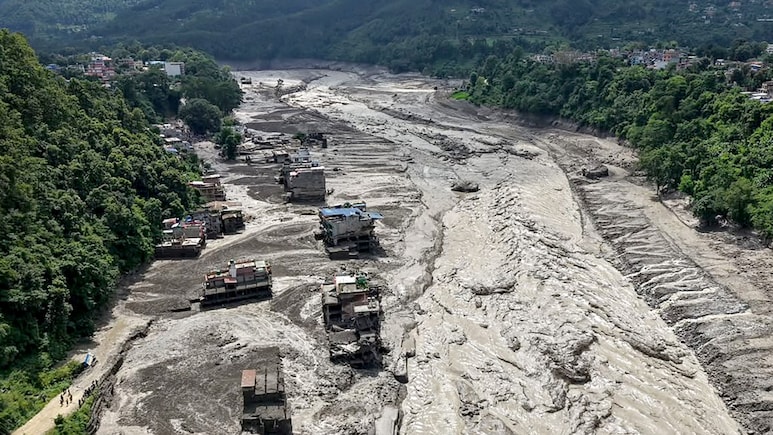
A powerful flash flood that tore through Nepal's Rasuwa district on Wednesday has triggered fresh fears of another disaster, with scientists warning that a blockage remains lodged upstream near the Nepal-China border and could unleash a second surge of floodwaters.
The warning comes from the International Centre for Integrated Mountain Development (ICIMOD), the Kathmandu-based intergovernmental organization that serves the eight countries of the Hindu Kush Himalayan region -- India, Nepal, Bhutan, China, Pakistan, Bangladesh, Myanmar and Afghanistan.
Founded in 1983, ICIMOD is one of the leading scientific institutions studying mountain environments, glaciers, climate change and disaster risks across the Himalayas.
According to ICIMOD, which released a detailed statement, a flood struck suddenly on August 26, sending a massive torrent of water, sediment and boulders down the Bhote Koshi and Trishuli river systems. Water levels rose dramatically within minutes, leaving officials and scientists racing to understand what caused the catastrophe and whether more danger lies ahead.
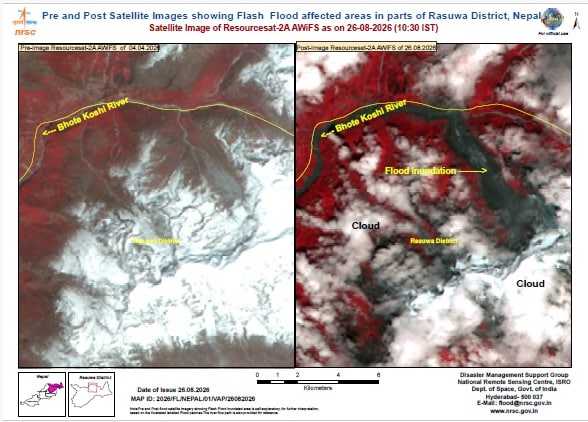
Areas further downstream in Nuwakot and Dhading districts are also being monitored.
ICIMOD's strongest warning came from Qianggong Zhang, Head of Climate and Environmental Risks at the organisation. "The same site devastated by last year's Rasuwa flood is once again under threat. An ice avalanche in the Lhende Khola is the suspected trigger, but the cause remains unconfirmed. With a blockage still lodged upstream on the Nepal-China border, authorities warn a second flood is imminent and evacuation orders are now in place for Jilong port," Zhang said.
The warning is particularly alarming because the affected region suffered a similar disaster last year.
ICIMOD scientists note that the same section of the basin which experienced severe flooding in 2024 has once again become the focus of concern.
Areas further downstream in Nuwakot and Dhading districts are also being monitored because of the potential for continued impacts.
According to preliminary assessments, the latest event has once again damaged infrastructure and hydrological monitoring systems while threatening communities and river valley settlements downstream.
The flood reportedly began around 9 a.m. local time, when water levels in the Bhote Koshi basin rose rapidly. The floodwaters swept downstream through the Bhote Koshi River into the Trishuli River system.
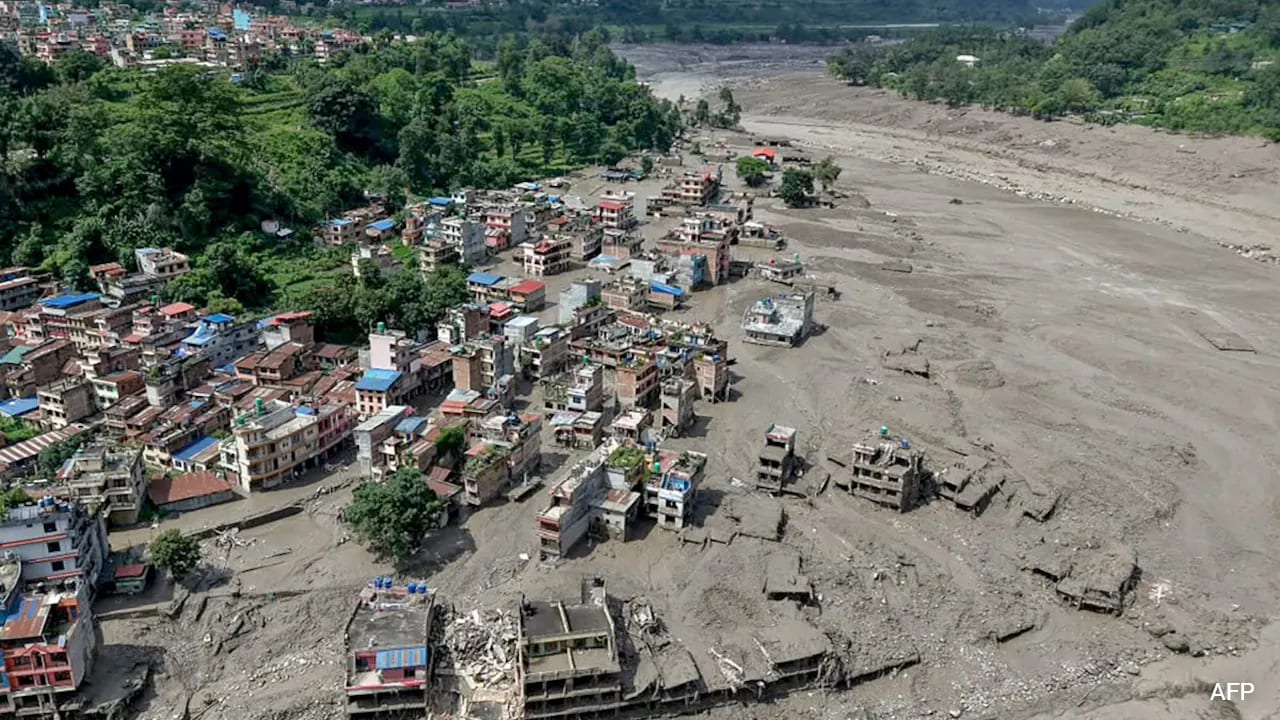
A key hypothesis is that a large ice-rock avalanche occurred high in the mountains.
Hydrological measurements reveal the extraordinary power of the event. Water levels in the Trishuli River at Galchchi reportedly surged by as much as nine metres within just 30 minutes. At Malekhu, river levels climbed by seven metres over a similar period. Such rapid rises are indicative of a sudden release of enormous volumes of water and debris from upstream.
Scientists are now investigating multiple possible explanations for the disaster.
One leading hypothesis is that a large ice-rock avalanche occurred high in the mountains.
Preliminary assessments based on video footage and observations from affected areas suggest that a huge mass of ice and rock debris may have crashed into the Lhende Khola, a tributary of the Bhote Koshi River.
Such an event could have displaced large quantities of water and generated a powerful surge that rushed downstream carrying rocks, sediment and debris.
A second possibility under investigation is the formation of a temporary landslide dam. Experts believe debris from the suspected avalanche may have blocked the river at a narrow section upstream.
Water accumulating behind such a blockage can create a dangerous natural dam. If the trapped water suddenly breaks through, it can generate a powerful secondary flood wave. This possibility has become the focus of immediate concern because authorities believe some blockage may still remain in place.
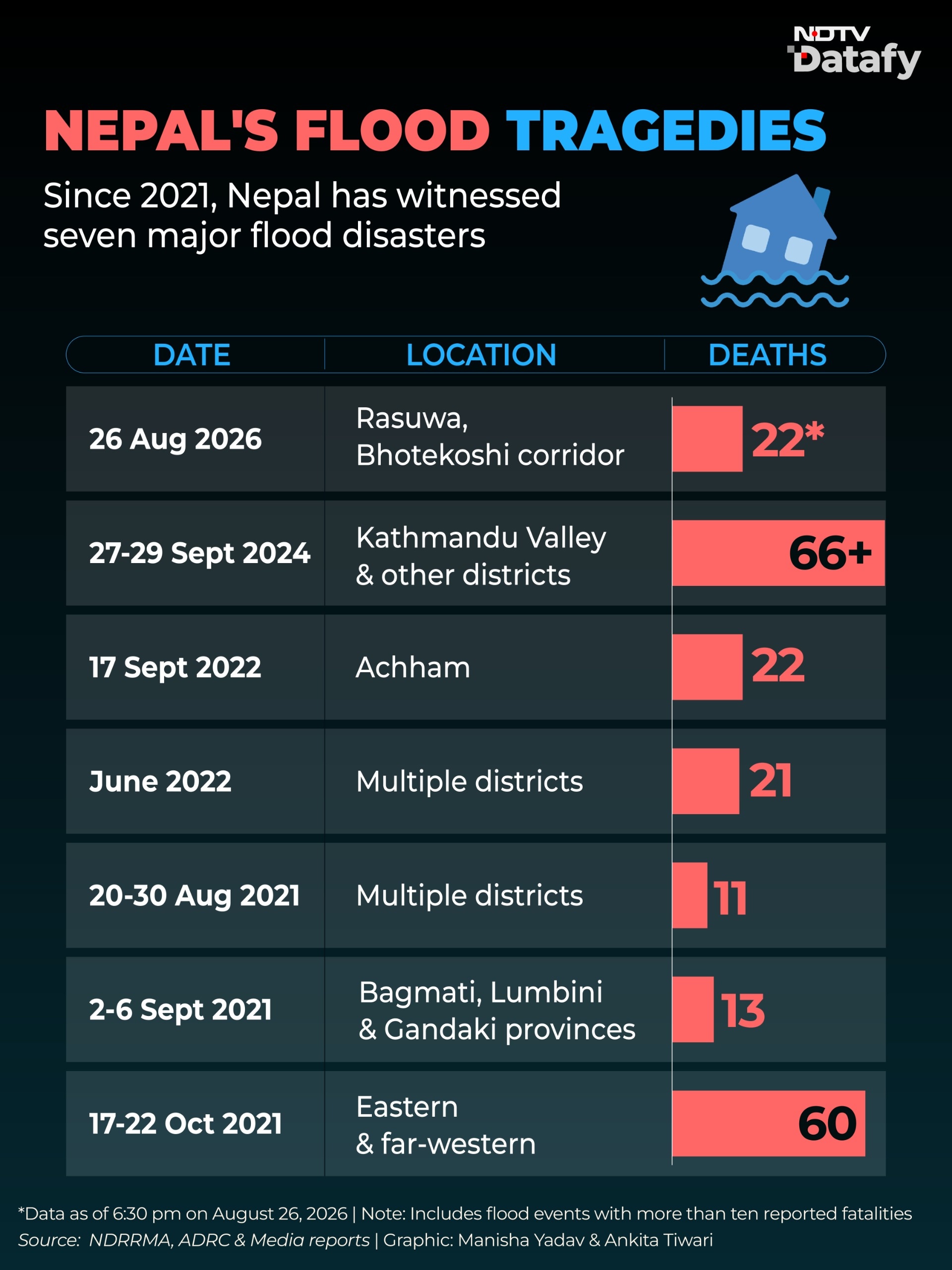
Photo Credit: NDTV
Scientists are also analysing unusual seismic signals recorded during the disaster. Preliminary examination of seismic records revealed anomalous activity detected by monitoring stations in Jilong, located about 12 kilometres from the affected zone, and another station in Zhangmu. Researchers are investigating whether these signals were generated by an avalanche or another major slope failure. However, ICIMOD has stressed that no direct causal relationship between the seismic signals and the flood has yet been established.
The event highlights growing concerns over hazards emerging from the cryosphere, the frozen parts of the Earth that include glaciers, snowfields and permafrost. Changes in these fragile mountain environments can trigger cascading disasters with little warning.
Saswata Sanyal, Disaster Risk Reduction Specialist at ICIMOD, described the incident as an example of how interconnected mountain hazards can rapidly escalate into disasters affecting human settlements.
"The Lhende Khola has flooded twice in fourteen months, this time most probably triggered by an ice avalanche blocked the river and released a sudden surge downstream. This still needs to be confirmed, as we receive further information. These are cascading hazards: a cryosphere event becomes a flood in a settlement within hours," Sanyal said.
Mohd. Farooq Azam, Senior Cryosphere Specialist at ICIMOD, emphasized that extreme mountain hazards are becoming more visible and require stronger cross-border cooperation.
"The increasing frequency of cryosphere hazards is now visible more than ever. The pace is so fast that our ongoing efforts are not able to cope with this rapid change. Today's disaster in the Lhende Khola is another cause for regional collaboration where governments should take some joint, consolidated steps to react to such cross-border hazards," Azam said.
ICIMOD Director General Pema Gyamtsho expressed solidarity with Nepal in the aftermath of the disaster.
"We are deeply saddened by this tragic disaster, which struck so suddenly and unexpectedly. We stand in solidarity with the people and Government of Nepal during this difficult time. Our thoughts and prayers are with the victims, their families and all those affected, and we are committed to providing support wherever possible," he said.
Scientists cautioned that while climate change is altering glaciers, snow conditions, permafrost and mountain slopes across the Hindu Kush Himalaya, it is too early to determine what role climate change played in this specific event.
As scientists continue to analyse hydrological, seismic and satellite data, the immediate focus remains on determining the stability of the suspected upstream blockage. For communities along the Bhote Koshi and Trishuli river systems, the danger may not yet be over. ICIMOD's warning that a second flood could occur has added urgency to evacuation efforts and ongoing monitoring in one of the Himalayas' most vulnerable mountain valleys.
Track Latest News Live on NDTV.com and get news updates from India and around the world

