



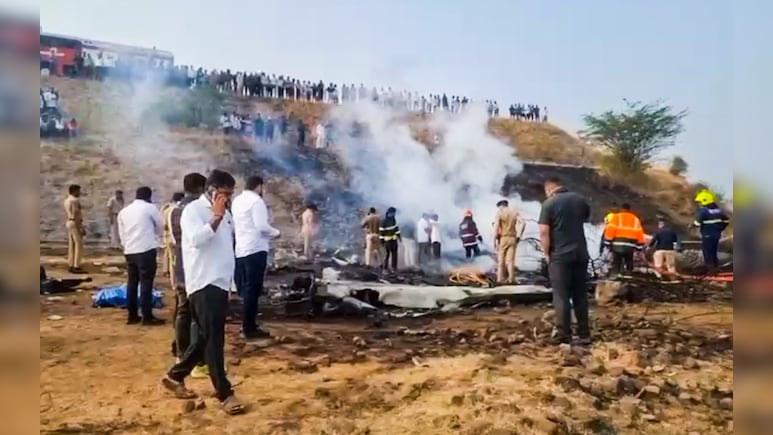
Ten years before the recent Jharkhand air ambulance crash, a similar flight from Patna to Delhi had a very different, miraculous outcome. In 2016, an air ambulance operating from Patna to Delhi went down in Najafgarh. Unlike the Red Airways crash that killed all seven on board, everyone in this accident survived. The pilots were hailed as heroes for averting a disaster.
But the subsequent probe by the Aircraft Accident Investigation Bureau (AAIB) exposed deeper concerns. The aircraft, a 27-year-old VT-EQO owned by Alchemist Air Pvt. Ltd., with a non-scheduled operator permit, had been grounded for five months before the accident.
In its final report, the AAIB noted that no procedure existed within the organisation to assess actual fuel consumption of its aircrafts.
"Absence of a procedure for assessing realistic fuel consumption rate of an aged aircraft is also a cause of concern," the AAIB had said, while listing improper fuel planning leading up to engine starvation as a probable cause of the accident.
Now, a decade later, the Directorate General of Civil Aviation or DGCA has cracked down on non-scheduled operators following a spike in accidents - including the January Baramati crash involving VSR Ventures that left all on board -- including NCP leader Ajit Pawar -- dead.
After analysing ten years of data, the regulator flagged SOP violations, flawed flight planning and training gaps.
In a significant shift, it fixed accountability on senior executives and Accountable Managers, not just pilots. Additionally, the watchdog also grounded four VSR-owned aircraft over serious safety lapses.
While DGCA didn't elaborate on the respective NSOPs, it did include stricter penalties for violations of flight duty time limitations (FDTL) and attempts to land below prescribed safety minima.
Multiple Accidents
NDTV went through a decade of Aircraft Accident Investigation Bureau's final reports and found that past probes have revealed that such violations aren't one off instances.
Moreover, multiple incidents were reported on Uttarakhand's Char Dham Yatra route last year. At least five helicopter incidents were reported in just six weeks, linked to low visibility and weather conditions. Two of them were fatal and claimed 13 lives. The final probe reports on these are awaited.
Last June, a two-year-old was among the seven on board a civilian helicopter when it crashed due to low visibility and weather conditions. The Bell 407 (VT-BKA), operated by Aryan Aviation Pvt Ltd, crashed near Gaurikund.
After the crash, an FIR was filed against two company officials for alleged violation of protocols set by the Directorate General of Civil Aviation (DGCA) and the Uttarakhand Civil Aviation Development Authority (UCADA), NDTV found.
The operator had faced tragedy and was also fined before.
In 2022, another Aryan Aviation helicopter crashed near the Kedarnath helipad leaving all seven on board dead. The AAIB's final report concluded that the crew had failed to properly assess weather conditions before take-off, NDTV found.
The DGCA has since mandated real-time weather update systems and recurrent pilot training with enhanced focus on weather awareness.
Aryan Aviation was fined the same year for several violations including inaccurate flying records, falsified flight logs, as well as non-compliance with maintenance schedules. Four other operators were also fined by the DGCA following a three-day audit.
In a separate incident in 2023, an official of the Uttarakhand Civil Aviation Development Authority died after being struck by a helicopter's tail rotor. Investigators found that mandatory passenger safety briefings and escort procedures were not conducted in accordance with SOPs.
"Safety briefing of passengers was not carried out before boarding as per SOP. SOPs were not followed for escorting the passengers for embarkation," the AAIB report notes. Investigators then also recommended that DGCA issues directions to all helicopter operators to "strictly adhere to the SOPs regarding safety briefing provided to the passengers prior to boarding".
The SOP is passenger embarking and disembarking is carried out by operator's ground staff, with rotors running. But in this case, it was done by UCADA officials and not the Kestrel Aviation Pvt. Ltd's dedicated personnel.
In one accident from May 2021 involving an air ambulance, the AAIB report reveals that the posts of the Quality Manager and the Chief of Flight Safety have been at a higher attrition rate than the others within the company Jet Serve Aviation Pvt. Ltd.
While this wasn't part of the conclusion or was directly attributed to any organisational lapse, investigators did note that the Chief of Flight Safety post was lying vacant as on the date of the accident.
The AAIB recommended that DGCA may carry out a detailed audit of the operator facilities to ensure the required standards are met and also asked the operator to address its high attrition rate in these key posts.
In a March 2021 accident involving Pinnacle Air Pvt Ltd, investigators found there was no Cockpit Voice Recorder (CVR) or Digital Flight Data Recorder (DFDR) installed.
The AAIB report said the crew failed to communicate the actual reason for the emergency to the Air Traffic Controller and did not fully follow emergency procedures. The probable cause was identified as oil leakage from the left engine mid-flight, leading to lubrication failure and overheating, though the root cause of the leak could not be determined. The AAIB recommended that the DGCA audit the operator's contracted maintenance organisation.
Track Latest News Live on NDTV.com and get news updates from India and around the world

