





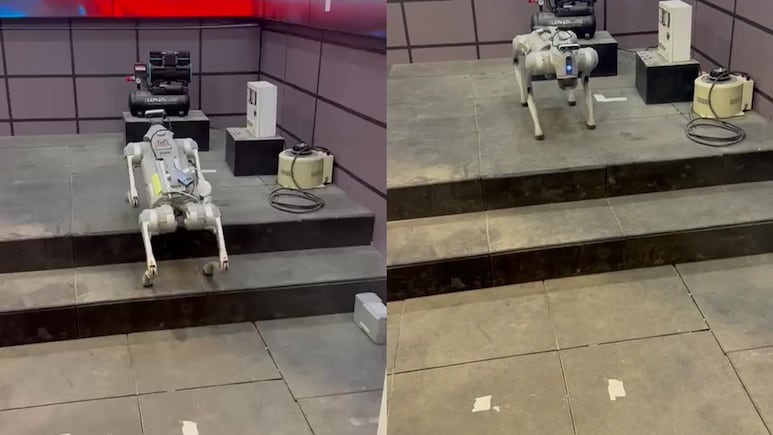
A quadruped machine that can navigate rubble, climb stairs, and diagnose mechanical failures without human intervention is the centre of attention at the India AI Summit.
This robot, developed for industrial "Physical AI" by Tata Consultancy Services, is designed to operate in industrial environments such as construction sites, warehouses, manufacturing plants and distribution centres.
By mimicking the movement of an animal and combining it with high-performance onboard processing, the unit can patrol construction sites, factories, and warehouses to perform inspections in complex, noisy, and risky environments. Today, inspections in such places are mostly manual, which increases the risk while checking equipment, recording readings and pointing out errors.
In heavy industries, even a small, unnoticed issue like a pressure drop or voltage fluctuation can turn into major downtime or a serious safety incident.
That's where this quadruped changes the game.
In the live demonstration, the quadruped robot operates inside a simulated factory setup. It walks independently across uneven surfaces, climbs elevated stairs and accesses restricted or difficult zones.
The robot's autonomy is driven by an integrated suite of LiDAR, depth cameras, and environmental sensors, all managed by an onboard GPU that allows it to interpret data in real time.
The robot captures readings from critical equipment such as compressors, electrical panels and power distribution units. Rather than simply recording video for a remote operator, the robot uses "closed-loop logic" to investigate anomalies. For instance, if it detects a pressure drop in a compressor, it does not just log the error; it automatically reroutes itself to check the connected power distribution units, attempting to validate the root cause before alerting a human technician.
When the system finds a problem, it immediately sends a maintenance alert. Technicians are informed at once so they can take action quickly. Humans are still involved in the process. The goal is not to replace workers but to keep them away from dangerous areas and help them work faster and smarter. This ability to cross-reference symptoms makes the machine an active diagnostic tool rather than a passive observer.
Beyond simple equipment monitoring, the robot is capable of detecting gas leaks, thermal fluctuations, and welding defects that the human eye might miss. On construction sites, it functions as an autonomous auditor, scanning structural joints and comparing the physical progress of a building against its digital architectural blueprints. It also serves a safety function by monitoring work zones for compliance, identifying whether personnel are wearing required protective gear and triggering alerts if violations occur.
By taking over the tasks of manual patrolling, the robot keeps workers away from high-voltage panels and chemical-leak zones while providing them with more accurate data. The system is built to bridge the gap between digital AI and the physical world.
Track Latest News Live on NDTV.com and get news updates from India and around the world

