



- IBM plans to set up India's first commercial quantum computer in Amaravati's Quantum Valley Tech Park
- The IBM Quantum System Two will use advanced quantum processors with TCS aiding algorithm development
- Quantum computers require extreme cooling near absolute zero to maintain superconductivity
Amaravati, the under-construction capital of Andhra Pradesh, is preparing to host what could become one of the most consequential pieces of scientific infrastructure ever built in India: a full-scale quantum computing facility anchored by IBM.
If plans now that are taking shape materialise as intended, IBM will set up the country's first large, commercial-grade quantum computer at the Quantum Valley Tech Park in Amaravati, marking a decisive shift in how India approaches next-generation computing.
The proposed installation, an IBM Quantum System Two powered by an IBM's most advanced quantum processor that would be the most powerful quantum computer ever envisioned on Indian soil. Discussions between IBM and the government of Andhra Pradesh are at an advanced stage, and Tata Consultancy Services (TCS) has joined the initiative to help develop algorithms, applications and skills that can put quantum computing to work for Indian industry and academia. Together, the partners see Amaravati as the nucleus of a national quantum ecosystem aligned with India's ambitious National Quantum Mission.
For most people, the word "computer" still means silicon chips, transistors and laptops that have steadily become faster and smaller over decades. Quantum computers, however, represent a radically different approach, one that even seasoned technologists describe as counter-intuitive.
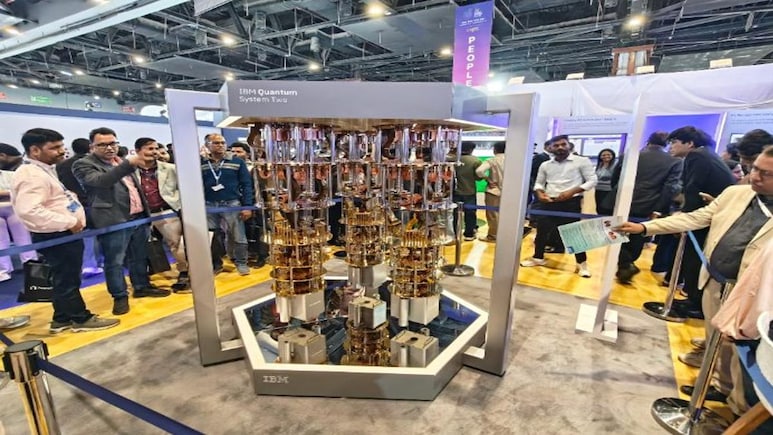
Standing beside a life-size replica of IBM's quantum computer, a striking chandelier-like structure of gold-coloured plates and tubes, Amithh Singhee, Director of IBM Research India and Chief Technology Officer of IBM India and South Asia, put it plainly: "The quantum computer does not work like a normal computer at all. Not just that it does not look like one, the way you program it, the way it works, is very different."
Beyond Silicon
Classical computers are built on bits that exist in one of two states, 0 or 1. Everything from email to supercomputer simulations ultimately boils down to this binary logic. Quantum computers, by contrast, use quantum bits or qubits, which can exist in multiple states at once through a property called superposition, and can be linked through entanglement. This allows certain kinds of calculations to be performed in ways that classical machines simply cannot manage efficiently.
"We have been using computers for many decades, and yet there are classes of problems for which even the biggest supercomputers are not very efficient," Singhee explained. "If you want to simulate the chemistry inside a battery, or how a protein and a drug interact at the electron and molecular level, classical computers can only do approximations. Once quantum computers become powerful enough, you can reproduce that behaviour much more precisely, in a reasonable time."
That promise, of modelling nature at the quantum level, is what has drawn global attention to the field. Potential applications range from drug discovery, vaccine development and materials science to energy optimisation, climate modelling and complex logistics.
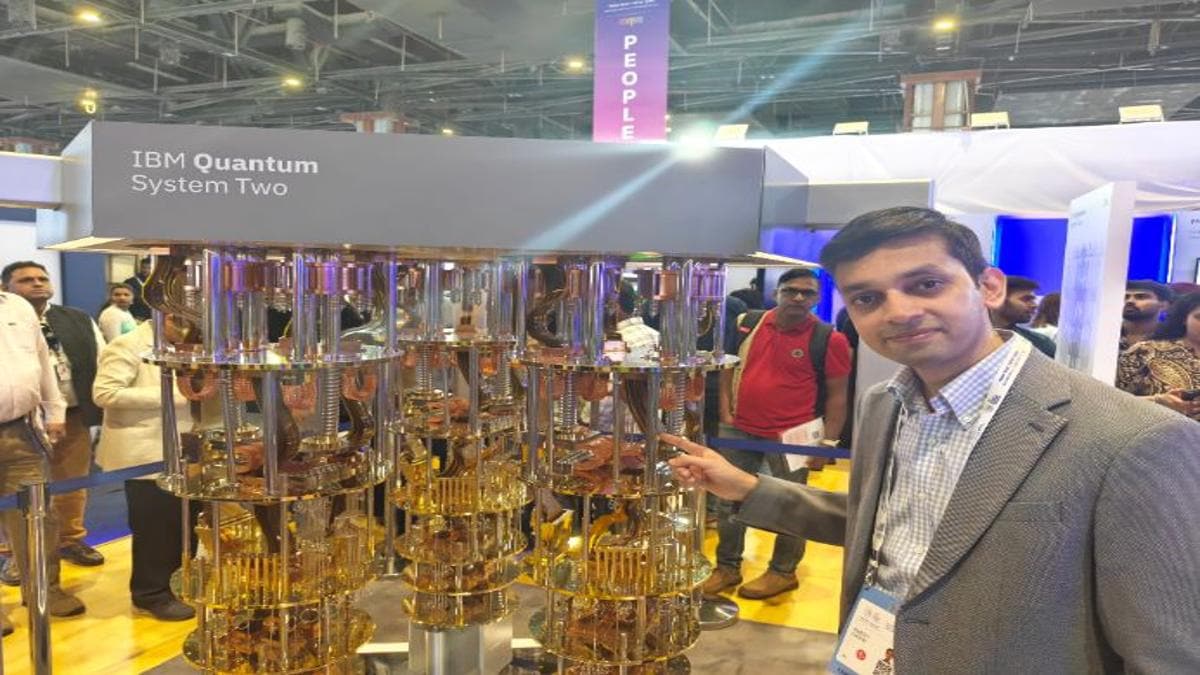
Amithh Singhee, Director of IBM Research India and Chief Technology Officer of IBM India and South Asia, beside a replica of IBM's Quantum computer. "The quantum computer does not work like a normal computer at all. Not just that it does not look like one, the way you program it, the way it works, is very different," he said.
India's Quantum Mission
India's push into quantum technologies is being driven by the National Quantum Mission (NQM), approved by the Union Cabinet in April 2023 with an outlay of Rs 6,003 crore over eight years (2023-24 to 2030-31).
The mission aims to seed and scale up both scientific and industrial research across quantum computing, secure quantum communications, quantum sensing and metrology, and quantum materials, with the goal of positioning India among the world's leading quantum nations.
Under the NQM, the government has set up four thematic hubs and is investing in intermediate-scale quantum computers with 50 to 1,000 qubits, satellite-based quantum secure communication networks, and a large national talent-development programme. The Amaravati Quantum Valley initiative, anchored by IBM's proposed quantum computer, is seen as a critical industry-facing complement to the mission, translating public investment in quantum science into real-world applications, jobs and strategic capability.
Colder Than Outer Space
The not so computer like or albeit "funny-looking machine" that drew crowds at the recently concluded AI summit in India is not a futuristic design for its own sake. It reflects the extreme physical conditions required for quantum computing. The actual quantum processor sits inside a dilution refrigerator, cooled to temperatures in the milli-kelvin range.
"By the time you get to the box where the chip is, it is colder than outer space," Singhee said. "Near absolute zero. That is essential because these are superconducting qubits. At higher temperatures, noise sets in and superconductivity goes away."
This need for extreme cooling has often led people to assume that quantum computers will remain rare laboratory curiosities. Singhee counters that view. "You can keep it cold and contained. What matters is creating the right environment for the properties of the qubit to emerge."
IBM today operates a global fleet of quantum computers, with more than 20 systems available via the cloud and over 80 built so far. Yet having a machine physically located in India carries strategic significance.
"There is value in having a data centre with a quantum machine here," Singhee said. "India wants to do research here and keep the intellectual property here. It helps build an ecosystem and gives confidence that the IP stays in the country."
Amaravati's Quantum Ambition
The Quantum Valley Tech Park in Amaravati is designed precisely with that ecosystem in mind. Under current plans, members of the tech park will be able to access IBM's quantum computers through the cloud, facilitated by TCS, even before the physical system becomes operational. Once installed, the IBM Quantum System Two would serve as a focal point for research, training and industrial experimentation.
Andhra Chief Minister N Chandrababu Naidu has framed the project as central to India's long-term technological competitiveness. The state government hopes the park will create high-end jobs, attract global talent and investment, and contribute directly to the goals of the National Quantum Mission.
For IBM, the Amaravati facility fits into a global roadmap that envisions much larger machines in the future. "We see a future where you will have many machines connected together, just like servers in a data centre," Singhee said. "By around 2033, we are talking about systems with over 100,000 qubits."
Protecting The Classical World
Quantum computing's power also raises a more unsettling question: could it be used to break today's digital security? Much of the world's online infrastructure, including banking and secure communications, relies on cryptographic systems such as RSA (RSA (Rivest-Shamir-Adleman) is a foundational asymmetric cryptographic algorithm used for secure data transmission, digital signatures, and key exchange), which are based on mathematical problems that are extremely hard for classical computers to solve.
"That assumption is that we will only forever have classical machines," Singhee said. "When sufficiently powerful quantum computers arrive, that assumption no longer holds."
However, he was careful to stress that today's quantum machines are nowhere near capable of breaking real-world encryption. "Even the real ones today are not powerful enough. That time will come, but not yet."
What is happening in parallel is the development of post-quantum cryptography, new encryption methods based on mathematical problems believed to be resistant even to quantum attacks. "There is a lot of work going on to come up with cryptography that cannot be hacked by quantum computers," Singhee said. "Post-quantum cryptography uses mathematics that is not easily solvable even by a quantum machine."
The challenge, he noted, is migration. "As a society and as an industry, we will have to move from current cryptography to post-quantum systems. That migration has to start well before quantum computers become powerful enough to pose a threat."
India has begun to look at policies around post-quantum security, but Singhee believes execution will need to accelerate.
From Curiosity To Capability
At the AI summit where IBM showcased the quantum computer replica, the machine became a magnet for curiosity, a visual reminder that computing's future may look nothing like its past. Yet for IBM and its partners, the focus is firmly on moving beyond spectacle.
"Today, people are still discovering how to use quantum computers effectively," Singhee said. "Once we reach that level of understanding, the real discoveries will come."
That journey, he believes, is as much about people as hardware. Through cloud access, academic programmes and industry partnerships, IBM and TCS are working to build a generation of Indian scientists and engineers who are comfortable thinking in quantum terms.
As construction progresses at Amaravati and plans for India's first full-scale quantum computing facility take shape, the message from IBM is clear: quantum computing is no longer a distant scientific curiosity. It is becoming infrastructure, and India intends to be part of that future from the ground up.
Track Latest News Live on NDTV.com and get news updates from India and around the world

