





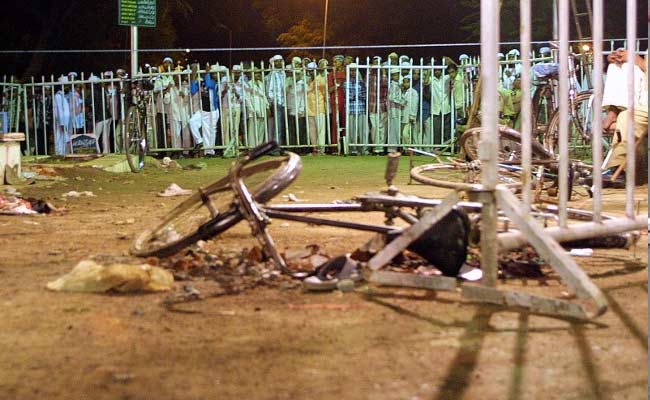
- The Bombay High Court discharged the final four accused in the 2006 Malegaon blasts case
- The 2006 blasts killed 31 people and injured 312 near Hamidia Masjid and Bada Kabrastan
- All accused have now been cleared, leaving the case unresolved after nearly 20 years
The Bombay High Court's discharge of the final four accused on Wednesday marks a stalemate in the two-decade-long prosecution into the 2006 Malegaon serial blasts in which 31 people were killed. The ruling by Chief Justice Shree Chandrashekhar and Justice Shyam Chandak concludes a case defined by "diagonally opposite" investigative theories presented by three of India's premier agencies.
The 2006 Triple-Blasts
On September 8, 2006, four improvised explosive devices (IEDs) detonated in the textile town of Malegaon, Maharashtra. The explosions occurred near the Hamidia Masjid and Bada Kabrastan during the Friday prayers of Shab-e-Baraat. The devices, three of which were rigged to bicycles, killed 31 people and injured 312 others. Local police and forensic teams initially handled the site, which would soon become the centre of one of the most complex jurisdictional handovers in Indian legal history.
The ATS-CBI Phase
The Maharashtra Anti-Terrorism Squad (ATS) took the lead in 2006, filing a chargesheet that attributed the blasts to the Students Islamic Movement of India (SIMI). The ATS alleged that the conspiracy was orchestrated with cross-border assistance to incite communal tension. By 2007, the Central Bureau of Investigation (CBI) took over the probe and ratified the ATS findings, confirming the involvement of nine Muslim men. These individuals remained in custody for years based on forensic evidence, including the alleged recovery of RDX traces from a godown.
The NIA Intervention
The trajectory of the case shifted in 2011 when the National Investigation Agency (NIA) was tasked with a fresh probe. Following a confession by Swami Aseemanand in a related case, the NIA pivoted the investigation entirely. In 2013, the agency filed a supplementary chargesheet naming four new accused -- Manohar Narwaria, Rajendra Chaudhary, Dhan Singh, and Lokesh Sharma. This new narrative alleged that the 2006 blasts were retaliatory strikes by right-wing elements, contradicting the prior findings of the ATS and the CBI.
The NIA's "Version 2.0" of the crime failed to legally supersede "Version 1.0." In 2016, a special court discharged the original nine accused, citing a lack of evidence in light of the NIA's new findings. However, the NIA's own case against the second set of accused relied heavily on retracted confessions and circumstantial links regarding the purchase of bicycles. The Bombay High Court noted that the NIA failed to explain or disprove the forensic evidence (like the RDX traces) that the ATS had originally used to charge the first group, leaving a prosecution narrative that was logically and legally at odds with itself.
The Current Legal Scenario
The discharge of Lokesh Sharma, Dhan Singh, Manohar Narwaria, and Rajendra Chaudhary means that every individual ever charged in connection with the 31 deaths has been released or cleared. The state's inability to reconcile the conflicting investigations of the ATS and the NIA has resulted in a collapse of the case. For the families of the victims, the judicial clock has been reset to zero, with no active trial or viable suspects identified two decades after the blast.
Track Latest News Live on NDTV.com and get news updates from India and around the world

