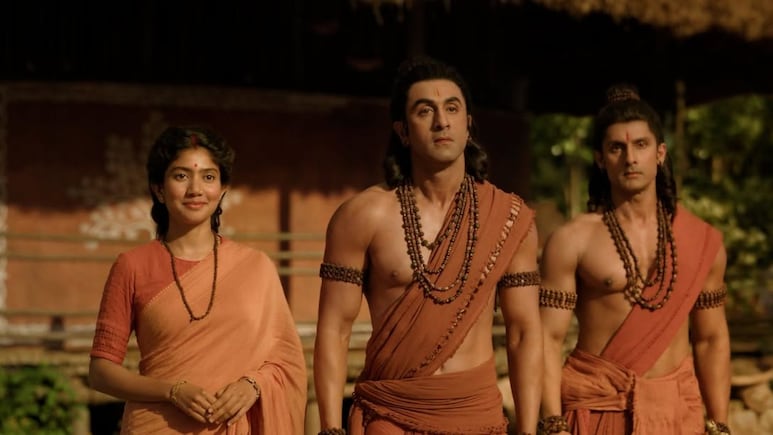
There is no shortage of conversation around Nitesh Tiwari's Ramayana: Part One. From its reported Rs 4,000 crore budget and star-studded cast to its music and visual effects, the film has become one of the most closely watched Indian productions in recent years.
The VFX, in particular, has generated significant discussion online. While some viewers have praised the scale of the visuals, others have questioned the quality of the effects based on teaser and trailer clips. However, the film's makers insist that what audiences have seen so far is only a glimpse of a much larger cinematic vision.
The English trailer itself tells us the film's global ambitions, carrying the line: "From the visual artists that brought you The Odyssey, Dune, Interstellar." The reference is significant because DNEG (Double Negative) served as the lead visual effects studio behind Christopher Nolan's Interstellar as well as Denis Villeneuve's Dune films.
Building The World Of Ramayana
Ramayana: Part One is shaping up to be one of the most ambitious films ever mounted in India, bringing together large-scale storytelling, international talent, and cutting-edge visual effects to recreate the world of the ancient epic.
Leading the film's visual effects efforts are DNEG and ReDefine, the studios headed by producer Namit Malhotra. The teams have worked hard to build the expansive universe of Ramayana, which includes mythological kingdoms, sprawling landscapes, large-scale battle sequences, and visually rich settings central to the story.
As per a report by Business Today, the film relies heavily on visual effects to create and expand key locations, craft detailed digital environments, and seamlessly blend computer-generated imagery with practical sets and live-action performances. The aim is to present a cinematic world that feels immersive, cohesive, and grounded despite its mythological scale.
The production has also assembled an international creative team. Production designers Ravi Bansal and Ramsey Avery have overseen the film's visual design, while action specialists Terry Notary and Guy Norris have led the stunt and action choreography.
The Risk That Started It All
In an interaction with Komal Nahta on ETC nearly 15 years ago, Namit looked back at a decision that shaped his career and the future of his visual effects business. Namit revealed that his family mortgaged their home to secure funding for the VFX venture.
Recalling the risk his family took in the late 1990s, he said, "In 1997, I knew there was no bigger risk than this. My company's turnover was Rs 75 lakh, and the loan we had taken was Rs 2 crore. I knew that if the business failed, our story would have been completely finished. After all, it was a new technology. We would have become homeless, as we had invested everything in it. I was 21. But without flinching, my father did it, maybe because I am his only son."
An 86-Camera Setup And Meticulous Planning
Actor Indiran Krishnan, who plays Kaushalya in the film, offered a glimpse into the scale of the production while speaking to NDTV.
Recalling her experience during the preparation process, she said, "I remember when I went in for my body measurements, they told me the machine was used for (Christopher Nolan's) Interstellar. It was an 86 camera setup. All 86 cameras flashed on me at once - I was zonked. They told me it's for the VFX, not just costume fittings. I had no idea how younger versions of the characters would be created. The process was meticulous. Even how Kaushalya walks or sits everything was planned. There were no dramatic dialogues, only poise and control."
She praised production banner Prime Focus and the VFX team, led by Jaykar, for the precision and scale of their work. "It is not easy to gather such a huge cast in one frame and seamlessly execute such heavy VFX."
Criticism
Ranbir Kapoor has a message for those judging the visual effects of Ramayana before watching the film in theatres. The actor has defended the extensive VFX work behind the upcoming epic and said people often do not realise how much time and effort goes into creating such visuals.
In a recent chat with Collider, Ranbir spoke about the growing number of people online who closely scrutinise computer-generated visuals after watching a film's teaser or trailer.
He said, "There's also a new phenomenon right now that in the last few years, there has been such a large number of people online who have become CG critics. They see a trailer and they are always critiquing that it's not good enough or it's seeming like it's not done."
The actor said the conversation around VFX has changed because audiences are now more interested in how computer-generated imagery is made. However, he believes many people may not fully understand the process.
"I feel like people are getting more aware, especially with the influx of AI. People are getting more interested in how good the CG is and how good the CG will finally look once the film releases. And I think that is quite funny sometimes. Because people who don't know how CG is done, people think like someone's just used some AI and released something. There are countless hours of work where artists are working for years. I have seen Nitesh sir and Namit sitting on VFX calls ever since this project started, trying to get even the colour of the sky right. It's tricky right now to really impress the audience with authentic CG," said Ranbir Kapoor.
Years of Work Behind A Single Sequence
Ramayana director Nitesh Tiwari, who was also part of the conversation, spoke about the amount of work that has gone into the film.
According to the filmmaker, some of the VFX sequences have taken close to three years to complete. The scale of the project has meant that the team has spent years refining individual scenes and ensuring they meet the film's visual standards before release.
Why the Makers Want Audiences to Watch It on the Big Screen
Producer Namit Malhotra also addressed the online reaction to the film's earlier teaser.
He said the response was very different when the same footage was shown to audiences on a large IMAX screen in 3D.
"When we launched our previous teaser, we heard a fair amount of noise around some aspects of what we had done. And the same people, when we showed it to them on a big IMAX screen in 3D, all of those conversations changed. Because they are also judging stuff on their phones, and not in great condition," said Namit.
He added that Ramayana has been designed with the theatrical experience in mind and urged audiences to watch the visuals on the big screen before forming an opinion.
"Here we are spending years and millions of dollars to try and make something for that big screen experience that we are waiting patiently to bring to you. And then you judge it on a phone or a not-great internet connection, saying, 'No, that's not good enough.' Only to be told, when you see it on the big screen it's meant to be consumed on, that it's actually beautiful," he further added.
Namit said the team has also invited creators and influencers to experience the footage in the format for which it was designed.
Drawing a comparison with watching Christopher Nolan's The Odyssey in 70mm IMAX, he argued that certain cinematic experiences simply cannot be replicated on a mobile phone or personal device.
The producer also reflected on his experience working with Nolan and explained how significantly a film can differ when viewed in a cinema.
"We know for a fact, because we have collaborated with Chris on all his films, that what you see in that theatrical experience, visually and in terms of audio, is completely unique to what you would watch on any digital device. And that exactly proves the point. Come judge it there and if you don't like it, that's fair," said Namit Malhotra.
Ramayana is planned as a two-part film and remains one of the biggest bets Indian cinema has made on visual storytelling.
