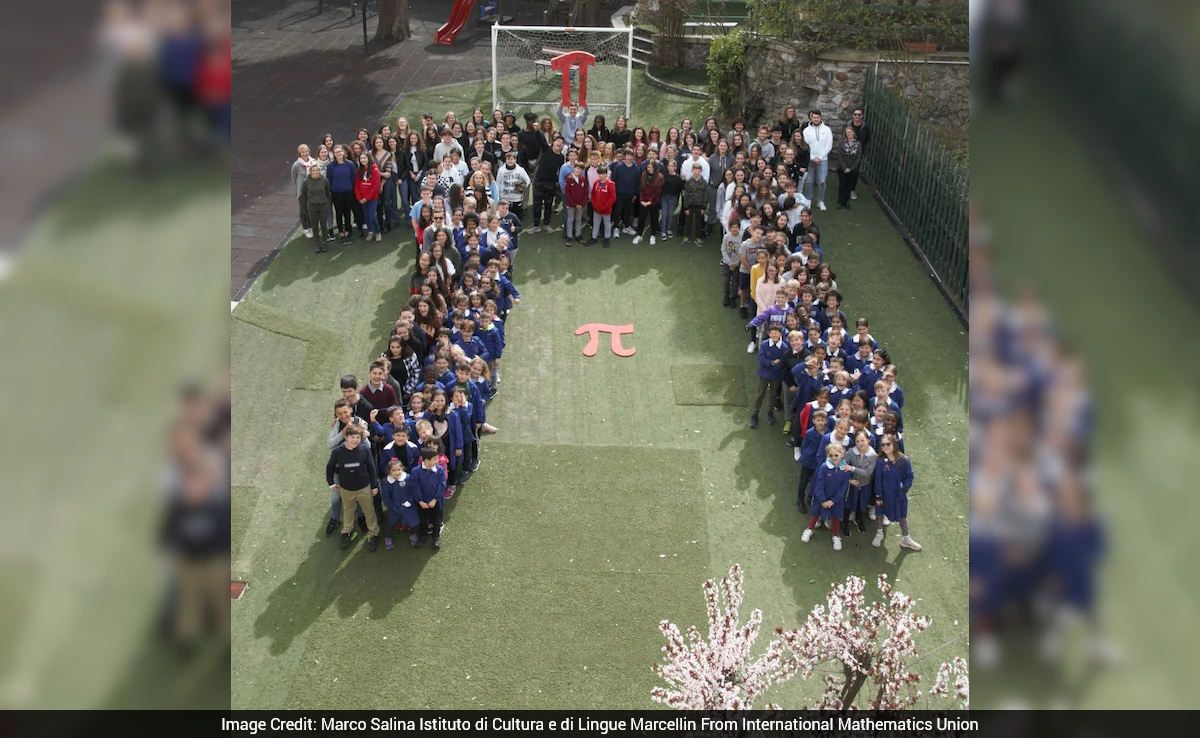
Pi Day 2026: March 14 is celebrated every year as Pi Day to commemorate the Mathematical constant Pi. The day also marks the birth anniversary of physicist Albert Einstein and is observed as a national holiday in the United States.
Pi represents the ratio of a circle's circumference to its diameter. When the circumference of any circle is divided by its diameter, the result is always approximately 3.14, whether the circle is as small as a pie plate or as large as a planet.
The date March 14 is written as 3/14 in the month/day format, which matches the first three digits of Pi. This makes it a fitting day for mathematicians, students and enthusiasts to celebrate the mathematical constant.
What Makes Pi Important And Unique?
Pi is an irrational and non-terminating number (3.14159...), meaning its digits go on infinitely without repeating. Because of this, the exact value of Pi can never be fully calculated, though approximations are widely used in Mathematics and Science.
Some theories also suggest that the Pyramids of Giza were designed using principles related to Pi. There is even a playful writing style based on Pi's digits known as "Pi-lish."
Origin Of Pi Day Celebrations
Physicist Larry Shaw, often called the "Prince of Pi," began celebrating Pi Day on March 14 at the Exploratorium in San Francisco.
At the Exploratorium, Pi Day celebrations traditionally include a pie feast, featuring fruit pies and tea. A ritual known as the pi procession is also held, where participants circle the Pi Shrine 3.14 times while listening to "Pomp and Circumstance," waving the digits of Pi and singing "Happy Birthday" to Albert Einstein before sharing slices of pie.
MIT Releases Admission Decisions On Pi Day At 'Tau Time'
Massachusetts Institute of Technology typically announces its undergraduate admission decisions on Pi Day (March 14), aligning with the annual celebration of the mathematical constant pi, according to their official website. In keeping with this tradition, the institute often releases the decisions at 6:28 p.m. Eastern Time - a moment informally known as "Tau time," referencing tau (2 pi), which equals approximately 6.28.
History Of Pi Day
In 1988, Larry Shaw first recognised March 14 as Pi Day at the Exploratorium. In 2009, the United States House of Representatives officially designated March 14 as Pi Day.
Later, in 2019, UNESCO declared the day as the International Day of Mathematics during its General Conference.
The value of Pi was first calculated by the ancient Greek mathematician Archimedes. The symbol of Pi later became widely accepted after mathematician Leonhard Euler used it in 1737.
How To Celebrate Pi Day
One interesting way to celebrate Pi Day is by recreating Buffon's Needle, a probability experiment used to estimate the value of Pi. The method was developed in the 18th century by French naturalist and mathematician Georges-Louis Leclerc, Comte de Buffon.
The experiment involves tossing toothpicks or needles onto a lined surface. By observing how often the needle crosses the lines and calculating the results, participants can estimate the value of Pi.
The more times the experiment is repeated, the closer the estimate comes to the true value of Pi. This technique works on any lined surface, as long as the distance between the lines is greater than the length of the object being thrown.
