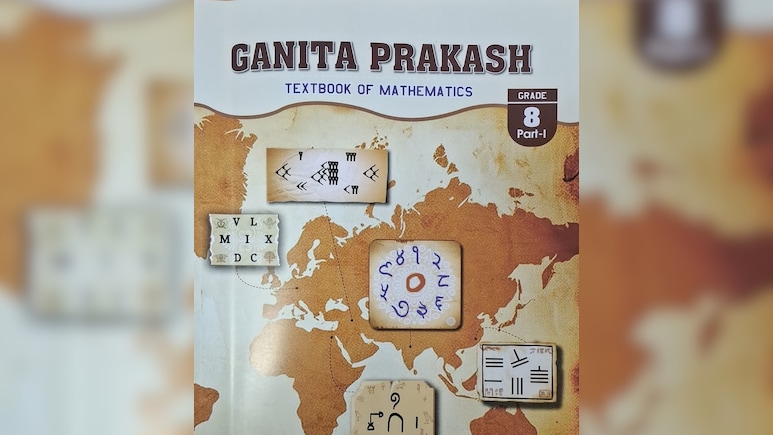

NCERT New Class 8 Mathematics Textbook Ganita Prakash: The National Council of Educational Research and Training (NCERT) has launched new textbooks for Classes 5 and 8 this year in line with the National Education Policy (NEP) 2020 and National Curriculum Framework for School Education (NCF-SE) 2023. The Class 8 Mathematics textbook, Ganita Prakash, aims to make learning more interactive, engaging, and connected to real-life applications.
It encourages students to link mathematical problems with everyday scenarios-such as "What mathematics is involved in making a cup of coffee?"-and incorporates the contributions of historic mathematicians like Aryabhatta, Aryabhatta-II, and Brahmagupta to explain various concepts.
-

-
 Is AI Bubble Waiting To Burst? Nikhil Kamath Warns Of Tougher Months Ahead
-
 "We Don't Have 5 Years": Celebrated American General Sounds Alarm On War
-
 "There Will Be Issues Between Big Countries": S Jaishankar On India-China
-
 Neha Goyal Makes Stunning Asian Games Gold Revelation At NDTV World Summit 2026
-
 Big NDTV Summit Impact: RBI Governor's Tata Sons Listing Remark Makes Top Newspaper Headlines
-
 "Certainty Is A Problem": Nikhil Kamath On Marriage, Children And Future
-
 "High Inflation Is Like Tax On Everyone": RBI Governor At NDTV World Summit
-
 RBI Governor Sanjay Malhotra's Big Hint On Tata Sons Listing Row At NDTV World Summit
-
 The Mystery Of A Bare Nail In Ashwini Vaishnaw's Office
-
 To PM Modi's "Failed Product" Jab At Rahul Gandhi, A Shashi Tharoor Counter
Here is a list of the Key Features of the New Class 8 Mathematics Textbook:
1. Contextual Examples
Contextual examples are used in the textbook to make students develop and understand connections- especially how Mathematics is related to the real world. For example- how a carpenter's problem is solved with Mathematics- "If you have two sticks of equal length and a thread, can you make a rectangular frame using the thread".
2. Hypothetical Questions
Engaging questions, such as "How many times would you need to fold a sheet of paper to reach the moon?" introduce students to large numbers and quantities.
3. Exploration of Patterns
The book encourages students to spot patterns for solving one question. One section discusses the famous "Hardy-Ramanujan" number, 1729, the smallest number expressible as the sum of two cubes in two distinct ways.
4. Hindu Number System
The textbook introduces students to the significance of "Hindu Numbers" and "0"- how the Hindu Number System is robust in using only 10 numbers in representing any number of quantities and more.
5. "?" Mark
The "?" mark is used in the textbook to indicate students to start thinking and figure things out. A bold "?" denotes a main question, while a regular one indicates a sub-question, prompting students to think and explore.
6. Teacher's Guide
Includes suggestions for educators on effectively using the textbook.
7. Puzzles and Games
Puzzles, Games and activities are introduced in the textbook to make learning fun and engaging and questions are used in each part of the section rather than at the end of the chapters.
8. Illustrations and Comics
Colourful visuals and comics make concepts easier to grasp and more engaging.
Overall, Ganita Prakash introduces a fresh approach with visual cues, historical references, and real-world contexts to spark curiosity and critical thinking in students.
