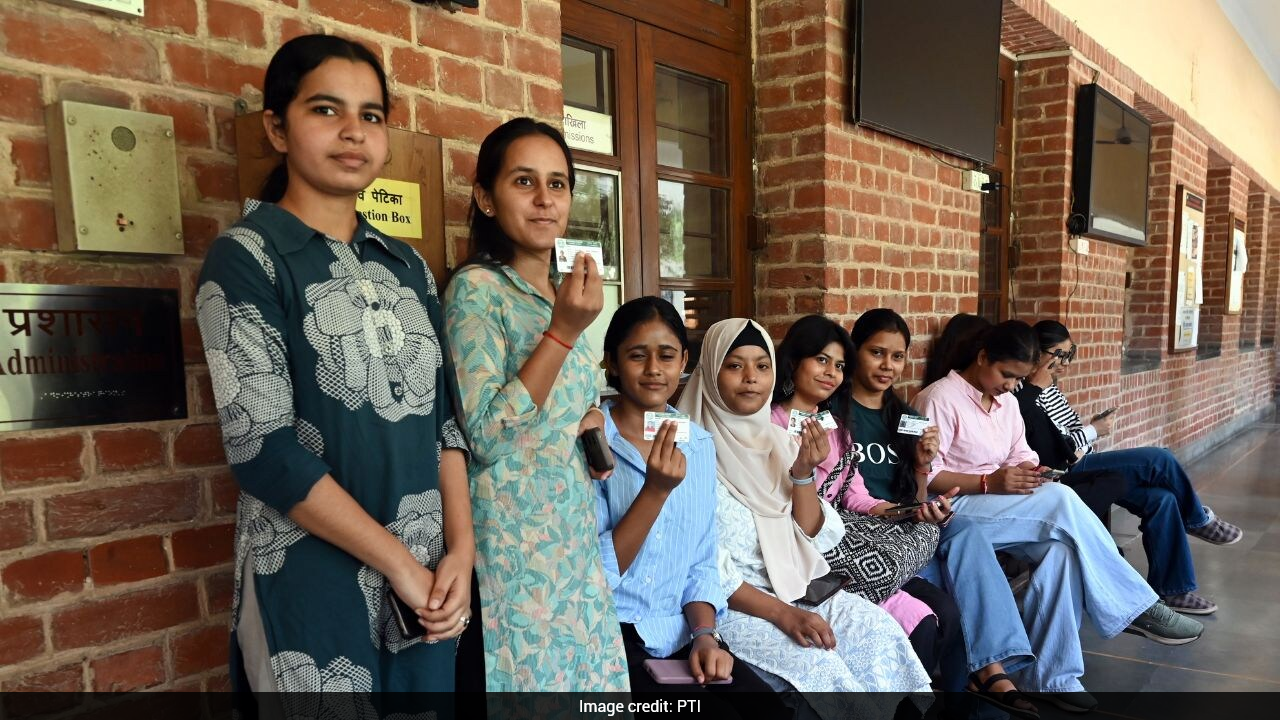

The election slogans and energy of polling day are unmistakable across Delhi University - crowded campuses, students queuing to vote, and campaign pamphlets being handed out across the university. But beneath the election buzz, students say the issues shaping their vote this year are far more basic - where they live, how safely they travel, how much they pay, and whether their campuses provide adequate infrastructure.
"I don't think this time we're voting on the basis of caste or regionalism. This time, the vote is about issues of accommodation, roads, safety, and basic infrastructure," a third-year student of Hindu College told NDTV.
That sentiment is echoed across campuses, where students say the shortage of affordable and safe accommodation, women's safety, rising fees, poor civic infrastructure, and the demand for a metro concession are among the issues shaping their choices.
The concerns have acquired particular urgency after the Satya Niketan tragedy earlier this month, in which a five-storey building being used as a private student hostel collapsed, killing seven people, including five Delhi University students. The incident has put the safety of private PGs and student accommodation at the centre of conversations on campuses.
Nikhil Patidar, a third-year BCom student at Hansraj College, said hostel accommodation was among the key issues on his mind.
"Fee hikes and hostel accommodation are major concerns. Many students come from outside Delhi and struggle to find affordable and safe housing. After the Satya Niketan incident, the issue of student accommodation has become even more important," he said.
For students who come to Delhi from outside the city, accommodation is not simply about finding a room; it is about finding one that is affordable, accessible, and safe.
Nikhil also pointed to problems with basic infrastructure inside colleges. "We need better infrastructure, properly equipped science laboratories, adequate water facilities, and better health and hygiene. Washrooms also need attention. For women students, even basic facilities such as sanitary-pad vending machines are important," he said.
At Hansraj College, fee hikes were among the first concerns raised by students.
Sneha, a third-year Physics Honours student, said the annual increase in fees has become a concern for students already dealing with rising costs.
"Every year, our fees increase by around Rs 2,000 to Rs 3,000. Our fees are already higher than those of several other colleges, so the repeated hikes are a major concern," she said.
Connectivity is another recurring demand.
Students who travel long distances to reach their colleges say a metro concession could reduce the daily financial burden.
"Many students travel from far away and depend on the Metro every day. A student concession pass would make a real difference.
Connectivity is therefore an important issue for us," Nikhil said.
Anshul Yadav, a second-year BA student at Hansraj College, listed three priorities: "For me, the top three issues are a metro concession pass, better infrastructure, and women's safety."
Women's safety has emerged as a particularly important concern among female students.
A Hindu College student said the open nature of the campus can make it difficult to distinguish between students and outsiders.
"Since we have an open campus, many outsiders enter every day. It becomes difficult to know who is a student and who isn't. Something needs to be done about this because it is ultimately a question of our safety. Even the way some people drive around campus, including large SUVs, can pose a safety hazard," she said.
Another Hindu College student said her vote this year was about what happens after the election.
"I want accountability. I don't want someone who disappears after winning the election. I want representatives who remain accessible to students and can show what they have actually done," she said.
For Akshita, also a third-year Physics Honours student at Hansraj College, the issue is about students having a greater say in campus life.
"There are several concerns with the college administration. Students should have the freedom to protest and raise their concerns. Even organising college fests has become difficult. We want our representatives to take up these issues with the administration," she said.
More than 1.51 lakh students are eligible to vote across 52 colleges in this year's Delhi University Students' Union election, with 20 candidates in the fray for the four central posts. Students without identity cards have been allowed to show their fee receipts to cast their votes.
The issues are unfolding against a high-profile contest between the two major student organisations - the Akhil Bharatiya Vidyarthi Parishad (ABVP), affiliated with the RSS, and the Congress student wing, the National Students' Union of India (NSUI). Other candidates, including those backed by the AISA-SFI alliance and independents, are also in the fray.
ABVP has fielded Yash Dabas for president, Ishu Maurya for vice-president, Riya Chhawadi for secretary, and Lakshya Raj Singh for joint secretary. Dabas is pursuing Buddhist Studies, while Singh is an international-level handball player.
NSUI has fielded Vijay Shankar Meena for president, Vir Chatrath for vice-president, Namrata Chaudhary for secretary, and Gopal Chaudhary for joint secretary. Meena is pursuing an MA in Buddhist Studies at Delhi University.
The presidential contest has seven candidates in all, while five are contesting for vice-president and four each for secretary and joint secretary.
But away from the campaign posters, slogans, and political affiliations, students on polling day are talking about problems much closer to campus life.
The crowds and campaign material may define the visual mood of polling day. But for many students, the questions behind the ballot are much more basic - a safe place to live, an affordable journey to college, a campus where they feel secure, and representatives who continue to answer to students after the votes are counted.
