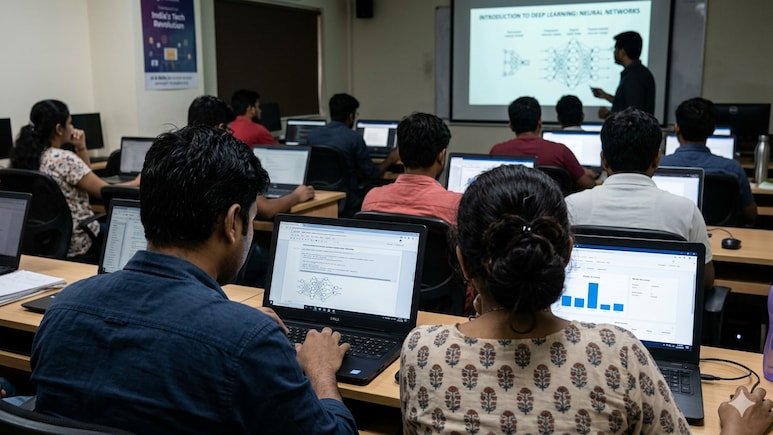
AI In Indian Classrooms: Artificial Intelligence (AI) has become an important tool for simplifying complex tasks and improving productivity across sectors. The education sector is no exception, with students increasingly using AI-powered chatbots to understand difficult concepts, clarify doubts, and strengthen their learning.
According to Manisha Malhotra, Director Principal, Satya School, Gurugram, this trend is particularly evident among young learners in India.
"Artificial Intelligence is no longer a concept of the future; it is already reshaping how students learn every day," she said.
"In India, this shift is particularly pronounced. Nearly half of ChatGPT's users fall within the 18-24 age group, with the country emerging as one of its largest and fastest-growing markets globally. This signals a fundamental change in how young learners seek knowledge, solve problems, and engage with information," she added.
Malhotra said that earlier, students who struggled to understand a concept or solve a question would typically turn to a teacher, tutor, or textbook. Today, however, AI-powered chatbots have increasingly become the first point of reference, often without much intervention from adults.
While many schools continue to debate whether such tools should be allowed in classrooms, she said the more significant question is how students are already using them and what this means for the future of learning.
Sharing her observations, Malhotra outlined seven key ways in which students are using AI-powered chatbots.
1. Decoding Textbooks And Challenging Back
A Class 11 student preparing for a Biology exam may paste a difficult paragraph into a chatbot and ask it to explain the concept in simpler terms. Once the topic becomes clearer, the student can ask the AI to conduct a quiz, challenge their answers, and point out gaps in their reasoning.
According to Malhotra, students are already discovering Socratic learning by defending their ideas and thinking critically without being explicitly taught to do so.
She suggested that schools can integrate this into classroom learning by asking students to use chatbots as debate partners on syllabus topics before presenting their arguments in class. This allows AI to act as a sparring partner while the classroom becomes the space where critical thinking is tested.
2. Revision And Exam Preparation
Students are also using chatbots to create personalised revision schedules.
For instance, a Class 12 student preparing for board examinations can upload the syllabus, identify weak chapters, and ask ChatGPT to generate a week-by-week study plan along with mock questions.
Malhotra described this as an example of self-organisation, one of the most valuable skills students can develop. She suggested that schools should formally teach students how to write effective AI prompts instead of leaving them to learn through trial and error.
3. Enhancing Writing And Communication
Many students are turning to AI to organise their ideas, improve the flow of their writing, and express themselves more clearly.
Malhotra emphasised that this is not about AI writing assignments for students but helping them become better writers. As communication becomes an increasingly important life skill, chatbots can help learners refine their expression and present ideas with greater clarity and confidence.
4. Elevating Creative Projects And Presentations
Students are also using AI to structure presentations and creative projects.
For example, a student preparing a presentation on renewable energy may use ChatGPT to decide which points to include, how to organise them, and how to begin with an engaging introduction.
According to Malhotra, this helps students present their learning in ways that are both creative and well organised.
5. Strengthening Research
AI can significantly reduce the time students spend gathering information by providing structured overviews of a topic.
However, Malhotra cautioned that this convenience can eliminate the productive confusion that often leads to deeper learning. The process of encountering conflicting information, questioning assumptions, and recognising gaps in understanding is an essential part of research.
She suggested that schools should encourage students to treat AI-generated responses as a starting point rather than a final answer. Students should verify information, identify inaccuracies, and explore what the chatbot may have overlooked.
6. Learning Beyond The Classroom Curriculum
Students are increasingly using chatbots to explore topics that extend beyond their prescribed curriculum.
Whether learning about space exploration, climate change, or artificial intelligence itself, chatbots enable students to pursue their curiosity, ask more questions, and discover new areas of interest.
Malhotra said schools can encourage this by inviting students to share what they have explored independently, reinforcing the idea that learning extends beyond the classroom.
7. Exploring Future Academic And Career Pathways
Students today face a range of choices related to subjects, academic streams, colleges, and careers.
Many students are using AI to better understand these options. A student interested in psychology, for example, may ask which subjects to study and what career opportunities the field offers. Others may discover professions they had never previously considered and spend time exploring them in greater depth.
AI Should Remain A Tool, Not The Teacher
Malhotra said AI has already become part of modern classrooms, helping students learn, explore concepts, and solve problems in new ways. Its growing use reflects a shift towards more personalised and self-directed learning.
However, she stressed that schools have an even greater responsibility to ensure AI supports learning rather than replaces it.
She said this requires rethinking both teaching and assessment methods. Classroom discussions, handwritten assignments, presentations, project work, and in-class activities completed without digital assistance remain essential for assessing genuine understanding, critical thinking, creativity, and problem-solving.
While AI can help students organise ideas and accelerate learning, she said it cannot replace human judgement, curiosity, or original thought. If students use AI to enhance their learning while relying on their own analytical and creative abilities, education will have achieved its purpose. In such an environment, AI becomes not a threat but a valuable partner in preparing learners for a future where technology complements, rather than substitutes, human intelligence.
