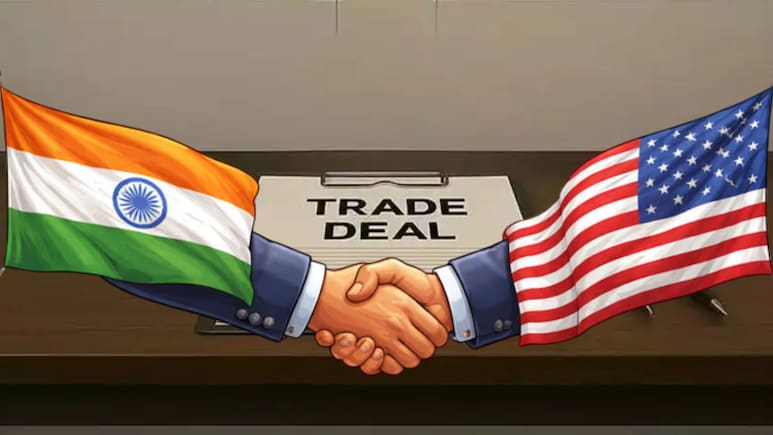
India and the United States have agreed on a framework for an interim trade deal that could ease the pressure on Indian automakers by offering preferential tariff-rate access for automotive parts entering the American market. The provisional understanding is expected to give Indian exporters some breathing room after years of facing high import duties in the US.
In a joint statement, both countries said the arrangement is consistent with US national security rules and revises earlier provisions under Proclamation 9888, which had tightened tariffs on automobile imports. Once implemented, Indian auto parts would qualify for lower tariffs under a special quota system, a move industry watchers see as a practical step to revive export momentum.
Also Read: FASTag Annual Pass Crosses 50 Lakh Users With Over 26 Crore Transactions In Six Months
Currently, most Indian auto component exports to the US face a 25 percent tariff. About half of these fall under Section 232 duties, mainly car parts, while commercial vehicle and off-highway parts have been subjected to even higher levies in recent years. Although a November 2025 clarification streamlined duties to a uniform 25 percent, the preferential quota offered under the new framework could help narrow costs further.
Also Read: Ferrari Amalfi India Price Revealed; Here's What The V8-Powered Supercar Costs
The timing of this announcement is significant. During the first half of FY26, India's auto component industry posted a trade deficit of around 200 million USD, largely due to weak shipments to the US. Data from the Automotive Component Manufacturers Association (ACMA) shows exports to the US reached 3.12 billion USD between April and September 2025, compared to 3.10 billion USD a year earlier, showing little change despite steady growth in other markets.
Also Read: Tata Motors To Start Local Assembly Of JLR Vehicles In Chennai
Commenting on the announcement, Vikrampati Singhania, President, ACMA and Vice Chairman & MD, JK Fenner (India), said, "These measures will lead to enhanced export competitiveness, deepen technology collaboration, and reinforce India's role as a trusted partner in resilient global automotive supply chains. ACMA looks forward to constructive engagement with both governments to ensure that automotive components are fully integrated into the final agreement, with balanced market access and long-term policy certainty."
Beyond the automotive sector, the interim India-US trade framework aims to broaden cooperation. The US has agreed to cut tariffs on a wide range of Indian goods, from textiles and leather to rubber and chemicals, bringing them down to 18% from the current 50%. In return, India plans to lower or eliminate duties on several US industrial and farm products, including animal feed, sorghum, dried distillers' grains, soybean oil, and processed fruit.
Track Latest News Live on NDTV.com and get news updates from India and around the world
