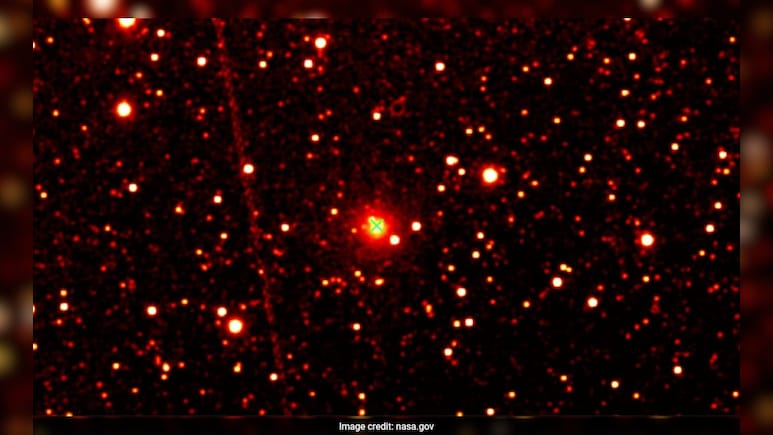
A mysterious interstellar object discovered earlier this year will reach its perihelion, closest point to the Sun, on October 29. On the said day, 3I/ATLAS will pass at a distance of about 1.36 astronomical units (AU) from the Sun, roughly the same as Mars's orbit.
Unlike typical comets, 3I/ATLAS has shown strikingly un-comet-like behaviour.
At perihelion, the comet will be bombarded by up to 33 gigawatts of solar radiation, possibly altering its speed or trajectory, as per NASA. Some speculate that if it's not natural, it could use the Sun's gravity to swing toward Earth.
Why 3I/ATLAS Is Different
- Tail against the Sun: Early observations showed an anti-solar tail, i.e, gas ejecting toward the Sun, not away. This was the opposite of basic cometary physics, where sunlight and solar wind typically push material outward, forming tails that stream away from the Sun.
- Tail reversal: By September, observations from the Nordic Optical Telescope in Spain's Canary Islands revealed that the anti-tail had flipped direction.
- Industrial chemical: Spectral analysis detected traces of nickel tetracarbonyl, a compound never before seen in natural comets. On Earth, this chemical is produced in industrial processes, particularly in the refining of metals. Such an element has no known natural cometary origin.
- Interstellar path: Its hyperbolic orbit proves it came from beyond our solar system and will exit again after passing the Sun. The Hubble Space Telescope captured images in July showing a teardrop-shaped dust envelope around a small icy nucleus between 440 metres and 5.6 km wide.
What Harvard Scientist Said
These anomalies have led Harvard astrophysicist Avi Loeb to suggest that 3I/ATLAS might not be a natural body at all.
"My colleague, Adam Hibberd, pointed out that if the object is an alien spacecraft slowing down, and the anti-tail is braking thrust, then this change from anti-tail to tail would be entirely expected near perihelion," Loeb said. "In that case, the transition would constitute a technosignature in the form of an unexpected phenomenon indicative of controlled manoeuvering, possibly with the intention of achieving a bound heliocentric orbit between Mars's and Jupiter's orbits."
NASA's Hubble, Webb, Parker Solar Probe, and other missions are tracking 3I/ATLAS to understand its true nature.
Is 3I/ATLAS A Threat To Earth?
According to NASA, although 3I/ATLAS's trajectory brings it into the inner solar system, it will not come close to Earth. As the comet journeys through space, it won't come closer than about 270 million km, a safe distance that poses no threat to our planet.


