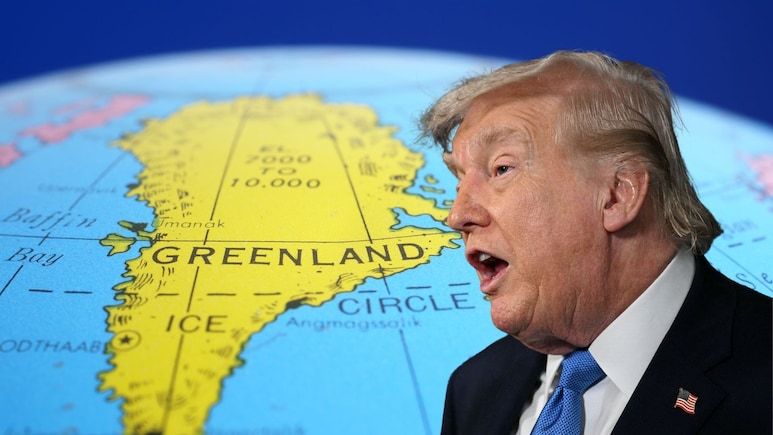
- Donald Trump suggested military action to occupy Greenland, citing security concerns
- Mercator map projection distorts size, making Greenland appear much larger than reality
- Greenland covers 2.16 million sq km, smaller than Africa but largest island globally
Donald Trump's repeated mentions of Greenland thrust it into the global spotlight, with the US President saying he was open to using military action to occupy the Arctic territory from Denmark. The White House has said all options are “on the table”, including force. Trump has called Greenland vital to their security, claiming, without evidence, that it was “covered with Russian and Chinese ships all over the place".
Located between North America and Russia, Greenland holds major strategic importance. The US already runs a military base there, which explains its value in Washington's security planning. Now, while Greenland dominates political discussions, its visual size on maps is deeply misleading.
Greenland On The World Map
At first glance, Greenland appears almost as large as the entire continent of Africa on many world maps. In reality, Greenland is about 14 times smaller than Africa. The reason for this confusion lies in cartography.
The Mercator Projection Problem
Created in 1569 by Flemish geographer Gerardus Mercator, the Mercator projection was groundbreaking for its time. It preserved the shapes of countries and let sailors draw straight-line sea routes, greatly improving navigation for traders and explorers.
This accuracy came at a price. Regions closer to the poles, like Greenland, Antarctica and Russia, are heavily stretched. The farther a place is from the equator, the larger it appears on the map. It is like trying to wrap flat paper around a round balloon: to make it fit, the edges must wrinkle or stretch. In maps, this distortion shows up near the poles so the centre looks smooth.
Penn State geography professor Fritz Kessler explained to NPR, “Mathematically (the parallels and meridians) get pulled apart, pulled in different amounts and magnitudes from the equator towards the poles, so you end up with this sort of exaggerated effect, if you will, in the upper latitudes where landmasses look huge.”
The Mercator projection favours navigation and direction, not land size.
To reduce this distortion, other map types exist. The Robinson projection balances shape and size, while the Equal Earth map shows continents more accurately. The African Union has also supported moving away from Mercator-style maps.
How Big Greenland Actually Is
Greenland is not small by any means. It is the world's largest island, covering roughly 2.16 million square km. That makes it:
- Roughly three times the size of Texas.
- About two-thirds the size of India.
- Nearly 20 times larger than Denmark proper.
It is still far smaller than Africa, which spans over 30 million square km.
Greenland is often ranked around the 12th largest territory in the world, depending on how political boundaries are defined. Technically, it is not an independent country, but a self-governing territory within the Kingdom of Denmark. It became a Danish colony in 1721 and was granted self-rule in 2009.
The island has a population of 56,000 people, who elect their own parliament and government to manage internal affairs. Denmark retains control over foreign policy and defence, and Greenlanders are Danish citizens.
Track Latest News Live on NDTV.com and get news updates from India and around the world


